English
 ကညီကျိာ်
 မြန်မာ
 Print:
This incident report describes events occurring in Kruh Tuh (Kyonedoe) Township, Dooplaya District, in March 2026. On 29 March 2026, the Burma Army fired two 120 mm mortar shells into Aa--- village in Th’Lweh Htaw village tract, injuring a villager, destroying his house, and damaging three other houses. After this incident, the villagers panicked and feared for their safety. Some villagers did not dare to sleep in their homes and instead slept temporarily at the monastery in the village at night.[1]
Part 1 – Incident Details
|
Type of Incident |
[Shelling.] SAC [State Administration Council[2], also known as the Burma Army[3]] shelling, injuring a villager, destroying a house, and damaging others. |
|
Date of Incident(s) |
29 March 2026 |
|
Incident Location (Village, Township and District) |
Aa--- village, Th’Lweh Htaw village tract,[4] Kruh Tuh Township, Dooplaya District.
|
|
Victim Information |
|
|
Name |
Saw[5] A--- |
|
Age |
19 years old |
|
Gender |
Man |
|
Ethnicity |
Karen |
|
Marital Status |
Single |
|
Occupation |
Farmer |
|
Religion |
Buddhist |
|
Position |
Villager |
|
Village |
Aa--- village, Th’Lweh Htaw village tract, Kruh Tuh Township, Dooplaya District |
|
Perpetrator Information (Armed Actors) |
||||
|
Name(s) |
Rank |
Unit |
Base |
Commander’s Name |
|
Unknown |
Unknown |
[Burma Army] LIB [Light Infantry Battalion][6] #230 |
Hlaing Wa army camp [near Kaw T’Ree Town, Dooplaya District] |
Unknown |
Part 2 - Information Quality
|
1. Explain in detail how you collected this information. |
|
I [a KHRG researcher] know of this issue from talking about the Burma Army’s shelling with an administrative staff member of the Karen Department of Health and Welfare (KDHW)[7] from Kruh Tuh Township. [The researcher went to the incident site, conducted interviews with the victim and the victim’s grandfather, and took photos of the injury.] |
|
2. Explain how the source verified this information. |
|
[The researcher] conducted interviews with the victim, Saw A---, and his grandfather. |
Part 3 – Complete Description of the Incident
|
Describe the Incident(s) in complete detail. |
|
Aa--- village, Th’Lweh Htaw village tract, Kruh Tuh (Kyonedoe) Township, Dooplaya District is under KNU [Karen National Union][8] control. The SAC [State Administration Council] had not been able to control this area from the [2021] coup[9] until 2026. Even though the SAC soldiers could not reach this area, the soldiers from Light Infantry Battalion (LIB) #230 fired 120 mm mortar shells into the village [often]. On 29 March 2026, at around 3-4 pm, the SAC fired two 120 mm mortar shells into Aa--- village, injuring a villager named Saw A--- (19 years old), destroying his house, and burning all of the clothes and kitchen materials inside the house. As his house was on fire, the neighbour tried to help by pouring water on the house to extinguish the fire. As the shelling landed very close to Saw A---, he could not hear [well] for three days. During the shelling, there were no armed groups present in the village, and no fighting occurred in the area. After he was injured, township health workers [from the Karen Department of Health and Welfare (KDHW)] transported him to Ab--- clinic, Wa Ka village tract, Kruh Tuh Township. [Ab--- clinic is administered by the KDHW and Saw A--- did not need to pay any treatment fees.]
Saw A--- [later] explained to KHRG that he and his father were building their new house [during the incident]. They were working on the rooftop of the house when the first shell landed in the middle of the village and damaged a house [of another villager]. When Saw A--- and his father heard the sound of the shelling, they came down from the rooftop and ran back to their old house. When they were on their way and about to reach their old house, another shell landed only ten yards away from them. The shrapnel from the explosion injured Saw A---’s face and thigh, [caused his old house to catch on fire which] destroyed his house, and also damaged his grandmother’s house and his uncle’s house.
As Saw A---’s house was burned, he and his family had to stay at his grandmother’s house temporarily. After this incident, the villagers became afraid and fled to the monastery in the village, where they slept at night. |
Part 4 - Permission for Using the Details
|
Did the victim(s) provide permission to use this information? Explain how that permission was provided. |
|
The information can be used. International stakeholders should advocate to the SAC to stop shelling villages. [The victim and his grandfather permitted KHRG to use the information.] |
Further background reading on shelling in Dooplaya District can be found in the following KHRG reports:
- Stolen Childhoods: Violations of children’s rights, urgent needs, and local agency in rural Southeast Burma during the conflict, October 2025.
- “Dooplaya District Short Update: Burma Army shelling, fighting, and villagers’ protest against the Burma military regime’s election in Noh T’Kaw Township (December 2025 to January 2026)”, May 2026.
- “Dooplaya District Incident Report: Burma Army shelling injured a villager in Noh T’Kaw Township (December 2025)”, March 2026.
- “Photo Set: Shelling of villages in Southeast Burma by the Burma Army, the BGF, and other affiliated armed groups, and its impacts (January to November 2025)”, December 2025.
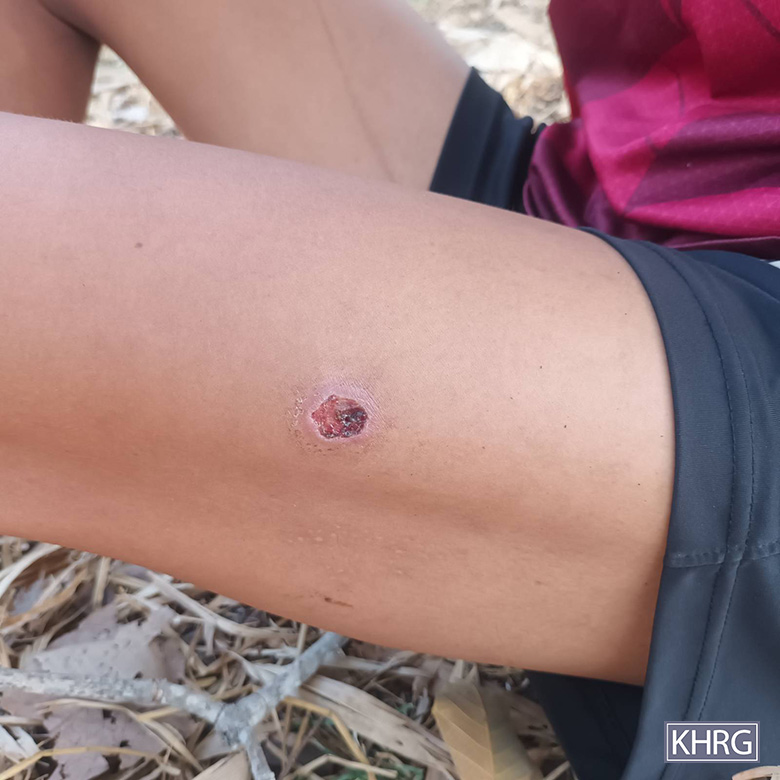
This photo was taken in April 2026, in Aa--- village, Th’Lweh Htaw village tract, Kruh Tuh (Kyonedoe) Township, Dooplaya District. On 29 March 2026, at around 3-4 pm, the Burma Army, based in Hlaing Wa army camp, fired two 120 mm mortar shells into Aa--- village, injuring Saw A--- (19 years old) on his face and thigh, destroying his house, and damaging three other villagers’ houses. This photo shows Saw A---’s thigh, which was injured by shrapnel from the explosion. [Photo: KHRG]
Footnotes:
[1] The present document is based on information received in April 2026. It was provided by a community member in Dooplaya District who has been trained by KHRG to monitor human rights conditions on the ground. The names of the victims, their photos and the exact locations are censored for security reasons. The parts in square brackets are explanations added by KHRG. This document combines several received reports with the following KHRG internal log numbers: #26-118-I1, #26-118-A1-I1, and #26-118-A2-I1.
[2] The State Administration Council (SAC) was the name of the executive governing body of the Burma military regime created in the aftermath of the 1 February 2021 military coup. It was established by Senior General Min Aung Hlaing on 2 February 2021 and was composed of eight military officers and eight civilians. The chairperson serves as the de facto head of government of Burma/Myanmar and leads the Military Cabinet of Myanmar, the executive branch of the government. Min Aung Hlaing assumed the role of SAC chairperson following the coup. The military junta changed its name on 31 July 2025 from SAC to State Security and Peace Commission (SSPC), with Min Aung Hlaing retaining his position as chairperson.
[3] The terms Burma military, Burma Army, SAC, Tatmadaw, and junta are used interchangeably throughout this report to describe the Burma military regime’s armed forces. Villagers themselves commonly use Burma Army, Burmese soldiers, or alternatively the name adopted by the Burma military regime at the time —from the 2021 coup to July 2025, the State Administration Council (SAC). On 31 July 2025, the military junta changed its name to the State Security and Peace Commission (SSPC).
[4] A village tract is an administrative unit of between five and 20 villages in a local area, often centred on a large village.
[5] Saw is a S’gaw Karen male honorific title used before a person’s name.
[6] A Light Infantry Battalion (LIB) comprises 500 soldiers. Most Light Infantry Battalions in the Tatmadaw are under-strength with less than 200 soldiers, yet up-to-date information regarding the size of battalions is hard to come by, particularly following the signing of the NCA. LIBs are primarily used for offensive operations, but they are sometimes used for garrison duties.
[7] The Karen Department of Health and Welfare (KDHW) is the health department of the Karen National Union. It was established in 1956 to address the lack of public healthcare resources in rural Southeast Myanmar. It currently operates a network of community-based clinics in the region, but its capabilities remain limited due to funding constraints.
[8] The Karen National Union (KNU) is the main Karen political organisation. It was established in 1947 and has been in conflict with the government since 1949. The KNU wields power across large areas of Southeast Myanmar and has been calling for the creation of a democratic federal system since 1976. Although it signed the Nationwide Ceasefire Agreement (NCA) in 2015, following the 2021 coup staged by Burma Army leaders, the KNU officially stated that the NCA has become void.
[9] On 1 February 2021, the Myanmar military deposed the democratically elected government led by the National League for Democracy (NLD). The military proclaimed a year-long state of emergency and transferred power to Min Aung Hlaing, the Commander-in-Chief of Myanmar's Armed Forces. Based on unproven fraud allegations, the Tatmadaw invalidated the landslide victory of the NLD in the November 2020 General Election and stated it would hold new elections at the end of the state of emergency. The coup d'état occurred the day before the Parliament of Myanmar was due to swear in the members elected during the 2020 election. Elected President Win Myint and State Counsellor Aung San Suu Kyi were detained, along with ministers, their deputies and members of Parliament.