English
 ကညီကျိာ်
 မြန်မာ
 Print:
This Incident Report describes events occurring in Noh T’Kaw (Kyainseikgyi) Township, Dooplaya District, in March 2026. On 31 March 2026, at around 10 am, the Burma Army carried out a drone strike on a village in Meh Ka Tha village tract, killing two women and injuring one child. The drone strike also destroyed a shop and damaged a pigsty. After the drone strike, the victims’ family members and other villagers were afraid and did not dare to sleep in their homes at night.[1]
Part 1 – Incident Details
|
Type of Incident |
[Drone strike.] SAC [State Administration Council,[2] also known as the Burma Army[3]] drone strike killed two women and injured one child. |
|
Date of Incident(s) |
31 March 2026 |
|
Incident Location (Village, Township and District) |
Aa--- village, Meh Ka Tha village tract,[4] Noh T’Kaw Township, Dooplaya District. |
|
Victim Information |
|||
|
Name |
Naw[5] A--- |
Naw B--- |
Naw C--- |
|
Age |
31 years old |
33 years old |
6 years old |
|
Gender |
Woman |
Woman |
Girl |
|
Ethnicity |
Karen |
Karen |
Karen |
|
Marital Status |
Married |
Married |
- |
|
Occupation |
Dependent |
Daily worker |
Student |
|
Religion |
Buddhist |
Christian |
- |
|
Position |
Villager |
Villager |
Villager |
|
Village |
Ab--- Town [Kaw T’Ree Township, Dooplaya District] |
Ac--- village, Ayeyarwady Region |
Ac--- village, Ayeyarwady Region |
|
Perpetrator Information (Armed Actors) |
|||
|
Type of Aircraft |
Unit |
Base |
Commander’s Name |
|
Drone [Unmanned Aerial Vehicle] |
State Administration Council Air Force |
Unknown |
[General Htun Aung serves as the Commander-in-Chief of the Burma Army Air Force] |
Part 2 - Information Quality
|
1. Explain in detail how you collected this information. |
|
A local leader in Dooplaya District sent the photos, including death photos, names, and ages, so I [a KHRG researcher] knew about this incident. [The KHRG researcher went to the incident place, conducted interviews with the victims’ family members, and took some photos of the damage.] |
|
2. Explain how the source verified this information. |
|
The people who provided the information to me [a KHRG researcher] are the husbands of the dead women. [The victims] were killed because the State Administration Council’s drone dropped 200-pound bombs. [The KHRG researcher conducted interviews with both of the victims' husbands to verify the information.] |
Part 3 – Complete Description of the Incident
|
Describe the Incident(s) in complete detail. |
|
Aa--- village, Meh Ka Tha village tract, Noh T’Kaw (Kyainseikgyi) Township, Dooplaya District, is under control of the KNU [Karen National Union].[6] The KNU controls the main road from Per Hkler village [Thai border, Umphang District] to the Three Pagodas Pass [Thai border, Kanchanaburi Province]. There are some mining areas along the road, so the SAC often conducts air strikes.
On 31 March 2026, at 10 am, the SAC conducted a drone strike beside the main road in Aa--- village. The drone dropped two 200-pound bombs, killing two villagers, injuring one child, and destroying a shop that was selling betelnut and some soft drinks. [The shrapnel from the explosion also damaged the roof of a pigsty.] Naw A--- (31 years old) is the shop owner, and she was injured on her whole body by the shrapnel from the explosion. She was transported to a DKBA [Democratic Karen Benevolent Army][7] Bo[8] Aay Wah clinic[9] [in Noh T'Kaw Township], but she died within half an hour.
Furthermore, the shrapnel from the explosion hit a villager's house located 300 yards (274 metres) away from the place where the bomb landed and killed the owner, Naw B--- (33 years old), also injuring her daughter, Naw C--- (6 years old). Naw B--- sustained an injury to her abdomen. She was taken to the [DKBA] clinic, but she died before receiving treatment. Her daughter, Naw C---, was injured on her left arm, and her arm was broken. She was also sent to the DKBA clinic. She received treatment [free of charge], and a metal implant was inserted in her arm. [As 7 April 2026,] she was discharged from the clinic, but she still needs to go to the clinic for a medical appointment.
Naw B---’s husband, Saw[10] D---, explained to KHRG: “She [Naw B---] was playing with her daughter [Naw C---] during the incident. […] I had to look after my children, so I could not take care of their mother [when she got injured]. The other one [Naw C---] was injured on her arm and ran back to me, and I carried her. I saw her mother was dirty with blood. My son ran to his mother, but when he saw his mother [was injured], he ran back to me. I did not know what to say when they [son and daughter] were crying. I tried to ask for help from others, but everyone else was also running. I tried to look for a car [to transport the victim to the clinic for treatment]. At around 11 am, they [the victims] were transported [to the clinic].”
After the incident, the victims’ family members dared not to sleep in their house at night because they had experienced an incident that they had never seen before. They slept in the ditch behind their house to avoid the danger of the aircraft. Similarly, other villagers also slept in another place far from their houses at night temporarily. |
Part 4 - Permission for Using the Details
|
Did the victim(s) provide permission to use this information? Explain how that permission was provided. |
|
[The KHRG researcher] asked for permission from the victims’ family members, and they allowed KHRG to use the information. |
Further background reading on the situation on drone strikes in Southeast Myanmar can be found in the following KHRG reports:
- “ကဘီယူၤဟဲလံ Aircraft coming! : Impacts of air strikes on local communities and villagers’ protection strategies in Southeast Burma since the 2021 coup”, November 2024.
- “Taw Oo District Short Update: Burma Army air strikes injured a 16-year-old girl and damaged six houses in Daw Hpah Hkoh Township (February to March 2026)”, May 2026.
- “Taw Oo District Short Update: Burma Army drone strike injured two villagers in Htaw Ta Htoo Township (March 2026)”, April 2026.
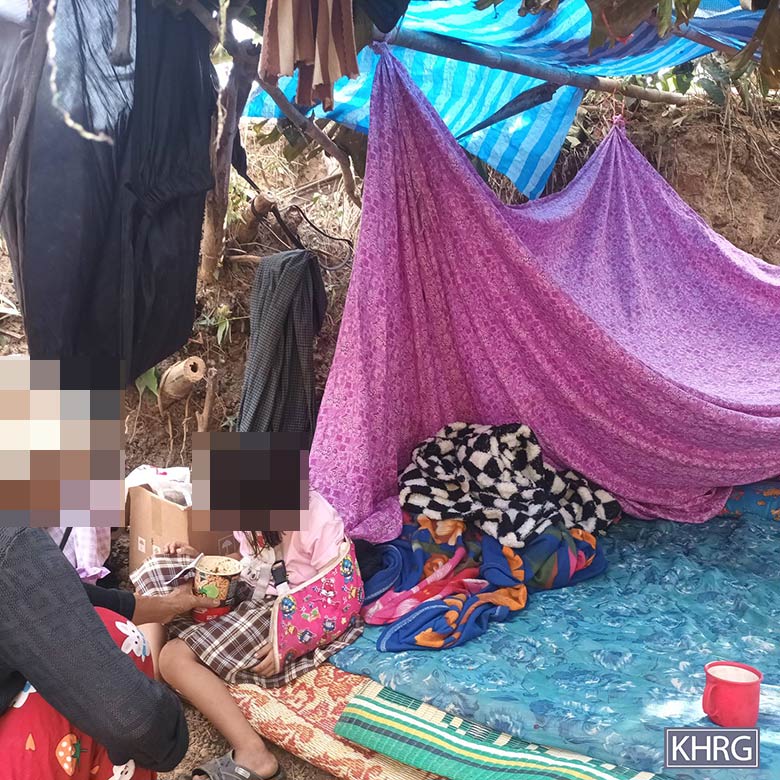
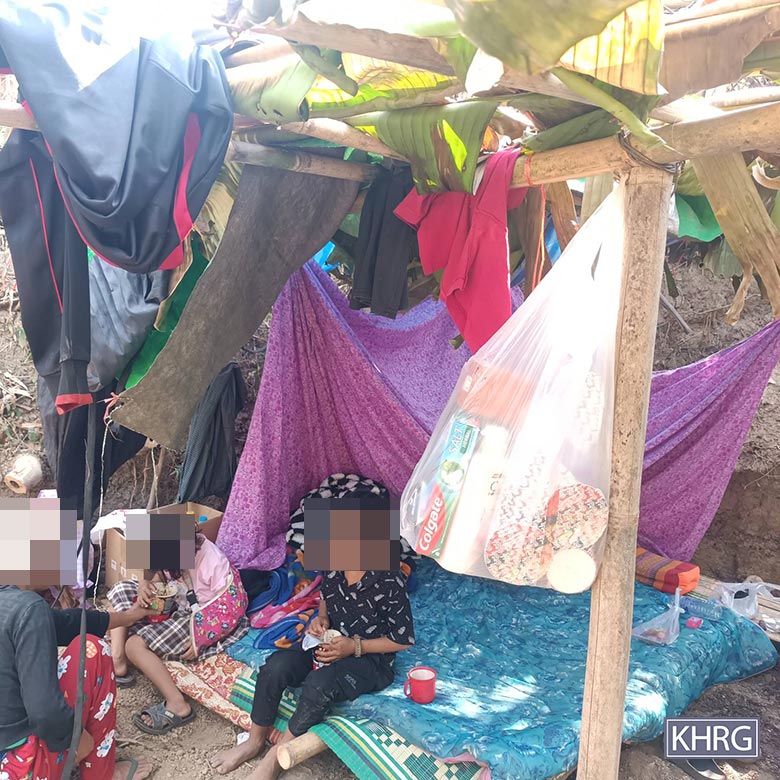
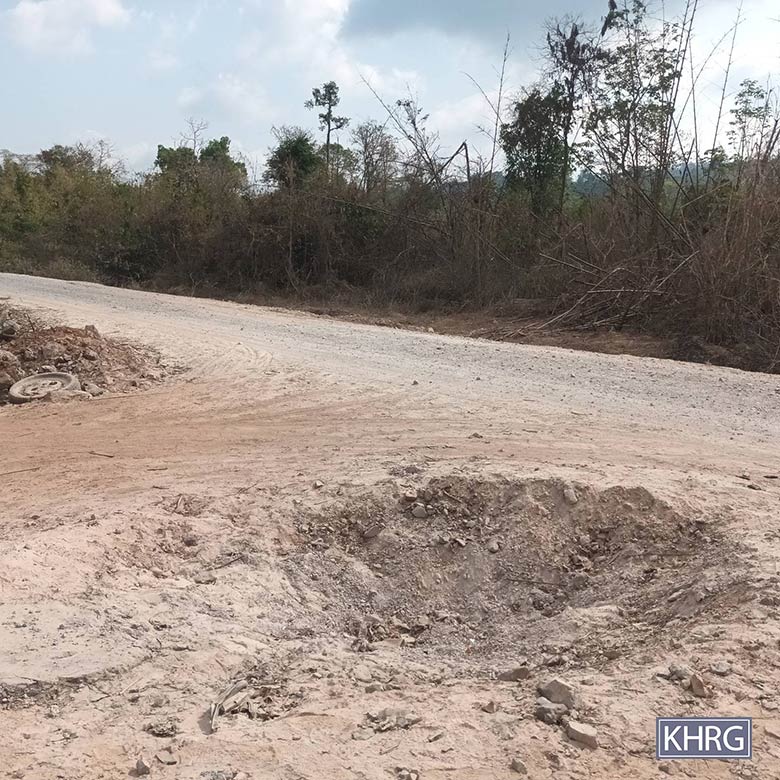
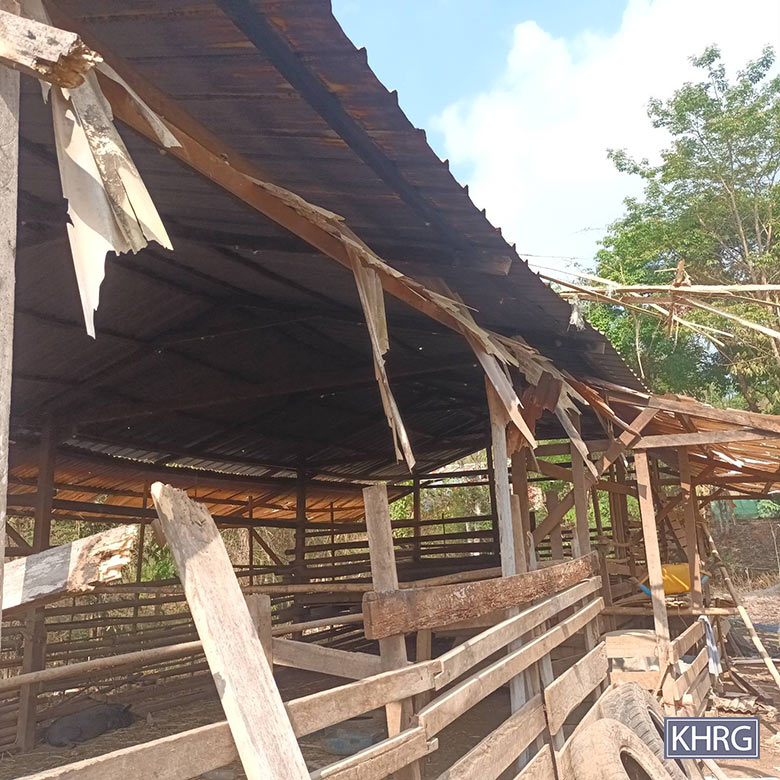


These four photos were taken in April 2026, in Aa--- village, Meh Ka Tha village tract, Noh T’Kaw Township, Dooplaya District. On 31 March 2026, at around 10 am, the Burma Army carried out a drone strike, killing both Naw A--- (31 years old) and Naw B--- (33 years old), and injuring Naw C--- (6 years old) on her arm. The two photos on the top show the living conditions of Naw C--- and her brother after the drone strike killed their mother. The photo on the bottom left shows the crater caused by the bomb explosion beside the road. The photo on the bottom right shows the pigsty roof, which was damaged by shrapnel from the bomb. [Photos: KHRG]
Footnotes:
[1] The present document is based on information received in April 2026. It was provided by a community member in Dooplaya District who has been trained by KHRG as a researcher to monitor human rights conditions on the ground. The names of the victims, their photos and the exact locations are censored for security reasons. The parts in square brackets are explanations added by KHRG. This document combines several received reports with the following KHRG internal log numbers: #26-114-I1, #26-114-A1-I1, and #26-114-A2-I1.
[2] The State Administration Council (SAC) was the name of the executive governing body of the Burma military regime created in the aftermath of the 1 February 2021 military coup. It was established by Senior General Min Aung Hlaing on 2 February 2021 and was composed of eight military officers and eight civilians. The chairperson serves as the de facto head of government of Burma/Myanmar and leads the Military Cabinet of Myanmar, the executive branch of the government. Min Aung Hlaing assumed the role of SAC chairperson following the coup. The military junta changed its name on 31 July 2025 from SAC to State Security and Peace Commission (SSPC), with Min Aung Hlaing retaining his position as chairperson.
[3] The terms Burma military, Burma Army, SAC, Tatmadaw, and junta are used interchangeably throughout this report to describe the Burma military regime’s armed forces. Villagers themselves commonly use Burma Army, Burmese soldiers, or alternatively the name adopted by the Burma military regime at the time —from the 2021 coup to July 2025, the State Administration Council (SAC). On 31 July 2025, the military junta changed its name to the State Security and Peace Commission (SSPC).
[4] A village tract is an administrative unit of between five and 20 villages in a local area, often centred on a large village.
[5] ‘Naw’ is a S’gaw Karen female honorific title used before a person’s name.
[6] The Karen National Union (KNU) is the main Karen political organisation. It was established in 1947 and has been in conflict with the government since 1949. The KNU wields power across large areas of Southeast Myanmar and has been calling for the creation of a democratic federal system since 1976. Although it signed the Nationwide Ceasefire Agreement (NCA) in 2015, following the 2021 coup staged by Burma Army leaders, the KNU officially stated that the NCA has become void.
[7] The Democratic Karen Benevolent Army (DKBA), formerly the Democratic Karen Buddhist Army, was formed in December 1994 and was originally a breakaway group from the KNU/KNLA that signed a ceasefire agreement with the Burma/Myanmar government and directly cooperated at times with Tatmadaw forces. The formation of the DKBA was led by monk U Thuzana with the help and support of the State Law and Order Restoration Council (SLORC), the name of the military government in Burma/Myanmar at that time.
[8] ‘Bo’ is a Burmese honorific title meaning ‘officer.’
[9] Local villagers refer to clinics run by the DKBA in this area colloquially as “Bo Aay Wah’s clinic” rather than the actual clinic names, after Colonel Saw Aay Wah, also known as Bo Aay Wah or Bo A1, who serves as the DKBA's Tactical Operation Commander at #2 Military Strategy Headquarters. The village and village tract are censored for security.
[10] ‘Saw’ is a S’gaw Karen male honorific title used before a person’s name.