English
 ကညီကျိာ်
 မြန်မာ
 Print:
This Incident Report describes events occurring in Noh T’Kaw (Kyainseikgyi) Township, Dooplaya District, in January 2026. Starting from January 20th 2026, the Burma Army deployed more soldiers near Kyainseikgyi Town for the Burma military regime’s election. On January 23rd 2026, soldiers from Burma Army Infantry Battalion (IB) #32 conducted a drone strike on Aa--- village, T’Hka Kloh village tract, injuring two villagers who were at their rubber plantation. One of the villagers, Saw A---, was seriously injured and was sent to a hospital in Three Pagoda Pass (a town bordering Thailand’s Kanchanaburi province) the same day. As of the reporting date, he had not yet been discharged from the hospital because removing the shrapnel could harm his eyes, and the health workers will need to perform a second surgery. The victim’s family did not receive any financial assistance and had to borrow money from relatives to pay for treatment. Some villagers became afraid and fled the village after hearing that the Burma Army deployed additional soldiers for the election.[1]
Part 1 – Incident Details
|
Type of Incident |
[Air strike.] Burma Army[2] drone strike injures villagers. |
|
Date of Incident(s) |
January 23rd 2026 |
|
Incident Location (Village, Township and District) |
Aa--- village, T’Hka Kloh village tract[3], Noh T’Kaw Township, Dooplaya District. |
|
Victim(s) Information |
||
|
Name |
Saw[4] B--- |
Saw A--- |
|
Age |
40 years old |
43 years old |
|
Gender |
Man |
Man |
|
Ethnicity |
Karen |
Karen |
|
Marital Status |
Married |
Married |
|
Occupation |
Plantation worker |
Plantation worker |
|
Religion |
Buddhist |
Buddhist |
|
Position |
Villager |
Villager |
|
Village |
Aa--- village, T’Hka Kloh village tract, Noh T’Kaw Township, Dooplaya District. |
Aa--- village, T’Hka Kloh village tract, Noh T’Kaw Township, Dooplaya District. |
|
Perpetrator Information (Armed Actors) |
||||
|
Name(s) |
Rank |
Unit |
Base |
Commander’s Name |
|
Unknown |
Unknown |
[Burma Army] Infantry Battalion (IB)[5] #32 |
Kyainseikgyi Town [locally known as Seik Gyi Town], Noh T’Kaw Township, Dooplaya District. |
Unknown |
Part 2 - Information Quality
|
1. Explain in detail how you collected this information. |
|
During the [Burma military regime’s] election[6] period [during the second phase, in 2026], the SAC [State Administration Council[7]] patrolled the areas near the election site [Kyainseikgyi Town, locally known as Seik Gyi Town]. I [a KHRG researcher] asked the village head of Aa--- village to inform me if any incidents occurred. I [a KHRG researcher] knew about this particular incident because the village head reported it to me. [The KHRG researcher then conducted interviews with the village security guard, Maung[8] K---; the victims’ mother-in-law, named Naw[9] C---; and one of the victims, Saw B---.] |
|
2. Explain how the source verified this information. |
|
[KHRG researcher] conducted interviews with the village security guard, Maung K---, and one of the victims, [and the victims’ mother-in-law], so this information is accurate. |
Part 3 – Complete Description of the Incident
|
Describe the Incident(s) in complete detail. |
|
The SAC [Burma military regime] maintains control over Kyainseikgyi Town in Noh T’Kaw Township, Dooplaya District [in 2026]. The KNU [Karen National Union[10]] does not control the town. As the SAC [Burma military regime] planned to hold [phase 3 of] the election on January 25th 2026, soldiers from [Burma Army] Infantry Battalions (IB) #283, #284, and #32 were deployed near Kyainseikgyi Town starting from January 20th 2026. On January 20th 2026, the SAC [Burma Army soldiers] shot and killed a villager working on her field in Ab--- village, T’Hka Kloh village tract, Noh T’Kaw Township, Dooplaya District [during the same deployment of soldiers].[11]
A few days later, on January 23rd 2026, at around 4 pm, SAC IB #32 conducted a drone strike on a rubber plantation farm near Aa--- village [located close to Kyainseikgyi Town]. The ordnance landed in front of a villager’s hut on a rubber plantation where villagers were staying [for work], injuring two residents from Aa--- village. During the incident, a villager named Saw B--- (40 years old) was inside the hut [built on stilts], and Saw A--- (43 years old) was underneath it. Saw B--- was injured on the big toe of his left foot. Saw A--- was seriously injured on his face and left buttock, and the shrapnel remained in his face. These two men are brothers-in-law. Saw B--- explained to KHRG that: “We heard from others that the situation was not good. We planned to return to the village after having our meal. Before we could leave, a drone appeared overhead. We did not run because we were afraid it might drop an ordnance on us. Then, the ordnance was dropped in front of our hut. During the incident, my brother-in-law was inside the hut. After we were injured, we could not find anyone nearby. His [Saw A---’s] injury was severe. I was wounded on my leg [big toe], but I carried him on a motorcycle, and we returned to the village.”
Saw B---, who was only slightly injured, managed to return to the village on his own and carried Saw A--- with him by motorcycle. Because they travelled slowly, they arrived back in the village at around 5 pm. Saw A---, being seriously injured, was sent [by one of his relatives] to the Three Pagoda Pass hospital [located in Three Pagoda Pass Town, bordering Thailand’s Kanchanaburi province]. That same night, Saw B--- received treatment for his toe injury at the Aa--- clinic [run by the Karen Department of Health and Welfare (KDHW)[12]].
The victims’ mother-in-law, Naw C---, explained to KHRG that: “I heard about the election. I was afraid. Some people fled from the village. I heard that the Burma Army would hold elections and deploy more soldiers. […] They [the victims] spoke to me over the phone, and I asked them to return to the village [because of the increase in deployed soldiers]. Shortly after I ended the call, a drone strike occurred. Then, they [the victims] called me again and informed me that they had been injured. In order to hold an election, it is not appropriate to harm or kill civilians. We want to live in peace. The Burma Army stated that they would hold an election, yet they conducted drone strikes indiscriminately.”
As of the reporting date [January 26th 2026], Saw A--- had not yet been discharged from the hospital. Health workers were unable to remove the shrapnel remaining in his face, as doing so could injure his eyes. The health workers need to perform a second surgery to remove the shrapnel. He had to pay approximately 3,000 THB [96.70 USD[13]] for his initial treatment. The victim did not receive any financial assistance, and the victim’s family had to borrow money from their relatives to cover the cost of treatment.
As of January 26th 2026, some villagers from Aa--- villagers who fled from the village had not yet returned to the village. |
Part 4 - Permission for Using the Details
|
Did the victim(s) provide permission to use this information? Explain how that permission was provided. |
|
This information can be used. [The victims’ mother-in-law and Saw B---, one of the victims, gave KHRG permission to use this information.] |
Further background reading on the situation on air strikes in Dooplaya District in Southeast Burma/Myanmar can be found in the following KHRG reports:
- ကဘီယူၤဟဲလံ Aircraft coming! : Impacts of air strikes on local communities and villagers’ protection strategies in Southeast Burma since the 2021 coup, November 2024.
- “Dooplaya District Situation Update: Fighting, SAC air strikes and shelling causing casualties, displacement, and challenges to education, travelling, and livelihoods, in Kaw T’Ree Township (April to June 2025)”, December 2025.
- “Dooplaya District Situation Update: SAC air strikes, education challenges, drug issues, and military activities in Noh T’Kaw and Kruh Tuh townships (January to June 2025)”, November 2025.
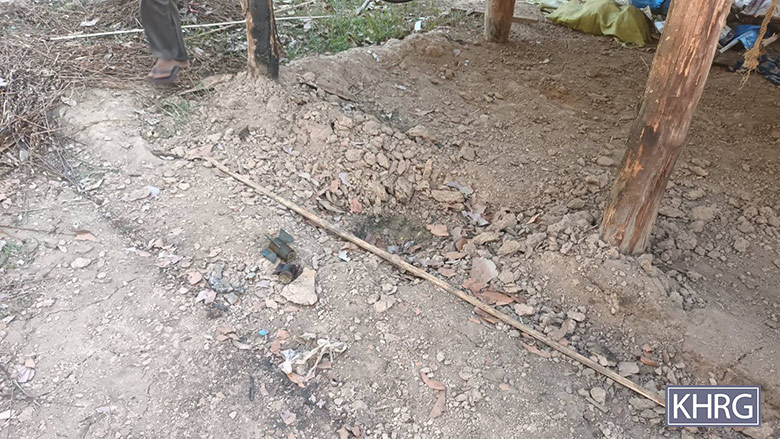
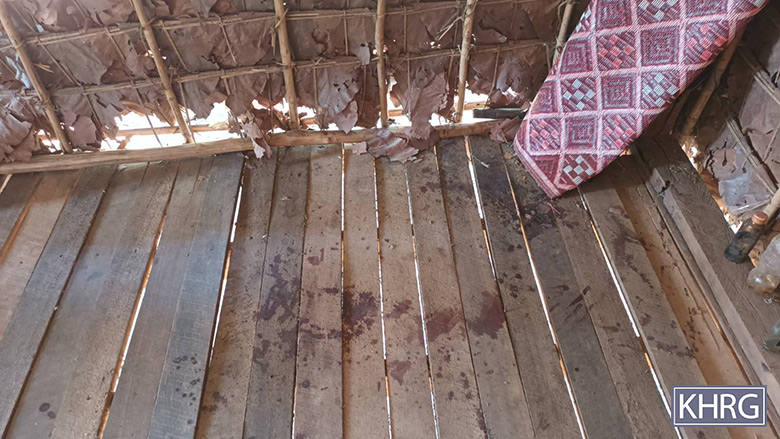
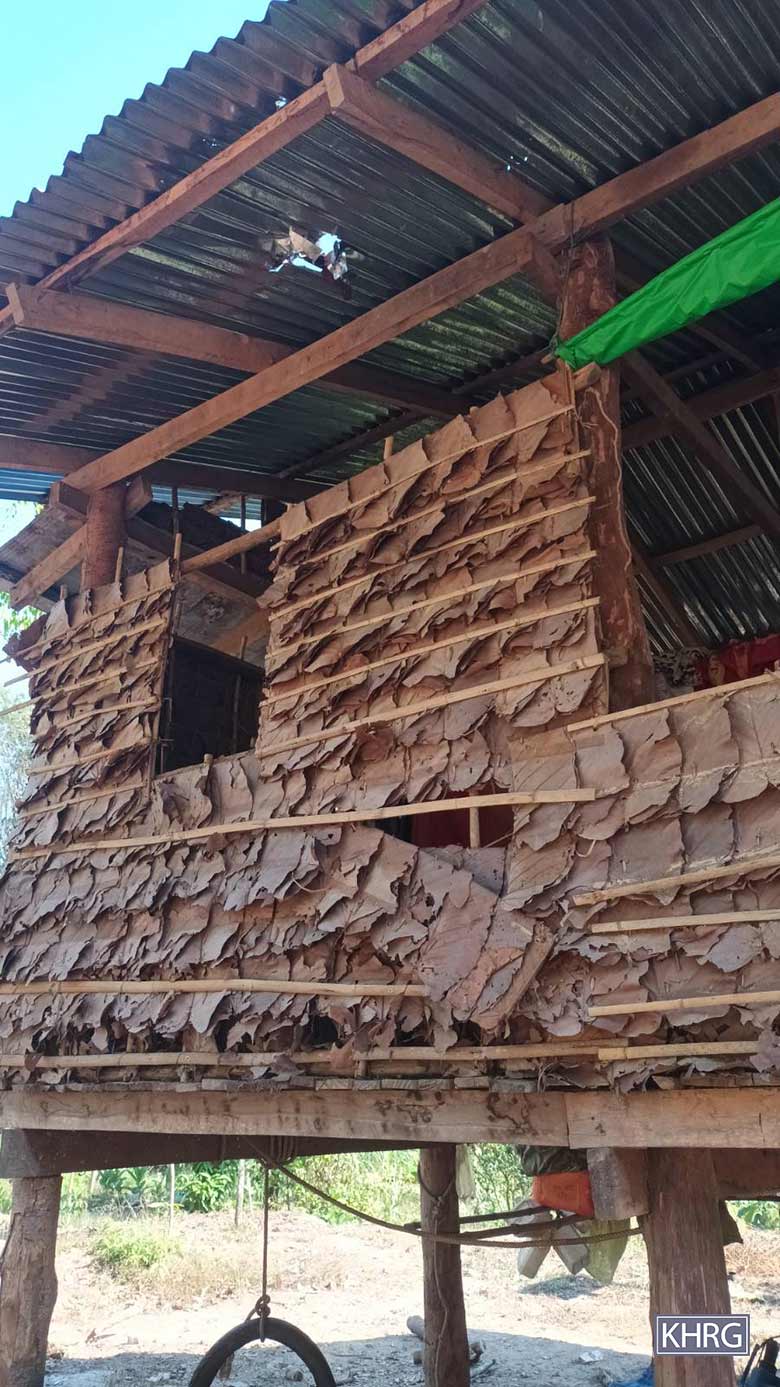
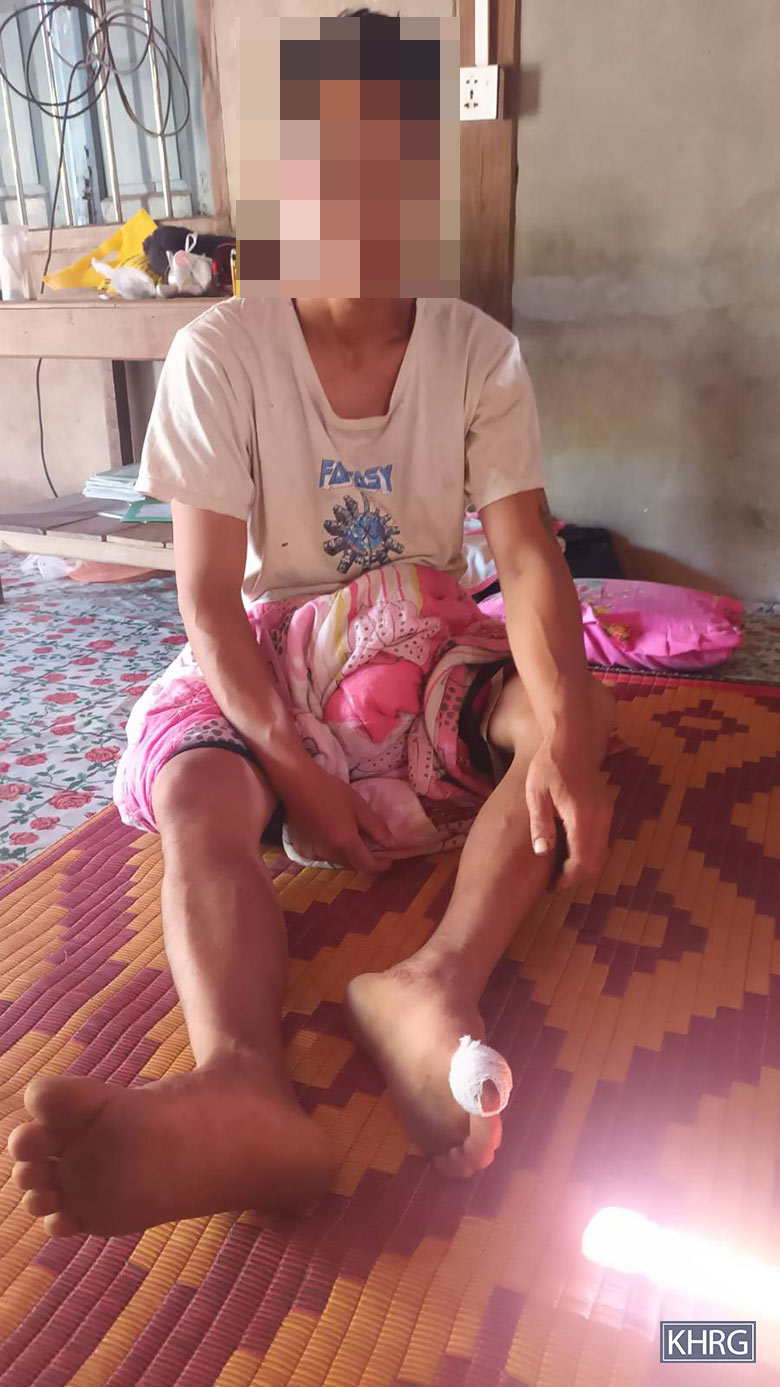


These photos were taken in January 2026. On January 23rd 2026, at around 4 pm, Burma Army IB #32 conducted a drone strike on a villager’s hut near Aa--- village, T’Hka Kloh village tract, Noh T’Kaw Township, Dooplaya District. The ordnance landed in front of a villager’s hut on a rubber plantation where villagers were staying, injuring two residents from Aa--- village. The photo in the top left shows the remaining ordnance remnants after the explosion. The photo in the top right shows the blood stain resulting from Saw A---’s injury. The photo in the bottom left shows roof damage resulting from the Burma Army drone strike. The photo in the bottom right shows Saw B---'s toe injury, caused by shrapnel from the explosion. This picture was taken at his home in Aa--- village. [Photos: KHRG]
Footnotes:
[1] The present document is based on information received in January 2026. It was provided by a community member in Dooplaya District who has been trained by KHRG as a researcher to monitor human rights conditions on the ground. The names of the victims, their photos and the exact locations are censored for security reasons. The parts in square brackets are explanations added by KHRG. This document combines several received reports with the following KHRG internal log numbers: #26-47-I1; # 26-47-A1-I1; #26-47-A2-I1 and #26-47-A3-I1.
[2] The terms Burma military, Burma Army, SAC, Tatmadaw, and junta are used interchangeably throughout this report to describe the Burma military regime’s armed forces. Villagers themselves commonly use Burma Army, Burmese soldiers, or alternatively the name adopted by the Burma military regime at the time —from the 2021 coup to July 2025, the State Administration Council (SAC). On July 31st 2025, the military junta changed its name to the State Security and Peace Commission (SSPC).
[3] A village tract is an administrative unit of between five and 20 villages in a local area, often centred on a large village.
[4] ‘Saw’ is a S’gaw Karen male honorific title used before a person’s name.
[5] An Infantry Battalion (IB) comprises 500 soldiers. However, most Infantry Battalions in the Tatmadaw are under-strength with less than 200 soldiers. Yet up to date information regarding the size of battalions is hard to come by, particularly following the signing of the NCA. They are primarily used for garrison duty but are sometimes used in offensive operations.
[6] The non-democratic elections held by the Burma military regime in 2025-2026 have been largely condemned by various international stakeholders, including ASEAN and high-ranking UN officials, as not legitimate. The junta’s election was split into three phases, making polling stations subsequently available in different regions: phase 1 took place on December 28th 2025; phase 2 took place on January 11th 2026; and phase 3 took place on January 25th 2026. The military junta backs the Union Solidarity and Development Party (USDP), a party which is known for its close ties with the military and from which most officials are former military personnel. The junta was formerly self-designated as the State Administrative Council (SAC), after the February 1st 2021 military coup headed by Senior General Min Aung Hlaing, which deposed the democratically elected government led by the National League for Democracy (NLD), following Burma’s 2020 general elections.
[7] The State Administration Council (SAC) was the name of the executive governing body of the Burma military regime created in the aftermath of the February 1st 2021 military coup. It was established by Senior General Min Aung Hlaing on February 2nd 2021, and was composed of eight military officers and eight civilians. The chairperson serves as the de facto head of government of Burma/Myanmar and leads the Military Cabinet of Myanmar, the executive branch of the government. Min Aung Hlaing assumed the role of SAC chairperson following the coup. The military junta changed its name on July 31st 2025 from SAC to State Security and Peace Commission (SSPC), with Min Aung Hlaing retaining his position as chairperson.
[8] ‘Maung’ is a Burmese male honorific title used before a person’s name.
[9] ‘Naw’ is a S’gaw Karen female honorific title used before a person’s name.
[10] The Karen National Union (KNU) is the main Karen political organisation. It was established in 1947 and has been in conflict with the government since 1949. The KNU wields power across large areas of Southeast Myanmar and has been calling for the creation of a democratic federal system since 1976. Although it signed the Nationwide Ceasefire Agreement (NCA) in 2015, following the 2021 coup staged by Burma Army leaders, the KNU officially stated that the NCA has become void.
[11]. KHRG, “Dooplaya District Short Update: The Burma Army fatally shot a villager in Noh T’Kaw Township (January 2026)”, February 2026.
[12] The Karen Department of Health and Welfare (KDHW) is the health department of the Karen National Union. It was established in 1956 to address the lack of public healthcare resources in rural Southeast Myanmar. It currently operates a network of community-based clinics in the region, but its capabilities remain limited due to funding constraints.
[13] All conversion estimates for Baht are based on the official market rate as of 16 January 2026 at 1 USD = 31.03 THB; conversion rate available at https://wise.com/gb/currency-converter/.