
 English
 ကညီကျိာ်
 မြန်မာ
This Incident Report describes events occurring in Moo (Mone) Township, Kler Lwee Htoo (Nyaunglebin) District in December 2025. On 3 December 2025, at approximately 12 pm, Burma Army soldiers from Light Infantry Battalion (LIB) #599, based at Moo (Mone) army camp, fired six 120 mm mortar shells and launched a drone strike on Gn--- village, Nyaung Pin Tha village tract, Moo Township. The attacks killed two villagers, 68-year-old U J--- and 30-year-old Maung M---, and injured 57-year-old Daw L---. A villager’s house was also destroyed. Following the incident, villagers were displaced, feared further military attacks, sought shelter in makeshift bunkers, and faced difficulties maintaining their livelihoods.[1]
Part 1 – Incident Details
|
Type of Incident |
[Shelling and air strike.] [The Burma Army[2]] conducted mortar shelling and a drone strike. |
|
Date of Incident(s) |
3 December 2025 |
|
Incident Location (Village, Township and District) |
Gn--- village, Nyaung Pin Tha village tract,[3] Moo Township, Kler Lwee Htoo District.
|
|
Victim Information |
|||
|
Name |
Daw[4] L--- |
U[5] J--- |
Maung[6] M--- |
|
Age |
57 years old |
68 years old |
30 years old |
|
Gender |
Woman |
Man |
Man |
|
Ethnicity |
Bamar[7] |
Bamar |
Bamar |
|
Marital Status |
Married |
Married |
Married |
|
Occupation |
Daily wage worker |
Daily wage worker |
Daily wage worker |
|
Religion |
Buddhist |
Buddhist |
Buddhist |
|
Position |
Villager |
Villager |
Villager |
|
Village |
Gn--- village |
Gn--- village |
Gn--- village |
|
Perpetrator Information (Armed Actors) |
||||
|
Name(s) |
Rank |
Unit |
Base |
Commander’s Name |
|
Myanmar military regime [Burma Army] |
Unknown |
LIB [Light Infantry Battalion][8] #599 |
Moo (Mone) army camp |
[Senior General] Min Aung Hlaing[9] [the Commander-in-Chief of Burma’s Armed Forces and the Chairperson of State Security and Peace Commission (SSPC)[10]] |
Part 2 - Information Quality
|
1. Explain in detail how this information was collected. |
|
I [a KHRG researcher] saw information in the media [about the incident] in Moo Township, then I contacted a local coordinator [from the Karen National Union (KNU)[11]]. He provided me with detailed information. Afterward, I went and documented the information myself. |
|
2. Explain how the source verified this information. |
|
Some of those who provided me [the KHRG researcher] with the information were local authorities, and some were family members of the victims. They witnessed the incident first-hand. I also conducted an interview with U C--- from Gn--- village, Nyaung Pin Tha village tract, Moo Township, Kler Lwee Htoo District. He is the husband of Daw L--- and the father-in-law of Maung M---. |
Part 3 – Complete Description of the Incident
|
Describe the Incident(s) in complete detail. |
|
On 3 December 2025, at 12 pm, Burma military regime soldiers from LIB [Light Infantry Battalion] #599, based in Moo (Mone) army camp, located in Moo Town, Kler Lwee Htoo (Nyaunglebin) District, indiscriminately fired six 120 mm mortar shells into Gn--- village, Nyaung Pin Tha village tract, Moo (Mone) Township, Kler Lwee Htoo District. At the same time, the Burma Army also dropped bombs by drone onto Gn--- village. The mortar shells and bombs landed and exploded in the village. A house belonging to U R--- was destroyed.
68-year-old U J--- was inside his house when the drone strike was conducted. One of the bombs landed in U J---’s garden and shrapnel from the explosion hit his house and also struck U J---, severely injuring the right side of his chest. Other villagers immediately transported him to a hospital. However, because of the severity of his injury, he died after arriving at the hospital. Meanwhile, a villager named Maung M---, 30 years old, started his motorbike as soon as he heard the sound of mortar shelling, with his mother-in-law, Daw L---, 57 years old, sitting on the back of the motorbike, in order to move to another place to avoid the mortar shelling. A mortar shell landed beside the road where he was driving. As it landed close to him, shrapnel from the mortar shell hit his right temple and penetrated deeply. He died immediately. As Maung M--- was hit by the shrapnel, the motorbike crashed, causing Daw L--- to sustain minor injuries to her face and right eye. She was transported to Rk--- hospital, located in Taw Oo Town, Taw Oo (Toungoo) District, and run by the SAC [State Administration Council].[12] Because of these violations by the Burma military regime, villagers faced displacement [including to forests, plantations, other villages, and towns] and difficulties in their livelihoods.
U C---, the husband of Daw L--- from Gn--- village, explained: “On 3 December 2025, at 12:05 pm, my daughter opened [announced] the two-digit lottery result at my house. Then the two-digit lottery result came out as number 24. While she was about to pay those who won the lottery, the shell landed there [in the garden of U C---’s house]. At that time, there were also people who sold two-digit lottery tickets [present]. They all ran into a makeshift bunker. My daughter and my son-in-law, who [later] died, were running [to the bunker]. Then, he [my son-in-law] returned again to pick us up. When he arrived back, my wife said she would follow him. I told her, ‘Do not follow him. It is dangerous.’ Then, while she followed him [sitting on the back of his motorbike], the shell landed in front of my house. The shrapnel from the explosion had already scattered and injured someone. Then, someone [U J---] screamed to me from a distance, ‘U C---… U C---… the shrapnel hit me.’ Then, I phoned my daughter. I told her, ‘U J---, who lived opposite our house, is injured. So, come back to Dad. Your husband was carrying your mother on the motorbike and went there [departed] already.’”
He continued: “Then, another mortar shell landed again, and someone came to me to report the information [including that the mortar shell killed my son-in-law]. He asked another villager to transport the injured villagers to a hospital. At that time, I heard that my son [in-law] had already died. So, I asked, ‘What about my wife?’ They informed me that her face was full of blood and that she had entered a makeshift bunker. Then, after I went to check my son-in-law’s corpse, I carried his corpse back and left it at his father’s house. Then, I was searching for my wife, but I did not find her. So, I did not know which hospital she had been taken to. People told me that she had been taken to a hospital, but I did not know which hospital she was taken to. Only after they took my wife home, I rented a car to transport her to Rk--- hospital [located in Taw Oo Town and administered by the Burma Army]. I was busy with the funeral of the dead villagers [so could not transport her to the hospital earlier].”
U C--- added: “I no longer dare to live in my house. Also, there is no one around my village [because the other villagers had fled due to the incident]. A villager also died in front of my house [U J---, who lived opposite, died due to injuries from the drone strike]. I just live in my relatives’ houses [because I no longer dare to live in my house]. The house here is owned by my cousin, and the other house is my younger brother’s. I eat what they feed me. I locked my house.”
After this incident, villagers from [Gn---] village were not confident enough to live in the village. They also did not dare to go around [travel]. [Some villagers fled Gn--- village, while others remained. Some avoided travelling, while those who had no alternative continued to travel for work.] In addition, they were full of fear when they cooked their meals, worrying that the Burma Army would see the smoke from the fire and conduct an air strike or drone attack. Villagers [who stayed] in the village dug makeshift bunkers and went into them whenever they heard sounds similar to those of drones or aircraft. |
Part 4 - Permission for Using the Details
|
Did the victim(s) provide permission to use this information? Explain how that permission was provided. |
|
U C---, the family member of the victims, Maung M--- and Daw L---, who provided the information, gave full permission for it to be used. |
Further background reading on the situation on attacks on villages in Southeast Burma/Myanmar can be found in the following KHRG reports:
- In Spite of Fear: Women's experiences navigating the compounding challenges of displacement and insecurity in Southeast Burma, July 2026.
- “Mu Traw District Incident Report: Burma Army air strikes killed a four-year-old, injured 12 villagers, including two children, and caused displacement in Bu Tho Township (December 2025)”, September 2026.
- “Taw Oo District Situation Update: Healthcare, education, and military activities in Daw Hpah Hkoh Township (September 2025 to February 2026)”, August 2026.
- “Taw Oo District Situation Update: Burma Army shelling, arrests, and militarisation; drug issues; and challenges to education, transportation, and livelihood in Daw Hpah Hkoh Township (January to March 2026)”, August 2026.
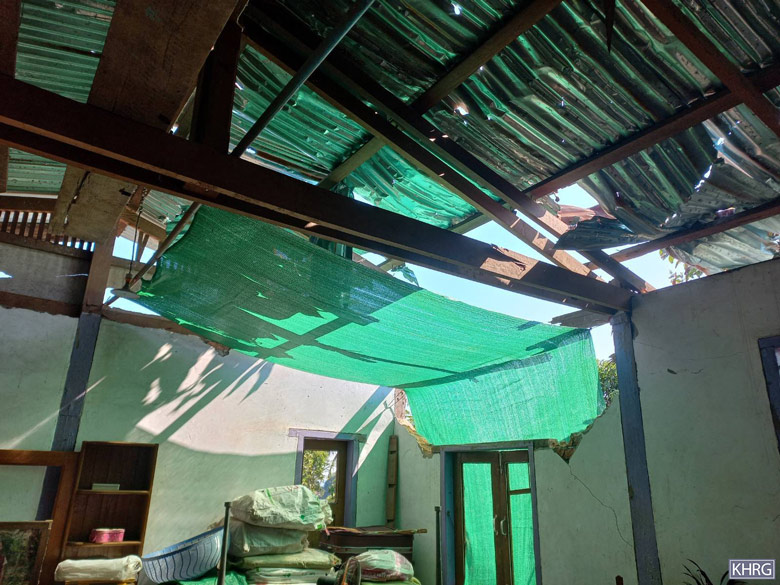


These photos were taken by a KHRG researcher in December 2025, in Gn--- village, Nyaung Pin Tha village tract, Moo Township, Kler Lwee Htoo District. On 3 December 2025, at 12 pm, Burma Army soldiers from an army camp based in Moo Town indiscriminately fired six 120 mm mortar shells and conducted a drone strike into Gn--- village. The photos show damage to a house that was caused by the mortar shelling. [Photos: KHRG]


These photos were taken by a KHRG researcher in December 2025, in Gn--- village, Nyaung Pin Tha village tract, Moo Township, Kler Lwee Htoo District. On 3 December 2025, at 12 pm, Burma Army soldiers from an army camp based in Moo Town indiscriminately fired six 120 mm mortar shells into Gn--- village. The photos show the tail of one of these mortar shells. [Photos: KHRG]
Footnotes:
[1] The present document is based on information received in December 2025. It was provided by a community member in Kler Lwee Htoo District who has been trained by KHRG as a researcher to monitor human rights conditions on the ground. The names of the victims, their photos and the exact locations are censored for security reasons. The parts in square brackets are explanations added by KHRG. This document combines several received reports with the following KHRG internal log numbers: #25-459-I1; #25-459-M1/P1 and #25-459-A1-I1.
[2] The terms Burma military, Burma Army, SAC, Tatmadaw, and junta are used interchangeably throughout this report to describe the Burma military regime’s armed forces. Villagers themselves commonly use Burma Army, Burmese soldiers, or alternatively the name adopted by the Burma military regime at the time —from the 2021 coup to July 2025, the State Administration Council (SAC). On 31 July 2025, the military junta changed its name to the State Security and Peace Commission (SSPC).
[3] A village tract is an administrative unit of between five and 20 villages in a local area, often centred on a large village.
[4] ‘Daw’ is a Burmese female honorific title used before a person’s name.
[5] ‘U’ is a Burmese title used for elder men, used before their name.
[6] ‘Maung’ is a Burmese male honorific title used before a person’s name.
[7] The majority ethnic group in Myanmar, also known as ethnic Burmese or Burman.
[8] A Light Infantry Battalion (LIB) comprises 500 soldiers. Most Light Infantry Battalions in the Tatmadaw are under-strength with less than 200 soldiers, yet up-to-date information regarding the size of battalions is hard to come by, particularly following the signing of the NCA. LIBs are primarily used for offensive operations, but they are sometimes used for garrison duties.
[9] Min Aung Hlaing, then a Senior General and the Commander-in-Chief of Burma’s Armed Forces, seized power in February 2021 in a coup d’etat, overthrowing the quasi-civilian government led by Daw Aung San Suu Kyi after her party, the National League for Democracy, won the 2020 elections in a landslide. Following the coup, he has responded to the nationwide resistance with extraordinary brutality while continually rebranding himself and his regime to appeal for legitimacy abroad. He declared himself the Prime Minister of Myanmar in 2021, the Acting President of Myanmar in 2024, and misappropriated the title of President of Myanmar in the non-democratic 2025-2026 elections. Although the regime claims Min Aung Hlaing now holds a civilian position, reports of parliamentary coercion and installation of loyalists in the military strongly suggest that Min Aung Hlaing is not acting as a civilian ruler.
[10] The State Security and Peace Commission (SSPC) is one of the names of the executive governing body created in the aftermath of the 1 February 2021 military coup. Formerly called the State Administration Council (SAC), it was renamed by Senior General Min Aung Hlaing, who served as chairperson, on 31 July 2025 and was technically dissolved on 10 April 2026 following the installation of a purportedly 'civilian' government via elections that were widely regarded as non-democratic. The name State Security and Peace Commission (SSPC) is used interchangeably with military junta and Burma military regime.
[11] The Karen National Union (KNU) is the main Karen political organisation. It was established in 1947 and has been in conflict with the government since 1949. The KNU wields power across large areas of Southeast Myanmar and has been calling for the creation of a democratic federal system since 1976. Although it signed the Nationwide Ceasefire Agreement (NCA) in 2015, following the 2021 coup staged by Burma Army leaders, the KNU officially stated that the NCA has become void.
[12] The State Administration Council (SAC) was the name of the executive governing body of the Burma military regime created in the aftermath of the 1 February 2021 military coup. It was established by Senior General Min Aung Hlaing on 2 February 2021 and was composed of eight military officers and eight civilians. The chairperson serves as the de facto head of government of Burma/Myanmar and leads the Military Cabinet of Myanmar, the executive branch of the government. Min Aung Hlaing assumed the role of SAC chairperson following the coup. The military junta changed its name on 31 July 2025 from SAC to State Security and Peace Commission (SSPC), with Min Aung Hlaing retaining his position as chairperson.
 Print:

