
 English
 ကညီကျိာ်
 မြန်မာ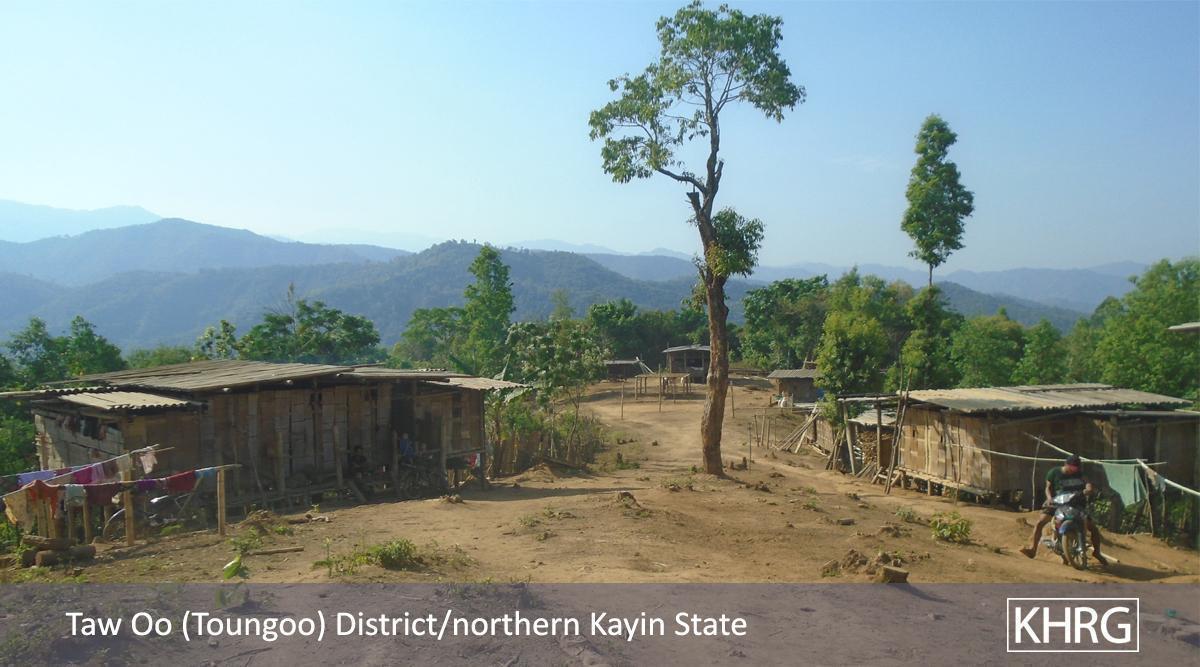
 Print:
This Situation Update describes events occurring in Daw Hpah Hkoh (Thandaunggyi) Township, Taw Oo (Toungoo) District. During the period from January to March 2026, the Burma Army shelled villages, killing two villagers and injuring four villagers. Then, the Burma Army Belu Column arrested five villagers and released four of them, while keeping one of them in detention. Additionally, the Burma Army arrested two villagers who were returning to Ai--- village, P’Shaw Loh village tract. The presence of Burma Army in the village caused fear for villagers to live in the village. The Burma Army not only invaded the villages but also looted villagers’ phones and money which belonged to a church. Daw Hpah Hkoh Township is a mixed-control area of both the Karen National Union (KNU) and the Burma Army. The Burma Army mostly administers towns, and they have army camps near towns, while the KNU administers villages and village tracts. For instance, schools in villages and village tract are administered by the Karen Education and Cultural Department (KECD), while schools in towns are administered by the Burma Army. Lastly, the surge in fuel prices led to high prices in goods when goods were transported to and sold in villages; meanwhile, local goods sold at lower profits, which has caused economic hardship for villagers.[1]
Indiscriminate shelling incidents in Thandaunggyi Section (3)
On 22 January 2026, revolutionary armed groups were not conducting their military operations and there was no fighting [in Thandaunggyi Section (3), Daw Hpah Hkoh (Thandaungyi) Township, Taw Oo (Toungoo) District]. However, at 8:50 pm, the SSPC [State Security and Peace Commission[2] also known as the Burma Army[3]] based in Thandaunggyi Ba Yit Naung Tat Myot area, Daw Hpah Hkoh Township, fired a (60 mm) motor shell. The shell landed and exploded in front of Aa--- church, Thandaunggyi Section (3), damaging Ab--- church hall, glasses [windows], and bricks [walls]. Additionally, Naw[4] A---, 34 years old, the wife of a [church leader, position censored for security], sustained an injury to her leg. Later, she received treatment at a hospital run by the SSPC in the Thandaunggyi Bayint Naung Tat Myo area.
On 3 February 2026, in the morning, SSPC Infantry Battalion (IB)[5] #26, based near Ac--- village, P’Shaw Loh village tract,[6] Daw Hpah Hkoh Township, fired two (60 mm) mortar shells. The two shells landed and exploded near Naw B---’s house, Ad--- village, P’Shaw Loh village tract. The shrapnel hit her neck, leading to her death shortly afterward.[7]
On 14 March 2026, an unknown armed [resistance] group attacked, firing two shots with a sniper [rifle] at the gate of [the army camp of] Light Infantry Battalion (LIB)[8] #603, which is located on a road between Toungoo Town and Leik Tho Town, killing one Burma Army soldier. Following the attack at 4 pm on the same day, [Burma Army soldiers from] Z’Leh army camp, located near Ae--- village, P’Shaw Loh village tract, indiscriminately shelled Ae--- village, killing a 60-year-old villager named Ma[9] C--- and injuring three other villagers: Saw[10] D--- on his head, 15-year-old Saw E--- on his leg, and 15-year-old Saw F---, who also sustained an [unspecified] injury.
Burma Army arrests
On 4 January 2026, 19-year-old Ko[11] G--- and 20-year-old H---, who live in Ai--- village, P’Shaw Loh village tract, travelled to Toungoo Town to watch and celebrate the Myanmar Independence Day festival. The next morning, 5 January 2026, the two of them and their cousin I---, who was released from prison on Independence Day, returned together to their village. On the way back to their village, Toungoo No. (3) Police arrested and detained them. They were arrested because the police suspected them of having connection with the PDF [People’s Defence Force].[12] A week later, they were released.
On 9 March 2026, in the morning, the SSPC Belu Column[13] arrested five villagers who were traveling between Af--- village and Ag--- village, P’Shaw Loh village tract. [On the same day,] four villagers were released; however, one villager had still not been released [as of 11 August 2026]. The missing villager used to live in Ah--- village, P’Shaw Loh village tract. Villagers reported that they do not know where he is; however, there was a rumour in the village that he was forcibly recruited as a [Burma Army] soldier. A village head of the P’Shaw Loh village tract reported that the SSPC Belu Column is extremely terrifying and brutal.
Militarisation operation
In January 2026, SSPC Belu Column, IB #26, IB #19, LIB #603, and LIB #604 entered Aj--- village, P’Shaw Loh village tract. Villagers did not feel safe to live in the village due to their [Burma Army] presence. Additionally, villagers were not pleased that they [Burma Army soldiers] were checking identification cards of villagers who were traveling in and out of the village. Thus, [some] villagers were displaced.
On 17 February 2026, KNLA [Karen National Liberation Army][14] Battalion #5, under the control of Brigade #2, attacked the SSPC’s military operations on Ah Shay Nyaung Ku La Htaing Kway Road, located at the upper part of Ac--- village, P’Shaw Loh village tract. [Later, on the same day, villagers found the dead body of a KNLA soldier with his throat slit on a road near Ak--- village, P’Shaw Loh village tract. They believed the Burma Army arrested and killed the soldier following the KNLA attack.]
On 5 March 2026, the Belu Column entered Al--- village, P’Shaw Loh village. Then, they looted 450,000 kyats (214.29 USD[15]) worth of offerings given to the Am--- church, as well as two phones of villagers. A villager [from Al--- village] informed the village tract leader of the incident. One of the soldiers said: “If you want the phones and money, you’ll get shrapnel.”
On 14 March 2026, at 11:30 pm, some villagers reported that KNLA Battalion #5, under the control of Brigade #2, combined with PDF, launched 18 (107 mm) rockets at the Ketu Mati Air Force, [located in Toungoo Town, Bago Division] and hit fuel tanks. 13 out of 18 (107 mm) rockets exploded. The Bayint Naung Tat Myo army camp conducted shelling in return. [It is unknown to KHRG where the shelling landed or if there were any damages.]
On 27 March 2026, combined forces of the PDF and [KNLA] Battalion #5, under the control of Brigade #2, attacked a military training location in Bayint Naung Tat Myo Town. A KNLA authority said that four out of five rockets exploded. Later, on the same day, SSPC [Light Infantry] Battalion #593, under the control of Military Operations Command (MOC)[16] #20, fired two shells, and Bayint Naung Tat Myo army camp also fired more than four shells into villagers’ plantations in Day Loh Mu Nu Lar village tract. However, no one sustained injury.
Administration in Daw Hpah Hkoh Township
On 5 February 2026, the KNU [Karen National Union][17] elected their relevant departments [members] and township administrator in Daw Hpah Hkoh Township. There are nine departments. Some new members were elected. This congress was completed step by step. KNU members were elected from village, village tract, and township. The new township administrator’s name is Saw J---. However, the SSPC still administered Thandaunggyi Town, Leik Tho Town, and Baw Ka Li Town, with SSPC army camps based in those areas. In addition, drugs like Yaba[18] (WY) were sold and villagers were purchasing drugs from those towns. The SSPC had not taken any action or prohibited the drugs yet [as of March 2026].
Education
In 2026, there were Karen Education and Culture Department (KECD)[19] administered schools in all village tracts in the township; yet, villagers from An--- village, Shan Leh Pyin Kyi village tract, [Daw Hpah Hkoh Township] and [throughout] P’Shaw Loh village tract wanted more KECD schools and wanted to link [existing self-funded schools] with the KECD. Schools administered by the SSPC were in Thandaunggyi Town, Thandaung 13 Miles Town, and Leik Tho Town.
Transportation and economy
The roads and bridges which were damaged from flooding and landslides in 2025 were being repaired in 2026. Some bridges and roads had been repaired, and villagers were using them for traveling. When it rained, some of the roads and bridges became difficult to travel by motorcycle, so villagers walked while crossing some bridges.
In March 2026, the price of petrol was between 15,000 kyats (7.14 USD) and 16,000 kyats (7.62 USD) per litre. Cars and motorcycles without licenses were prohibited from purchasing petrol at petrol stations. Some SSPC checkpoints looted fuel from taxi drivers, who carried fuel in bottles for sale, which led to high prices in goods and high taxi fees. In contrast, [selling] local crops made little profit [for villagers].
Further background reading on the situation on shelling in Southeast Burma/Myanmar can be found in the following KHRG reports:
- Photo Set: Burma Army human rights violations in Southeast Burma (January to June 2026), July 2026.
- In Spite of Fear: Women’s experiences navigating the compounding challenges of displacement and insecurity in Southeast Burma, July 2026.
- “Kler Lwee Htoo Incident Report: Burma Army ground operations, air strikes, and shelling killed at least 31 villagers, including 15 children, injured many others, and caused extensive property destruction and displacement in Ler Doh Township (March 2026)”, July 2026.
Footnotes:
[1] The present document is based on information received in April 2026. It was provided by a community member in Taw Oo District who has been trained by KHRG as a researcher to monitor human rights conditions on the ground. The names of the victims, their photos and the exact locations are censored for security reasons. The parts in square brackets are explanations added by KHRG. This document combines several received reports with the following KHRG internal log numbers: #26-125-S1; #26-27-D1; and #26-27-A1-I1.
[2] The State Security and Peace Commission (SSPC) is the new name of the executive governing body created in the aftermath of the 1 February 2021 military coup. Formerly called the State Administration Council (SAC), it was renamed by Senior General Min Aung Hlaing on 31 July 2025.The chairperson serves as the de facto head of government of Burma/Myanmar and leads the Military Cabinet of Myanmar, the executive branch of the government. Min Aung Hlaing assumed the role of SAC chairperson following the coup and remains the head of the SSPC. The name State Security and Peace Commission (SSPC) is used interchangeably with military junta and Burma military regime.
[3] The terms Burma military, Burma Army, SAC, Tatmadaw, and junta are used interchangeably throughout this report to describe the Burma military regime’s armed forces. Villagers themselves commonly use Burma Army, Burmese soldiers, or alternatively the name adopted by the Burma military regime at the time —from the 2021 coup to July 2025, the State Administration Council (SAC). On 31 July 2025, the military junta changed its name to the State Security and Peace Commission (SSPC).
[4] ‘Naw’ is a S’gaw Karen female honorific title used before a person’s name.
[5] An Infantry Battalion (IB) comprises 500 soldiers. However, most Infantry Battalions in the Tatmadaw are under-strength with less than 200 soldiers. Yet up to date information regarding the size of battalions is hard to come by, particularly following the signing of the NCA. They are primarily used for garrison duty but are sometimes used in offensive operations.
[6] A village tract is an administrative unit of between five and 20 villages in a local area, often centred on a large village.
[7] KHRG, “Taw Oo District Short Update: Burma Army shelling killed one villager, injured a pregnant woman, and caused damage in Daw Hpah Hkoh Township (December 2025 and February 2026)”, April 2026.
[8] A Light Infantry Battalion (LIB) comprises 500 soldiers. Most Light Infantry Battalions in the Tatmadaw are under-strength with less than 200 soldiers, yet up-to-date information regarding the size of battalions is hard to come by, particularly following the signing of the NCA. LIBs are primarily used for offensive operations, but they are sometimes used for garrison duties.
[9] ‘Ma’ is a Burmese female honorific title used before a person’s name.
[10] ‘Saw’ is a S’gaw Karen male honorific title used before a person’s name.
[11] ‘Ko’ is a Burmese title meaning older brother. It can be used for relatives as well as non-relatives.
[12] The People’s Defence Force (PDF) is an armed resistance established independently as local civilian militias operating across the country. Following the 1 February 2021 military coup and the ongoing brutal violence enacted by the junta, the majority of these groups began working with the National Unity Government (NUG), a body claiming to be the legitimate government of Burma/Myanmar, which then formalized the PDF on 5 May 2021 as a precursor to a federal army.
[13] A column is a combination of companies assembled for operations, usually 100-300 soldiers fighting strength.
[14] The Karen National Liberation Army (KNLA) is the armed wing of the Karen National Union.
[15] All conversion estimates for the Kyat are based on the official market rate as of 30 July 2026 at 1 USD = 2,100 MMK; conversion rate available at https://wise.com/gb/currency-converter/usd-to-mmk-rate
[16] Military Operations Command (MOC) is comprised of ten battalions for offensive operations. Most MOCs have three Tactical Operations Commands (TOCs) made up of three battalions each.
[17] The Karen National Union (KNU) is the main Karen political organisation. It was established in 1947 and has been in conflict with the government since 1949. The KNU wields power across large areas of Southeast Myanmar and has been calling for the creation of a democratic federal system since 1976. Although it signed the Nationwide Ceasefire Agreement (NCA) in 2015, following the 2021 coup staged by Burma Army leaders, the KNU officially stated that the NCA has become void.
[18] Yaba, which means ‘crazy medicine’ in Thai, is a tablet form of methamphetamine. First developed in East Asia during the Second World War to enhance soldiers' performance, methamphetamine has become increasingly popular in Thailand, Laos, Cambodia, Vietnam, and Burma/Myanmar where it is typically manufactured.
[19] The Karen Education and Culture Department (KECD) is the education department of the Karen National Union. Its main goals are to provide mother tongue education services to rural Karen populations in Southeast Myanmar, as well as to preserve the Karen language, culture and history. Despite being an important education provider in the region, it is not officially recognised by the Myanmar government.


