
 English
 ကညီကျိာ်
 မြန်မာ
This Short Update describes events occurring in Noh T’Kaw (Kyainseikgyi) Township, Dooplaya District, in January 2026. On January 20th 2026, at around 7 pm, Burma Army soldiers from Infantry Battalion (IB) #284 shot and killed a woman while she was extracting rubber latex in a rubber plantation near Aa--- village, T’Hka Kloh village tract. She was hit on her left temple and died on the spot. The victim’s family did not receive any compensation from the Burma Army. After the incident, the Burma Army imposed a curfew in the village prohibiting travel after 7 pm. As a result of this incident, villagers became afraid to extract rubber latex and faced serious livelihood challenges. Some villagers also fled the village. The army camp of the Burma Army’s IB #284 is located in nearby Seik Gyi Town. These soldiers had been conducting frequent military operations in the area since the 2021 coup, including indiscriminate shelling into nearby villages, firing machine guns, and imposing travel restrictions on villagers.[1]
Burma Army military activities in Seik Gyi Town and nearby areas
After the military coup in 2021, the Burma Army[2] frequently conducted shelling, and some shells landed near villages close to Seik Gyi Town, Noh T’Kaw Township, Dooplaya District. The Burma Army carried out shelling whenever they were attacked by the KNLA [Karen National Liberation Army][3] with drones. Sometimes, they [the Burma Army] also shelled indiscriminately, even when no attacks or fighting were taking place.
Seik Gyi Town and nearby villages are [mostly] under the control of the Burma Army. [The Burma Army’s] Infantry Battalion (IB)[4] #284 is stationed near Seik Gyi Town. After the military coup in 2021, soldiers from IB #284 have regularly patrolled the area surrounding their army camp to maintain security. During night patrols, the Burma Army has often fired machine guns, usually between three and ten times. As the Burma Army planned to hold an election[5] in January 2026, militarisation increased in areas under its control.
[Since the 2021 coup,] the Burma Army [also] restricted villagers’ access to Seik Gyi Town. They opened the gate [entrance checkpoint] at 6 am and closed it after 6 pm. In cases of medical emergencies, villagers were required to inform the Burma Army. Villagers were allowed to enter the town only after receiving approval from the Burma Army. The Burma Army provided the village head with a phone number for villagers to contact in case of [medical] emergencies. Due to these restrictions, some villagers faced challenges in accessing the hospital for treatment in Seik Gyi Town.
The Burma Army’s Infantry Battalion (IB) #284 army camp is [also] near Aa--- village, T’Hka Kloh village tract[6], Noh T’Kaw Township.
January 20th 2026: Burma Army soldiers killed a villager in T’Hka Kloh village tract
On January 20th 2026, Ma[7] A--- and her husband [from Aa--- village] went to their rubber plantation to extract rubber latex. At around 7 pm, soldiers from the Burma Army’s IB #284 shot at them multiple times, killing Ma A--- (41 years old) on the spot. She was struck on her left temple and died immediately under the rubber trees. After the incident, her husband carried her back to the village.
A village security guard, named U[8] B---, from Aa--- village, believed that Burma Army soldiers deliberately shot at Ma A---. He believed that Burma Army soldiers might have gone to a hut located near the incident site and shot the woman, because when he observed the incident place, the place where Burma Army soldiers stayed [during the incident], and the incident place are very close. U B--- expressed to KHRG: “They [Burma Army soldiers] should not shoot if they are not sure of their target. If necessary, they [Burma Army] should fire warning shots into the air. In this incident, the shooting was intentional.” He added: “Villagers rely on daily work to support their livelihoods, but following this incident, many are afraid to extract rubber latex. This fear creates serious livelihood challenges. If such shootings continue, villagers will remain afraid to work. The Burma Army must provide compensation to the victim’s family.”
Previously, there was no curfew in Aa--- village. After the incident, the Burma Army imposed a curfew requiring villagers to travel only before 7 pm. Some villagers were frightened and fled the village after the incident.
Further background reading on the situation of killings in Southeast Burma/Myanmar can be found in the following KHRG reports:
- “Dooplaya District Short Update: SAC shelling and displacement challenges in Kruh Tuh Township (July 2025)”, January 2026.
- “Taw Oo District Incident Report: SAC shelling killed a four-year-old boy and injured two villagers, including a six-year-old girl, in Daw Hpah Hkoh Township (June 2025)”, January 2026.
- “Kler Lwee Htoo District Incident Report: SAC air strike caused casualties, including a child, and destruction in Moo Township (April 2025)”, December 2025.
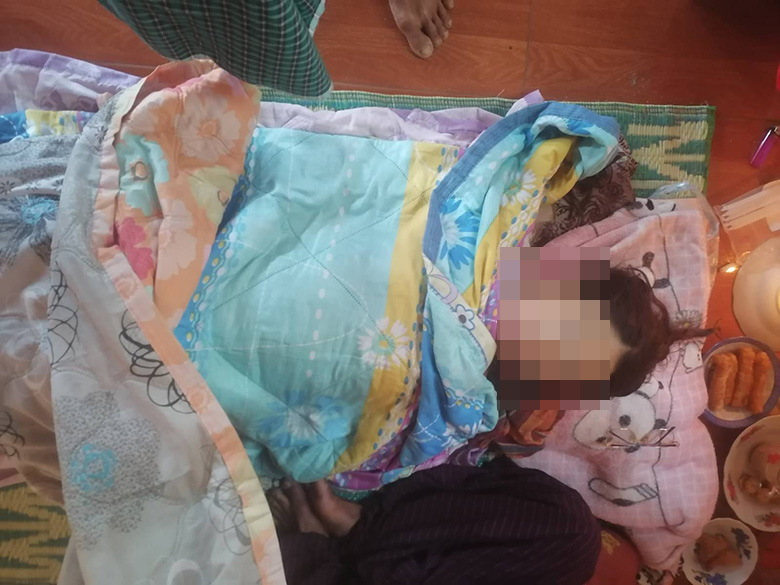
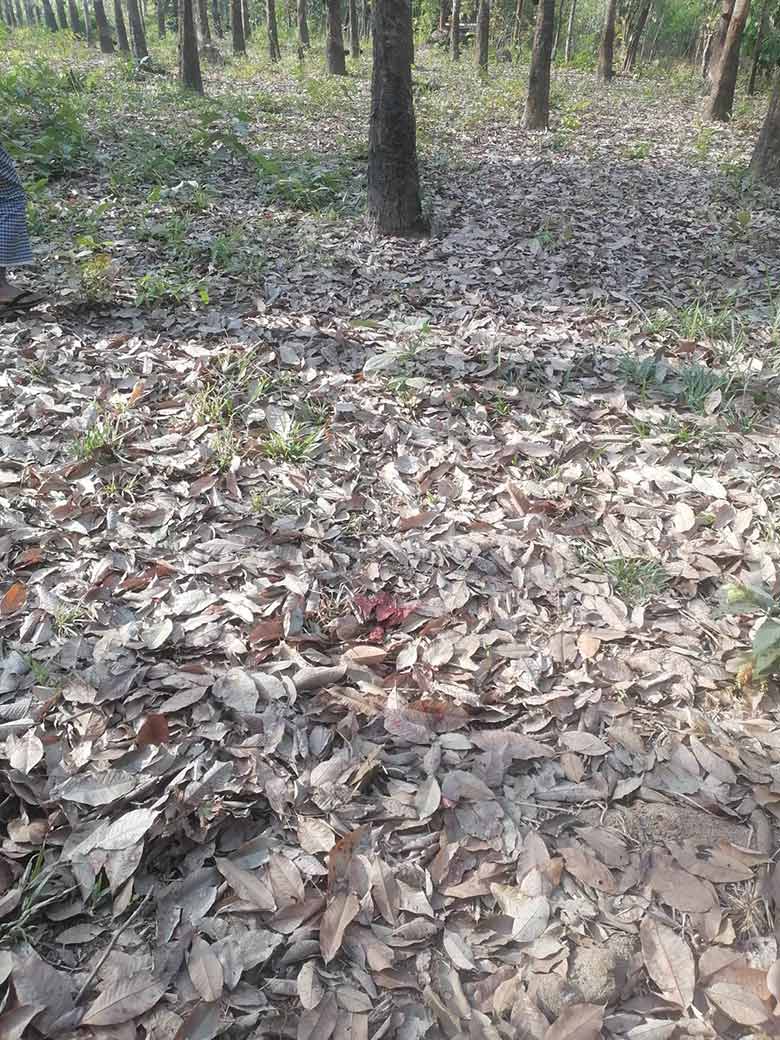


KHRG received these two photos from a local leader from Aa--- village, T’Hka Kloh village tract, Noh T’Kaw Township, Dooplaya District, on January 23rd 2026. On January 20th 2026, Burma Army Infantry Battalion (IB) #284 soldiers shot at a villager named Ma A---, while she was extracting latex at her rubber plantation, and killed her on the spot. The photo on the left shows Ma A---’s body in her house before the funeral. The photo on the right shows the place where she was fatally shot. [Photos: local leader]
Footnotes:
[1] The present document is based on information received in January 2026. It was provided by a community member in Dooplaya District who has been trained by KHRG to monitor human rights conditions on the ground. The names of the victims, their photos and the exact locations are censored for security reasons. The parts in square brackets are explanations added by KHRG. This document combines several received reports with the following KHRG internal log numbers: #26-45-I1, #26-45-A1-I1, and #26-45-A2-I1.
[2] The terms Burma military regime, Burma Army, junta, and SAC are used interchangeably throughout this report to describe Burma’s armed forces. Villagers themselves commonly use Burma Army, Burmese soldiers, or alternatively the name adopted by the Burma military regime at the time –from the 2021 coup to July 2025, the State Administration Council (SAC). On July 31st 2025, the military junta changed its name to State Security and Peace Commission (SSPC).
[3] The Karen National Liberation Army is the armed wing of the Karen National Union.
[4] An Infantry Battalion (IB) comprises 500 soldiers. However, most Infantry Battalions in the Tatmadaw are under-strength with less than 200 soldiers. Yet up to date information regarding the size of battalions is hard to come by, particularly following the signing of the NCA. They are primarily used for garrison duty but are sometimes used in offensive operations.
[5] The non-democratic elections held by the Burma military regime in 2025-2026 have been largely condemned by various international stakeholders, including ASEAN and high-ranking UN officials, as not legitimate. The junta’s election was split into three phases, making polling stations subsequently available in different regions: phase 1 took place on December 28th 2025; phase 2 took place on January 11th 2026; and phase 3 took place on January 25th 2026. The military junta backs the Union Solidarity and Development Party (USDP), which serves as their political proxy. The junta was formerly self-designated as the State Administrative Council (SAC), after the February 1st 2021 military coup headed by Senior General Min Aung Hlaing, which deposed the democratically elected government led by the National League for Democracy (NLD), following Burma’s 2020 general elections.
[6] A village tract is an administrative unit of between five and 20 villages in a local area, often centred on a large village.
[7] ‘Ma’ is a Burmese female honorific title used before a person’s name.
[8] ‘U’ is a Burmese title used for elder men, used before their name.
 Print:
