
 English
 ကညီကျိာ်
 မြန်မာ
 Print:
This Short Update describes events that occurred in Kruh Tuh Township, Dooplaya District, in July 2025. On July 9th 2025, the State Administration Council (SAC) Light Infantry Battalion (LIB) #545, based in Kruh Tuh Town, conducted shelling into Ab--- village, in Tha Lwen Taw village tract, causing fear and minor property damage. Moments after the explosion, local villagers found a 55-year-old woman dead, believed to have died due to the shell blast wave, as she suffered from high blood pressure. Since April 2025, fighting often occurred along the Asian Highway in Kruh Tuh Township, forcing many villagers to flee their homes. Some displaced villagers, including elderly people, are seeking refuge in Aa--- area of Ab--- village, where they are in need of food and medical support.[1]
SAC shelling into Tha Lwen Taw village tract:
Since April 2025, fighting between the State Administration Council [SAC][2] and armed resistance groups occurred almost daily along the Asian Highway[3] road [between Kruh Tuh Town and Kaw T’Ree Town] in Kruh Tuh Township, Dooplaya District. The SAC Light Infantry Battalion [LIB][4] #545, based in Kruh Tuh Town, conducted shellings once or twice per week, regardless of whether fighting took place.[5]
On July 9th 2025, at around 9 pm, villagers heard the sounds of the SAC firing multiple mortar shells. One 120 mm mortar shell landed in Aa--- area of Ab--- village, Tha Lwen Taw village tract[6], Kruh Tuh Township, Dooplaya District. Shrapnel from the explosion struck and slightly damaged the fence surrounding the monastery in the village.
After the incident, an ailing woman, Ma[7] A--- (55 years old) was found dead in her bed, bleeding from her eyes, ears, and nose. After the incident, Ma A---’s youngest daughter and granddaughter went to find the village head of Ab--- village, named Saw[8] B---, that night, and informed him about the incident. Saw B--- explained to KHRG: “After she [Ma A---] returned from the monastery, she ate Mama [instant] noodles. Her daughter and granddaughter were using the phone. As for her, she wanted to sleep, so then she went to sleep. A few moments later, the shelling happened. Then, her daughter called to her: ‘Mo Mo [mother], the shelling happened’, but she could not wake her mother. Her mother [’s body] was already cold.”
A local leader [Kruh Tuh Township documentation officer[9]] [who saw the body and also documented the incident] told the village head that he believed that the shelling explosion killed the ailing woman while she was sleeping. [Ma A---’s suffered from high blood pressure.] The blast [wave] [might have] caused her heart to stop beating, and she suffered bleeding from her eyes, ears, and nose. The village head [Saw B---] believed that Ma A--- was killed by her illness [high blood pressure]. However, based on the circumstances of Ma A---’s death [including the physical indicators that the body showed when found], the Kruh Tuh Township documentation officer believes that this was a casualty resulting from the SAC shelling.
In the past, shellings had never landed in Aa--- area of Ab--- village. This was the first time that a shelling landed [there]. The shelling landed in Aa--- area, but [villagers reported that] the sound was very loud [and was heard everywhere in Ab--- village].
Displacement challenges in Ab--- village:
Due to the [ongoing] fighting [along the Asian Highway road in Kruh Tuh], some villagers from Ac--- village and Ad--- village, Yay Pu Gyi village tract, Kruh Tuh Township, and Ae--- village, Kaw Wa Leh village tract, Kruh Tuh Township, fled to Aa--- area of Ab--- village.
Among the displaced are ailing elderly people and children, who urgently need food and medical supplies [as of July 2025]. They have been displaced since April 2025 after fighting broke out near their villages. Some villagers from Aa--- area (in Ab--- village) had also fled from their homes; therefore, the abandoned houses were opened to host displaced villagers from Ad---, Ae---, and Ac--- villages. However, it is difficult for the displaced people to find jobs, as employment opportunities are not available in the area.
Further background reading on the situation of shelling in Southeast Burma/Myanmar can be found in the following KHRG reports:
- Stolen Childhoods: Violations of children’s rights, urgent needs, and local agency in rural Southeast Burma during the conflict, October 2025.
- “Dooplaya District Incident Report: SAC shelling injured four children in Kruh Tuh Township (July 2025)”, December 2025.
- “Dooplaya District Situation Update: SAC shelling and air strikes caused casualties, displacement, and health and education challenges in Kruh Tuh Township (April 2025)”, November 2025
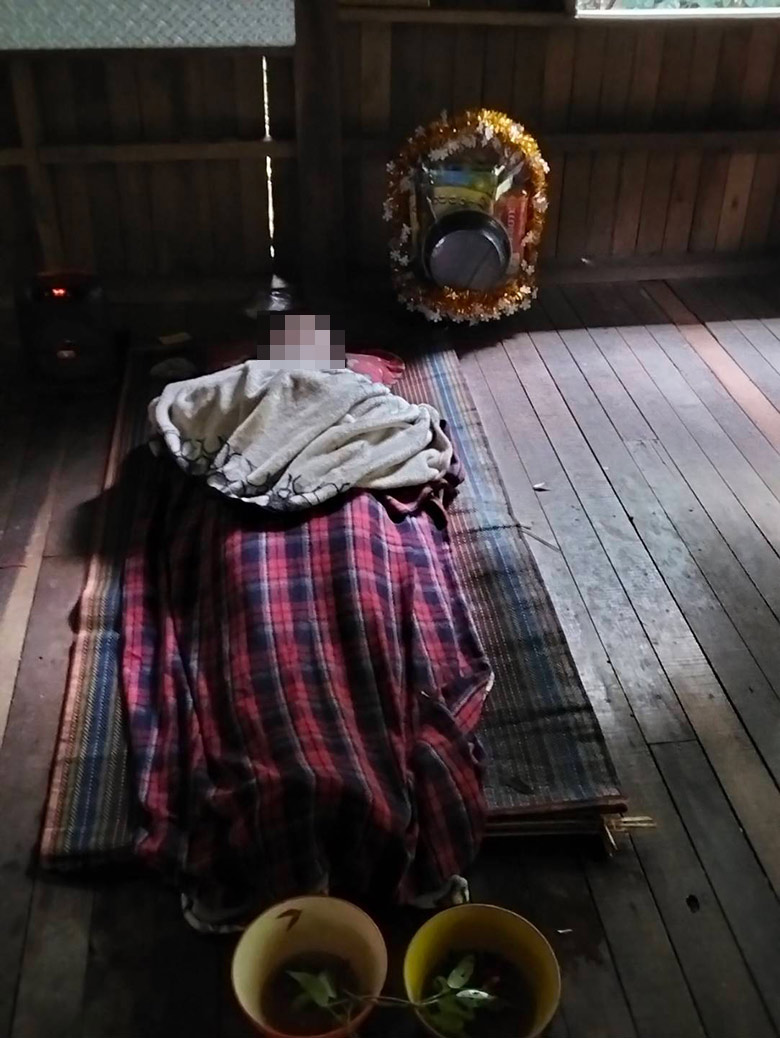
KHRG received this photo from an officer of KNU’s Kruh Tuh Township documentation group on July 14th 2025. On July 9th 2025, at 9 pm, the State Administration Council (SAC) Light Infantry Battalion (LIB) #545, based in Kruh Tuh Town, fired one 120 mm shell into Ab--- village, Tha Lwen Taw village tract, Kruh Tuh Township, Dooplaya District, which landed in Aa--- area of the village and exploded loudly. The photo shows the body of Ma A---, an ailing woman who was found dead after the explosion, believed to have been killed as a result of the blast wave from the SAC shelling explosion. [Photo: Township authority]
Footnotes:
[1] The present document is based on information received in July 2025. It was provided by a community member in Dooplaya District who has been trained by KHRG to monitor human rights conditions on the ground. The names of the victims, their photos and the exact locations are censored for security reasons. The parts in square brackets are explanations added by KHRG. This document combines several received reports with the following KHRG internal log numbers: #25-280-I1 and #25-280-A1-I1.
[2] The State Administration Council (SAC) is the executive governing body created in the aftermath of the February 1st 2021 military coup. It was established by Senior General Min Aung Hlaing on February 2nd 2021, and is composed of eight military officers and eight civilians. The chairperson serves as the de facto head of government of Burma (Myanmar) and leads the Military Cabinet of Burma, the executive branch of the government. Min Aung Hlaing assumed the role of SAC chairperson following the coup. The military junta changed its name on July 31st 2025 to State Security and Peace Commission (SSPC).
[3] The Asian Highway Network is a United Nations Economic and Social Council for Asia and the Pacific-supported project that aims to link 32 countries in Asia across 141,000 kilometres of roadway. In Burma/Myanmar the project has involved land confiscation and forced labour. For more information about the Asian Highway Network, see: KHRG, “Beautiful Words, Ugly Actions: The Asian Highway in Karen State, Burma”, August 2016; KHRG, “The Asia Highway: Planned Eindu to Kawkareik Town road construction threatens villagers’ livelihoods,” March 2015.
[4] A Light Infantry Battalion (LIB) comprises 500 soldiers. Most Light Infantry Battalions in the Tatmadaw are under-strength with less than 200 soldiers, yet up-to-date information regarding the size of battalions is hard to come by, particularly following the signing of the NCA. LIBs are primarily used for offensive operations, but they are sometimes used for garrison duties.
[5] See, for instance: KHRG, “Dooplaya District Situation Update: SAC shelling and air strikes caused casualties, displacement, and health and education challenges in Kruh Tuh Township (April 2025)”, November 2025.
[6] A village tract is an administrative unit of between five and 20 villages in a local area, often centred on a large village.
[7] ‘Ma’ is a Burmese female honorific title used before a person’s name.
[8] ‘Saw’ is a S’gaw Karen male honorific title used before a person’s name.
[9] These documentation teams, formed by groups of researchers, are founded by the Karen National Union (KNU) in the districts, and hence they are part of the KNU district staff members. Their role is to collect and document human rights violations on the ground and share them with KNU's Township and District staff, which then will be shared with the general public through the KNU's media pages and website.


