
 English
 ကညီကျိာ်
 မြန်မာ
 Print:
This Situation Update describes events occurring in Kruh Tuh Township, Dooplaya District, in April 2025, including shelling and air strikes, displacement, and challenges in accessing healthcare and education. On April 14th 2025, fighting broke out between the State Administration Council (SAC) troops and armed resistance groups along the Asian Highway, between Kaw T’Ree and Kruh Tuh towns. Following the fighting, the SAC conducted air strikes and shelling into Aa--- village, Kaw Wa Hlaing village tract, damaging two monastery buildings, two houses, and one car on an unknown date. On April 15th 2025, SAC air strikes and shelling in Myauk Kya Inn village tract also injured two villagers. On April 18th, shelling into Ywar K’Lay village tract injured two more villagers, and in Kaw Wa Hlaing village tract killed one villager. On April 23rd 2025, the SAC conducted an air strike on Wa Ka village tract, injuring a villager and damaging a school, a teachers’ dormitory, and three villagers’ houses. One bomb remained unexploded. Around 38,459 villagers were displaced in Kaw T’Ree and Kruh Tuh townships, requiring basic necessities such as food, clothing, and cooking materials. A local community-based organisation provided some rice and oil to the displaced villagers, but more assistance is needed. As villagers fled, some children were able to continue studying in other villages, while others had to stop attending school. SAC attacks also created security concerns for healthcare workers, limiting their ability to provide treatment at clinics and forcing pregnant women and newborns to return home shortly after delivery.[1]
SAC shelling and air strikes caused casualties and damages in Kruh Tuh Township
On April 14th 2025, fighting broke out between the SAC [State Administration Council][2] [Light Infantry Battalions (LIB)[3] #545 and #546] against armed resistance groups [Karen National Liberation Army (KNLA)[4] and People’s Defence Force (PDF)[5]] on the Asian Highway[6] between Kruh Tuh and Kaw T’Ree towns, in Dooplaya District. The fighting continued in the following days.
Since then [as of September 2025], the SAC has been constantly conducting air strikes and shelling in villages located near the fighting areas, causing casualties and damage to villagers’ houses and monasteries, as presented below. From April 14th to 23rd 2025, [at least] five villagers (including two children) were injured and one killed by SAC air strikes and shelling.
- April 2025: SAC attacks in Kaw Wa Hlaing village tract damaged a monastery and houses:
[On an unknown date in April 2025, the SAC conducted air strikes and shelling in Aa--- village, Kaw Wa Hlaing village tract[7], Kruh Tuh Township]. A displaced villager named Naw[8] A---, from Aa--- village, explained: “When the [Aa---] village head contacted me, he told me that at Ab--- monastery, [near Ah--- village] the Building 1 was damaged. For the monastery Building 2, all the glasses were damaged. However, no one got injured.” [Naw A--- was not able to confirm the exact date of the incident nor whether the monastery was damaged by the air strikes or the mortar shelling, as she had already fled the village when the attack happened]. She further added that her cousin’s house and a car were damaged by shelling, as well as a friend’s house [in Aa--- village].
- April 15th 2025: SAC attacks in Myauk Kya Inn village tract injured two villagers, including one girl:
On April 15th 2025, the SAC conducted air strikes and shelling into Ac--- village, Myauk Kya Inn village tract, Kruh Tuh Township. Two villagers from Ac--- village were injured by the shrapnel from ‘big weapons’. The type of weapon is unknown [as local villagers were not able to confirm whether the injury was caused by air strikes or shelling, since the patients had already been transferred to a hospital]. A villager named Ma[9] B--- (40 years old) was injured on her left arm. Naw C--- (a 9-year-old girl) was injured on her right thigh.
At first, the two villagers were sent to Ad--- clinic, in Wa Ka village tract, Kruh Tuh Township [for first aid treatment]. [This clinic is administered by the Karen Department of Health and Welfare (KDHW)[10], in an undisclosed location]. On the same day, they were transferred to a hospital in Three Pagodas Pass Town [controlled by the Democratic Karen Benevolent Army (DKBA)[11], located in a town bordering Thailand’s Kanchanaburi province,] [where they received treatment free of charge].
- April 18th 2025: SAC shelling in Ywar K’Lay and Kaw Wa Hlaing village tracts injured two villagers, including one boy:
On April 18th 2025, two villagers from Ae--- village, Ywar K’Lay village tract, Kruh Tuh Township, named Naw D--- (61 years old) and Saw E---- (16 years old), were injured [by SAC shelling]. The two villagers were immediately sent to the Three Pagoda Pass Hospital [where they received treatment free of charge].
On the same day, a villager from Af---- village, Kaw Wa Hlaing village tract, named U F--- (50-year-old man) was killed [by shelling].
- April 23rd 2025: SAC air strike in Wa Ka village tract injured one villager and damaged one school and houses
On April 23rd 2025, at 8 pm, an aircraft dropped three bombs on Ad--- village, Wa Ka village tract. One bomb landed on the school compound and damaged the roof and wall of the school, as well as the teachers’ dormitory. Another bomb landed next to villagers’ houses outside the school compound, damaging three houses and injuring one villager named Saw G--- (40 years old). He received treatment [free of charge] in Ad--- clinic. The last bomb remained unexploded. [Village authorities did not allow anyone to access the place where the unexploded bomb was located.]
Displacement of villagers due to SAC attacks
As the SAC repeatedly conducted air strikes and shelling on villages in the area between Kruh Tuh and Kaw T’Ree towns, villagers were forced to flee their homes. They fled to multiple locations: some to Hpa-an District [unspecified exact location], others to Dooplaya District [different places in Kaw T’Ree and Kruh Tuh townships]. The total number of civilians displaced to Kaw T’Ree and Kruh Tuh townships is around 38,459 people (19,648 men and 18,811 women), including children, pregnant women, and elderly people. [These numbers were provided by a KNU leader in Dooplaya District.] Some villagers returned to their villages when the fighting stopped.
[Villagers from the following] villages had to flee: from Kruh Tuh Township, Ae--- village, Ywa K’Lay village tract; Kaw Ag--- village, Kaw L’Yar village tract; Ah--- village, [no village tract]; Ai--- village, Mee K’Loh village tract; Aj--- village, Myauk Kya Inn village tract; Af--- village, Kaw Wa Laing village tract; Ak--- village, Yay Pu Gyi village tract; Al--- village, Tha Lwe Htaw village tract; Am--- village, Ywar Tar Shin village tract. From Noh T’Kaw Township [bordering Kruh Tuh Township], An--- village, Taung Kya Inn village tract; and Ao--- village, T’Ree T’Kaw village tract. Other locations remain unknown.
As villagers had to escape the fighting suddenly and without preparation, most were unable to carry food, cooking materials, and clothing with them. Some managed to take some food and clothes. H---, a villager from Af--- village, Kaw Wa Hlaing village tract, explained: “We took any clothes that we were able to grab. We had to hurry because the shelling was landing continually. All clothes and cooking materials were left at home [we were unable to carry them].”
Reportedly, the main need of displaced villagers is food, along with clothing and personal hygiene supplies. Naw A---, from Aa--- village, [who displaced to Htee Ap--- village, Htee Ghuh Thaw village tract, Kruh Tuh Township,] added: “As we live in another person's house, the owner gave us [mats and blankets]. However, it is not okay in the long term. We might need it [mats and blankets] later. If we have to live separately [live on their own], we might need everything, including pots, plates, salt, and hot water containers. When we stayed in other people's homes, the owner provided for us. […] The main thing is food.” As villagers do not know when the fighting will stop, they [continue to] need food, healthcare, shelter, and clothing.
The Committee for Internally Displaced Karen People (CIDKP) provided some rice and oil to displaced villagers. For additional necessities, CIDKP has already submitted a report [requesting aid from stakeholders].
Healthcare challenges
Due to the escalation of fighting in Kruh Tuh Township, the KDHW clinic in Ad--- village, Wa Ka village tract, was temporarily relocated [multiple times] to an undisclosed location. At times, healthcare workers also had to move elsewhere because they feared staying at the [new] clinic. In such cases, they provided treatment to patients in villagers’ houses.
After the relocation, sick villagers often struggled to find the clinic, as they did not know where it had been moved. For security reasons, newborns and pregnant women were not kept at the [relocated] clinic for the full period of care. Mothers were asked to return home shortly after giving birth, and health workers visited them there for follow-up check-ups. Mothers living nearby received home visits from clinic staff, while those living farther away received care from local village health workers.
Education challenges
In Kruh Tuh Township, [some schools are administered by the Karen Education and Culture Department (KECD)[12], while] some schools [administered by the Burma government] have been converted into self-funded schools, and other schools are still run by the Burma government [under the SAC control since the 2021 coup].
Since the escalation of fighting in April 2025 in the areas between Kruh Tuh and Kaw T’Ree, the Burma Army[13] air strikes and shelling have damaged schools, churches, and monasteries. As a result, schools had to close, and students were unable to continue their studies. Villagers who lived near the fighting areas had to flee.
Some schools have reopened despite ongoing security concerns for both students and teachers. In some cases, new grade levels were added to accommodate students from nearby schools that remained closed. As villagers were keen to use the KECD curriculum [in self-funded schools], more teachers who graduated from KECD schools are needed in the area.
Further background reading on the situation in Dooplaya District in Southeast Burma/Myanmar can be found in the following KHRG reports:
- ကဘီယူၤဟဲလံ Aircraft coming! : Impacts of air strikes on local communities and villagers’ protection strategies in Southeast Burma since the 2021 coup, November 2024.
- “Photo Set: Destruction of civilian livelihoods in Southeast Burma due to military attacks, December 2023 to December 2024”, August 2025.
- “Dooplaya District Incident Report: SAC shelling killed a villager in Kruh Tuh Township, April 2025”, May 2025.
- “Dooplaya District Situation Update: SAC air strikes, education challenges, drug issues, and military activities in Noh T’Kaw and Kruh Tuh townships (January to June 2025).”, November 2025.
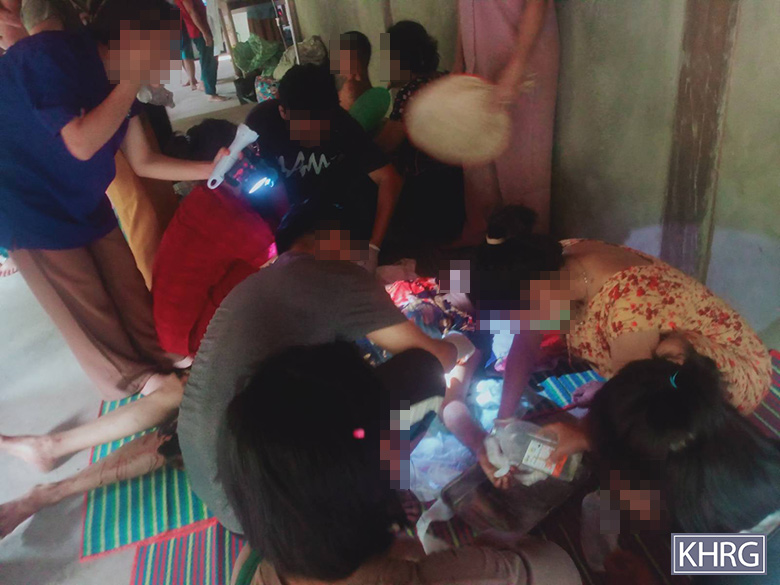
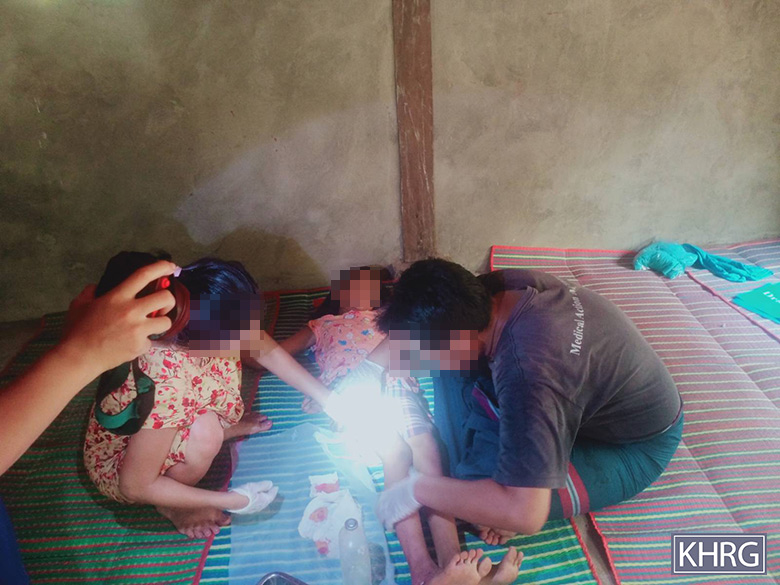


These two photos were taken in April 2025, at Ad--- clinic, Wa Ka village tract, Kruh Tuh Township, Dooplaya District. On April 15th 2025, SAC attacks injured two villagers from Ac--- village, Myauk Kya Inn village tract, Kruh Tuh Township. The photo on the left shows 40-year-old Ma B--- receiving treatment at Ad--- clinic. The photo on the right shows 9-year-old Naw C--- receiving treatment at the same clinic. After receiving first aid, they were transferred to the Three Pagodas Pass hospital, located in a town bordering Thailand’s Kanchanaburi province. [Photos: KHRG].


These photos were taken in April 2025. The photos show the situation of displaced people in Kruh Tuh Township, Dooplaya District. The two photos in the top row show villagers from Aq--- village tract, displaced in Ar--- village, Hk’Yin village tract. The two photos in the bottom row show villagers from Af--- village, Kaw Wa Hlaing village tract, and As--- village, Myauk Kya Inn village tract, displaced in Ap--- village, Htee Ghuh Thaw village tract. [Photos: KHRG]
Footnotes:
[2] The State Administration Council (SAC) is the executive governing body created in the aftermath of the February 1st 2021 military coup. It was established by Senior General Min Aung Hlaing on February 2nd 2021, and is composed of eight military officers and eight civilians. The chairperson serves as the de facto head of government of Burma/Myanmar and leads the Military Cabinet of Myanmar, the executive branch of the government. Min Aung Hlaing assumed the role of SAC chairperson following the coup. The military junta changed its name in July 31st 2025 to State Security and Peace Commission (SSPC).
[3] A Light Infantry Battalion (LIB) comprises 500 soldiers. Most Light Infantry Battalions in the Tatmadaw are under-strength with less than 200 soldiers, yet up-to-date information regarding the size of battalions is hard to come by, particularly following the signing of the NCA. LIBs are primarily used for offensive operations, but they are sometimes used for garrison duties.
[4] The Karen National Liberation Army is the armed wing of the Karen National Union.
[5] The People’s Defence Force (PDF) is an armed resistance established independently as local civilian militias operating across the country. Following the February 1st 2021 military coup and the ongoing brutal violence enacted by the junta, the majority of these groups began working with the National Unity Government (NUG), a body claiming to be the legitimate government of Burma/Myanmar, which then formalized the PDF on May 5th 2021 as a precursor to a federal army.
[6] The Asian Highway Network is a United Nations Economic and Social Council for Asia and the Pacific-supported project that aims to link 32 countries in Asia across 141,000 kilometres of roadway. In Burma/Myanmar the project has involved land confiscation and forced labour. For more information about the Asian Highway Network, see “Beautiful Words, Ugly Actions:The Asian Highway in Karen State, Burma”, KHRG, August 2016; “The Asia Highway: Planned Eindu to Kawkareik Town road construction threatens villagers’ livelihoods,” KHRG, March 2015.
[7] A village tract is an administrative unit of between five and 20 villages in a local area, often centred on a large village.
[8] ‘Naw’ is a S’gaw Karen female honorific title used before a person’s name.
[9] ‘Ma’ is a Burmese female honorific title used before a person’s name.
[10] The Karen Department of Health and Welfare (KDHW) is the health department of the Karen National Union. It was established in 1956 to address the lack of public healthcare resources in rural Southeast Myanmar. It currently operates a network of community-based clinics in the region, but its capabilities remain limited due to funding constraints.
[11] The Democratic Karen Benevolent Army (DKBA), formerly the Democratic Karen Buddhist Army, was formed in December 1994 and was originally a breakaway group from the KNU/KNLA that signed a ceasefire agreement with the Burma/Myanmar government and directly cooperated at times with Tatmadaw forces. The formation of the DKBA was led by monk U Thuzana with the help and support of the State Law and Order Restoration Council (SLORC), the name of the military government in Burma/Myanmar at that time.
[12] The Karen Education and Culture Department is the education department of the Karen National Union. Its main goals are to provide mother tongue education services to rural Karen populations in Southeast Myanmar, as well as to preserve the Karen language, culture and history. Despite being an important education provider in the region, it is not officially recognised by the Myanmar government.
[13] The terms Burma military, Burma Army, and SAC are used interchangeably throughout this report to describe Burma’s armed forces. Villagers themselves commonly use Burma Army, Burmese soldiers, or alternatively the name adopted by the Burma military regime at the time -since the 2021 coup, the State Administration Council (SAC).


