
 English
 ကညီကျိာ်
 မြန်မာ
 Print:
This Situation Update describes events occurring in Moo (Mone) Township, Kler Lwee Htoo (Nyaunglibin) District, during the period between February and May 2025. On 18 February 2025, Burma Army Infantry Battalion (IB) #73 from Zayatgyi Town fired two howitzer shells into Kl--- village, Nyaung Pin Tha village tract. The resulting explosions injured two villagers, including a woman on her legs and neck and her 12-year-old son on his left thumb, in addition to damaging two houses. On 3 March 2025 and 3 April 2025, Burma Army Light Infantry Battalion (LIB) #351, based in Ler Doh army camp, fired 120 mm shells into Haw Hkoh Ghaw village tract. Shrapnel from the mortar shells injured a young woman on her legs and forehead and damaged villagers’ property, including the houses of two villagers. Additionally, on 14 April 2025, Burma Army IB #5, based in Nyaung Pi Tha army camp, fired two 120 mm mortar shells into Yt--- village, Pin Za Lot village tract, Moo special area, injuring two villagers and damaging two houses, due to the shrapnel from the explosion. On 28 April 2025, a Burma Army fighter jet carried out an air strike on Za--- village, Kanyin Tan village tract, Moo special area, killing three villagers, injuring a 20-month-old child, and damaging four houses. On 5 May 2025, Burma Army LIB #439 fired a mortar shell into Yz--- village, Pa Ya La Ha village tract, Moo special area, injuring one villager when the shrapnel struck her neck. Consequently, due to the shelling and air strikes conducted by the Burma Army, some villagers needed to displace, and it caused disturbance to the villagers in from Moo Township. During the reporting period, Burma Army travel restrictions worsened villagers’ travel challenges and livelihood situations; attacks by the Burma Army impacted children’s education; and villagers faced challenges accessing needed healthcare services.[1]
Burma Army shelling caused casualties, destruction, and displacement
After the SAC [State Administration Council[2], now referred to as the Burma Army[3]] seized power [in the 2021 coup], they conducted activities such as firing mortar shells into villages in Moo (Mone) Township, Kler Lwee Htoo (Nyaunglibin) District, so the villagers had to face difficulties such as displacement, injuries, and destruction. On 18 February 2025, at 8:15 pm, the SAC IB [Infantry Battalion][4] #73, based in Zayatgyi Town army camp [located in Moo Township], indiscriminately fired two howitzer shells into Kl--- village, Nyaung Pin Tha village tract[5], Moo Township, and the first howitzer shell landed on the garden of Maung[6] J---, so his house and belongings were damaged. However, he was not injured.
Simultaneously, they [the Burma Army] fired another [second] howitzer shell. The howitzer shell landed and exploded underneath the house of U[7] D---. A 40-year-old named Daw[8] R---, who is the wife of U D---, was injured on both her legs and her neck. Also, their son, Maung B--- (12 years old) was hit on his left thumb and lost it. Due to the injuries, they were immediately sent to Rk--- clinic, located in Rk--- village, Moo special area, Moo Township, administered by the CDM [Civil Disobedience Movement][9]. They provided free treatment to the injured villagers. Afterward, due to the severity of Daw R---’s leg injuries, she was transferred to Taw Oo public hospital, located in Taw Oo Town and administered by the SAC. [It is unknown how much Daw R--- had to pay for the treatments.] His [U D---’s] house was also damaged, and his belongings such as a motorcycle, television, and other properties were damaged by the explosion, including kitchen supplies.
On 3 March 2025, at 8:35 pm, SAC soldiers from LIB [Light Infantry Battalion][10] #351, based in Ler Doh [army camp], fired two 120 mm mortar shells into Tk--- village, Haw Hkoh Ghaw village tract, Moo Township. The mortar shells landed on the garden of Saw[11] K--- and hit the belongings of Saw K---, such as petrol (diesel) and engine fuel (diesels); 20 big tins of fuel, which were burnt; some rice sacks, which were damaged; his diesel engine; a dynamo [an electric engine part]; the warehouse’s wall and roof, which were hit; a motorcycle, which was burnt; and his tractor, which was damaged as well.
On 3 April 2025, SAC soldiers from LIB #351, based in Ler Doh army camp, indiscriminately fired two 120 mm mortar shells into Tk--- village, causing destruction. Because the SAC soldiers deliberately targeted the village [a belief held by villagers due to the fact that armed resistance groups occasionally pass through the village] and fired a mortar into the village, the mortar shell landed and exploded on the house of a villager from Tk--- village named Naw[12] M---. None of the house owners were at home during the attack, so there were no casualties. Only the house and the roof of the house sustained significant damage.
However, the shrapnel from the explosion of the mortar shell scattered throughout the surrounding area and struck the house of another villager, named Saw T---. His 23-year-old daughter, Naw L---, was injured on her left leg and forehead. Because of the severity of her [Naw L---’s] leg injury caused by the shrapnel, local medics provided initial treatment and later referred her to Tl--- hospital [administered by the Karen Department of Health and Welfare (KDHW)[13] located in Tl--- village, P’Nah Wah Plaw village tract, Moo Township] for further treatment. They [villagers] do not need to pay treatment fees [at Tl--- hospital]. His [Saw T---’s] house was also damaged.
On 14 April 2025, at around 1 pm, SAC soldiers from IB #5, based in Nyaung Pin Tha village tract, indiscriminately fired two 120 mm mortar shells into Yt--- village, Pin Za Lot village tract, Moo special area. One of the mortar shells landed on a road in the village, [causing] no casualties. The remaining mortar shell landed close to the houses of Maung A--- and Ko[14] Z---, so their houses were damaged, and it also injured two villagers from Yt--- village. A 57-year-old named U Y--- was injured on his right armpit, and a 30-year-old named Maung I--- was injured on his back. Their injuries were not severe, so they received treatment from the local people responsible for healthcare [health workers] assigned by the KDHW. Villagers believe that when the SAC heard the information [received air reconnaissance] that villagers from Yt--- village set up a stage to celebrate the water festival, they [the Burma Army] acted arbitrarily and oppressively towards the villagers by conducting mortar shelling. Because the SAC conducted mortar shelling into the [Yt---] village, the villagers no longer dared to celebrate the water festival; furthermore, they moved to nearby villages to escape from the SAC oppression.
On 5 May 2025, at 8 am, soldiers from SAC Light Infantry Battalion (LIB) #439 conducted indiscriminate shelling of mortars into Yz--- village, Pa Ya La Ha village tract, Moo special area. The mortars landed beside Ma N---’s house (a Yz--- villager) and the mortar shrapnel injured Ma N---’s neck. Because the mortar shrapnel remained in her bone, she was transported to a community clinic administered by the KDHW. The health workers from the community clinic could not remove the shrapnel, so she was transported to Zk---’s hospital (general hospital) for further treatment. But doctors from the Zk--- hospital did not have enough medical equipment to remove the shrapnel, so they said that they would transport her to a hospital in Yangon city. The injured person’s family was not confident enough [did not feel safe] to send her to Yangon hospital [due to their security concerns about travelling to Yangon], so they came back and transported her to a hospital in the KNU [Karen National Union][15] area. A villager from Yz--- village named U Q--- said: “Before the SAC’s soldiers conducted mortar shelling, the PDF [People’s Defence Force][16]’s soldiers came into the village. Because they [the SAC] heard about that, they conducted mortar shelling into the village. But the mortars landed far away from [where] the PDF soldiers had sheltered; it landed into their place [Ma N--- house]. But the SAC’s soldiers do not only conduct mortar shelling when they hear their enemies live in the village; they always conduct indiscriminate shelling into the village.”
Burma Army air strike caused death, damage, and displacement
On 28 April 2025, at around 10:15 am, an SAC fighter jet conducted an air strike into Za--- village, Kanyin Tan village tract, Moo special area. The air strike killed three villagers from Za--- village named Ma[17] O--- (44 years old), who was decapitated; U S--- (40 years old), who was hit on his bladder; and Ma V--- (50 years old), who was hit on her belly. They all died on the spot. Ma O--- was cleaning her house, U S--- was using his phone on his hammock under his stilted house, and Ma V--- was reading Tripitaka [a book of Buddhist scriptures] while the air strike was conducted.[18]
The shrapnel from the explosion also injured Ma W--- (a female child), who is 1 year and 8 months old. The shrapnel hit her face below her eye, and she was transported to an SAC-run hospital in Zk--- Town. Due to the severity of her injury, she was then transferred to a hospital in Taw Oo Town, Taw Oo District, run by the SAC; then, finally, she was transferred once more to a hospital in Yangon [city]. Her family paid for her transportation and treatment themselves. They did not receive any support from any organisations or individuals. Both transportation and treatment cost 370,000 kyats (176.19 USD[19]) in total.
Due to the air strike, houses of villagers from Za--- village, owned by U C---, U G---, Ko H---, and Ma E---, were damaged.
The villagers have no idea why the SAC conducted an air strike into the village. The villagers had to suffer injury and death because the fighter jet conducted the air strike unexpectedly, and air strikes were not conducted in the village before. Also, on the date the air strike was conducted, there was no fighting happening in the village, although fighting was happening to the south of the village, one hour away by motorbike. The father of the victim named Ma O---, who is named U X---, stated: “In the past, aircraft used to come like this. But it was only striking in fighting areas. So, we were careless.[20] We thought the aircraft went there because fighting had occurred. Then, at around 10:15 am, an aircraft conducted an air strike onto the village. On that day, my daughter [Ma O---] told me that she would go back to her house and do cleaning. […] She then was hit on her head, and her head was decapitated by the shrapnel.”
After the incident, when the villagers heard the sound of aircraft, they were scared because they worried the aircraft would conduct an air strike again. They also hid in their makeshift bunker to avoid the danger of the aircraft. Some of the villagers fled to other villages, and some fled to Pyu Town just to avoid the potential harm of the air strikes.
Burma Army attacks caused displacement
The villagers in Moo Township faced displacement due to the SAC army conducting mortar shelling and air strikes into villages, as well as SAC soldiers sheltering in the villages. So, they [villagers] were no longer able to live in the villages. Therefore, they had to move to the villages that were far from [the area where] these types of SAC violations [happened]. Some villagers fled to their plantations and some fled to a forest. Because they did not have the chance to live in their villages and they had to displace, the consequences were [that they had] insufficient foods and they did not always have work; because they had to work for daily wages, it created difficulty for their livelihoods. Also, there were difficulties [in finding] places to live, and they had to live like that [in forests or on plantations, without adequate shelter, food, or work].
Conflict between armed groups and flooding caused travel restrictions for local villagers
When civilians travelled, they always had to be alert due to the fighting in some areas in Moo Township. Some of the villagers are shopkeepers, and they faced difficulties travelling into towns to buy things and coming back to sell in the villages, as the distances are far to travel. In addition, the SAC army stayed [set up checkpoints] on the road, conducted interrogations, and demanded [money], and [as a result] the price of commodities increased. In the rainy season, it was very difficult to travel and do business, because the roads were not good; there was mud in the fields and flooding; and in the places that there were no boats and bridges, it was difficult to cross rivers.
Education challenges due to Burma Army attacks
Regarding education in Moo Township, the challenges started after the SAC seized power [in the 2021 coup]. Before the 2025 academic year, schools in Moo Township were administered by the SAC. But in this year [2025], they [the SAC] were no longer able to control the area, because the KNU controlled the area, so the schools were administered by the KECD [Karen Education and Cultural Department][21]. Some schools are primary and some are middle schools. Only a few schools are high schools.
In the beginning of 2025, the villagers planned to send their children to school, but they were not confident enough for this, because they had security concerns due to the SAC seizing power. They [the SAC] conducted offensive military operations, such as firing mortar shells, carrying out drone strikes, and conducting air strikes. So, villagers lacked security.
Healthcare
Regarding healthcare in Moo Township area, it has difficulties and weaknesses; for example, if severe and serious injuries occur [to the villagers], there are insufficient medicines and not enough doctors. Furthermore, if related-blood diseases [hematologic diseases] occur, they have to face [the challenge that] there are no [available] medicines for it. About pregnant women giving birth, if they cannot give birth easily and need surgery to give birth, they have to go to a hospital in town to receive surgical treatment. For some of the villagers, if they suffer from an internal disease and need to find out about the disease [receive a diagnosis], there are no x-ray and ultrasound machines. So, they have to get it at the hospital from towns such as Pyu hospital [located in Pyu Town, Kler Lwee Htoo District] and Taw Oo hospital [located in Taw Oo Town, Taw Oo District]. Regarding patients, if they have to go to a hospital in town, the difficulties that they have to face are the far distance, difficulty to travel, and car rental fees.
Conclusion
These are the authentic incidents which happened in the area [Moo Township] that I [the researcher] documented in this report. As the information shows above, after the SAC seized power [in the February 2021 coup], the villagers have faced various difficulties. Due to the ongoing fighting, travel has become difficult; shelling resulted in casualties, destructions, and displacement; and there were disruptions to education and healthcare. Because of the brutality of the conflict, villagers have adopted different strategies to protect their [own] lives. However, some villagers have faced violations unexpectedly, and as a result, they have been unable to avoid such violations [employ agency strategies]. These challenges persist because there is still no peace in the country. Despite this, villagers continue to hope for a better life and lasting peace in the country.
Further background reading on the situation of human rights abuses in Kler Lwee Htoo District can be found in the following KHRG reports:
- Stolen Childhoods: Violations of children’s rights, urgent needs, and local agency in rural Southeast Burma during the conflict, October 2025.
- “Kler Lwee Htoo District Incident Report: Burma Army shelling injured a villager in Moo Township (December 2025)”, April 2026.
- “Photo Set: Shelling of villages in Southeast Burma by the Burma Army, the BGF, and other affiliated armed groups, and its impacts (January to November 2025)”, December 2025.
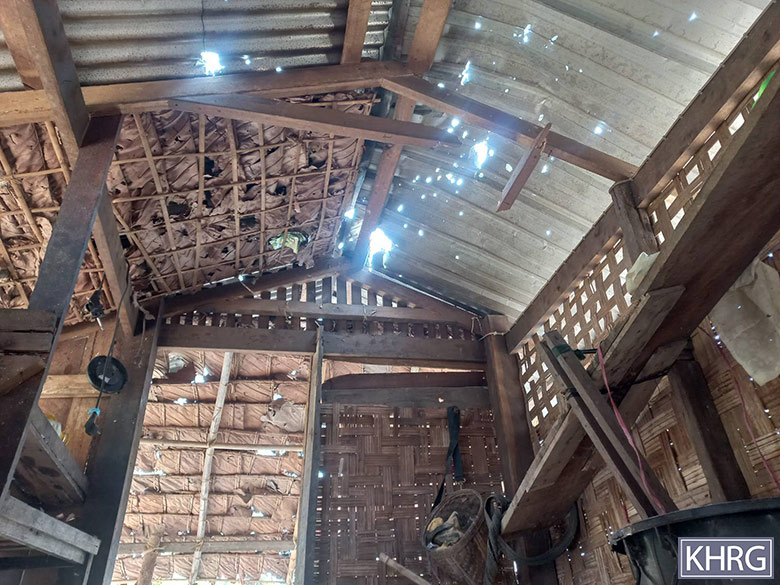
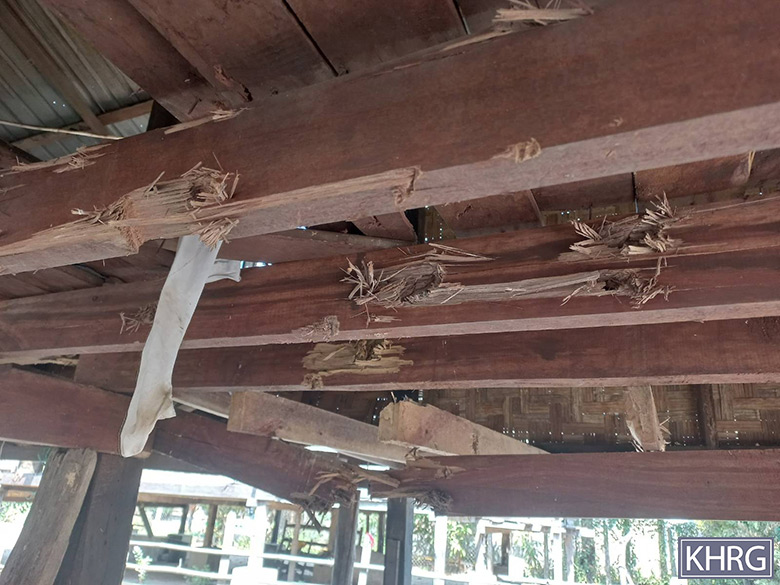
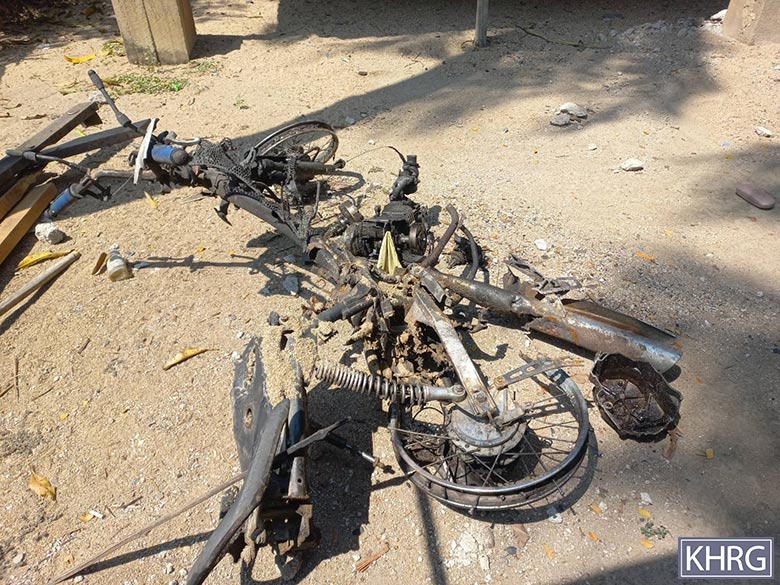


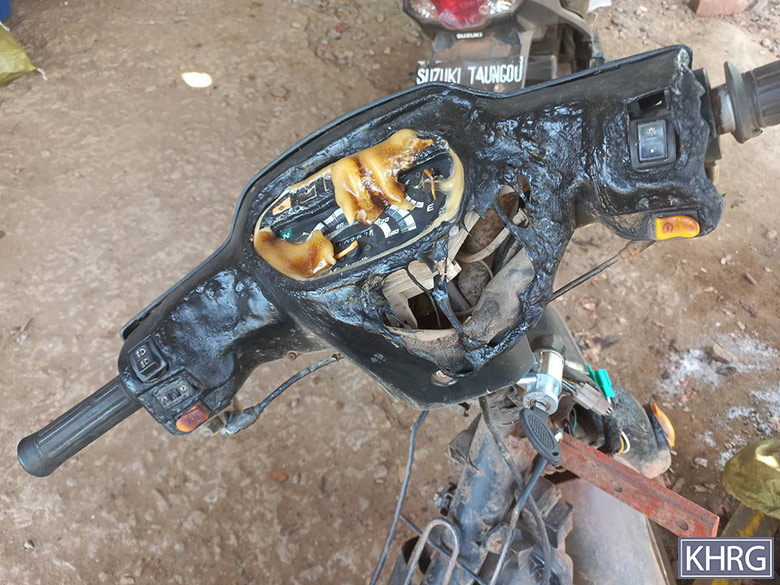
These photos were taken in February 2025, in Kl--- village, Nyaung Pin Tha village tract, Moo (Mone) Township, Kler Lwee Htoo (Nyaunglibin) District. On 18 February 2025, at 8:15 pm, Burma Army Infantry Battalion (IB) #73, based in Zayatgyi Town army camp, indiscriminately fired two howitzer shells into Kl--- village. The photos above show the house of Maung J---, which was damaged by the first shell. The photo below shows the motorbike of U D---, which was destroyed by the second howitzer shell. [Photos: KHRG]
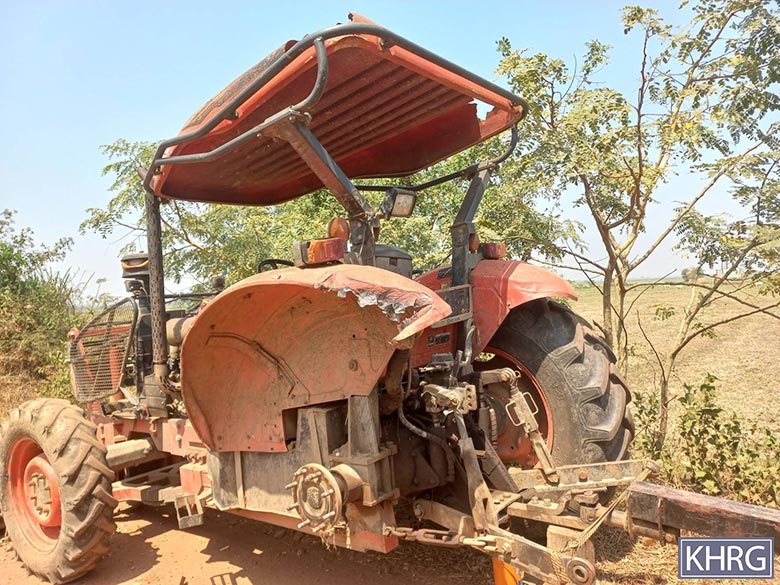
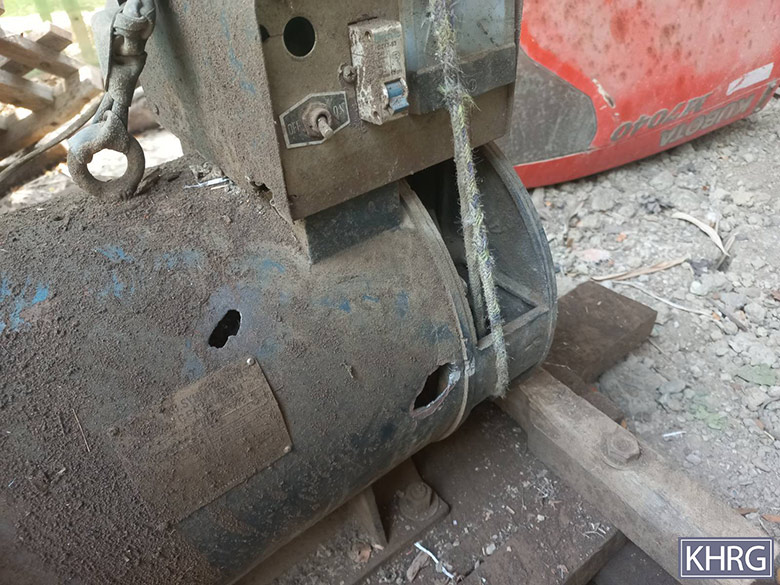
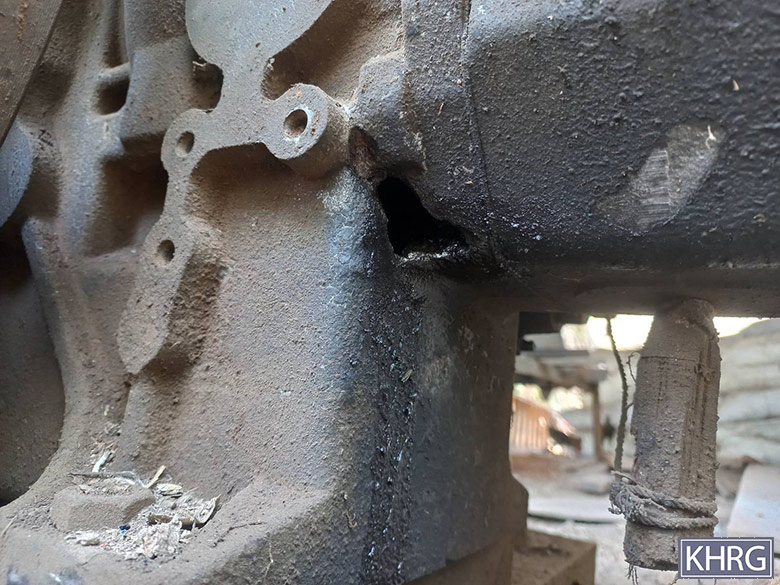
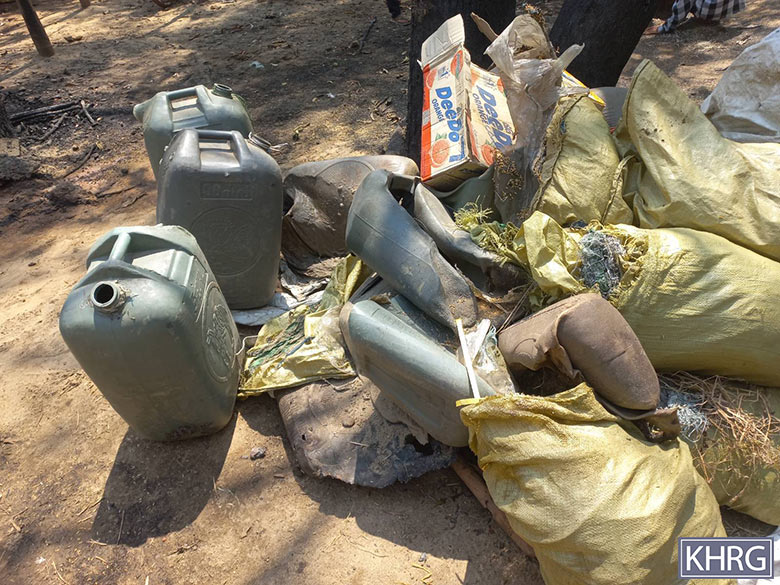
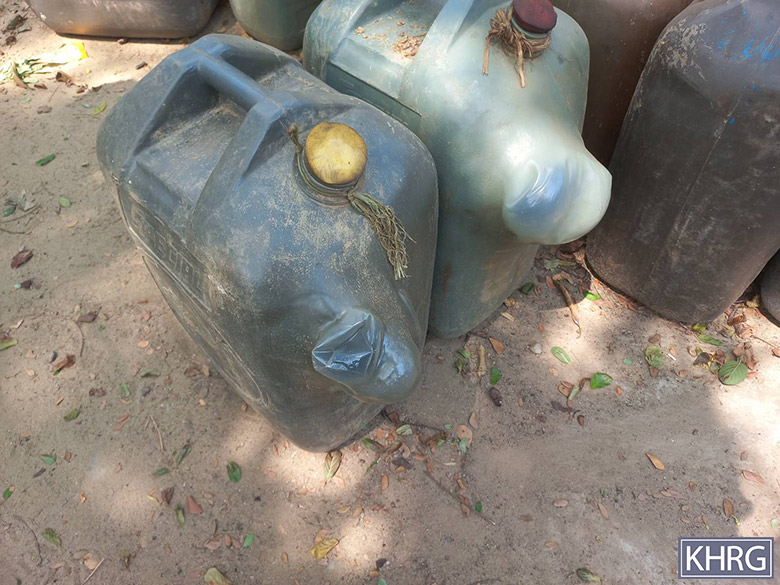
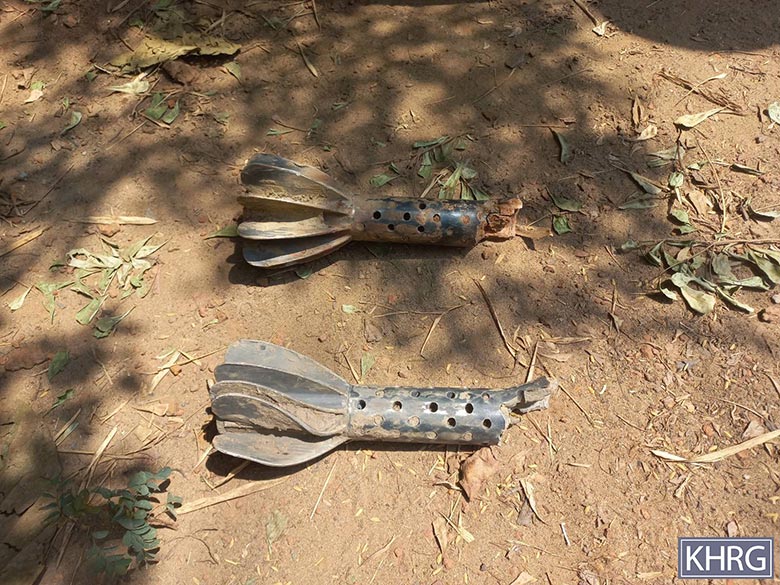
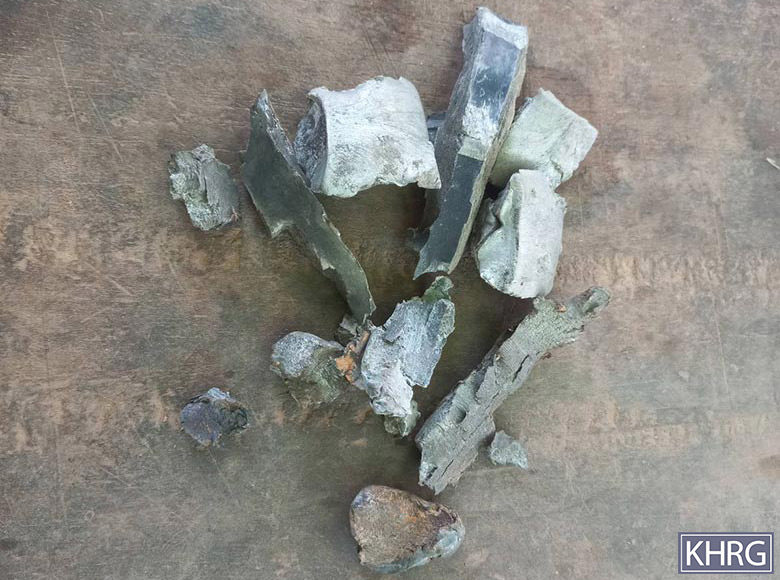


These photos were taken in March 2025, in Tk--- village, Hawh Hkoh Ghaw village tract, Moo Township, Kler Lwee Htoo District. On 3 March 2025, at 8:35 pm, Burma Army Light Infantry Battalion (LIB) #351, based in Ler Doh army camp, fired two 120 mm mortar shells into Tk--- village, and the mortar shells landed in the garden of a Tk--- villager named Saw K---. The four photos above show the tractor and the motorbike of Saw K---, which were damaged by the shelling. The next two photos show containers of diesel and rice sacks, which were also damaged by the shrapnel of the explosion. The photos in the last row show the tails and shrapnel of the mortar shells that landed and exploded in Saw K---’s garden. [Photos: KHRG]
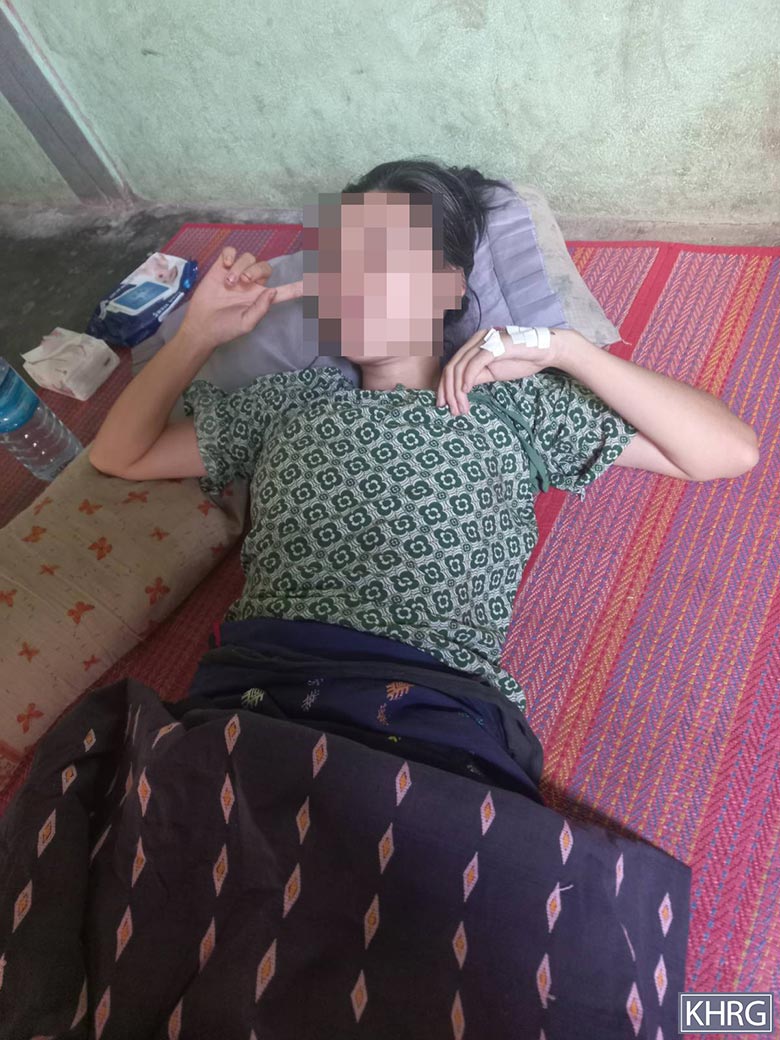
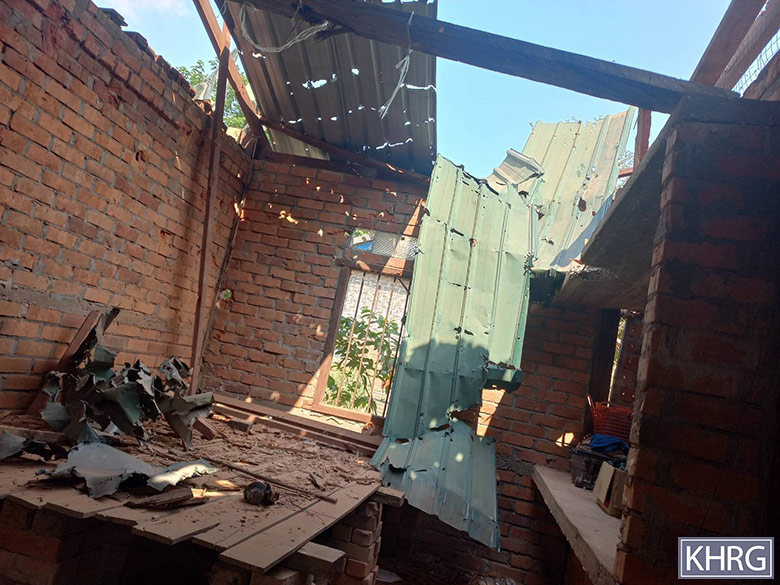


These photos were taken in April 2025, in Tl--- hospital, located in Tl--- village, P’Nah Wah Plaw village tract, Moo Township, Kler Lwee Htoo District. On 3 April 2025, Burma Army Light Infantry Battalion (LIB) #351, based in Ler Doh army camp, indiscriminately fired two mortar shells into Tk--- village, Hawh Hkoh Ghaw village tract, Moo Township. One of the mortar shells landed and exploded on the house of Naw M---, a villager from Tk--- village, and her house roof was destroyed by the explosion. The shrapnel of the explosion also hit the house of Saw T--- and injured his 23-year-old daughter, named Naw L---, on her forehead and left leg. The left photo shows Naw L--- receiving emergency treatment in Tl--- hospital and the right photo shows the roof of Saw T---’s house, which was destroyed by the mortar. [Photos: KHRG]
Footnotes:
[1] The present document is based on information received in February, March, April, and May 2025. It was provided by a community member in Kler Lwee Htoo District who has been trained by KHRG as a researcher to monitor human rights conditions on the ground. The names of the victims, their photos and the exact locations are censored for security reasons. The parts in square brackets are explanations added by KHRG. This document combines several received reports with the following KHRG internal log numbers: #25-75-D1; #25-82-D1; #25-122-D1; #25-136-D1; #25-184-D1; #25-198-D1; and #25-176-S1.
[2] The State Administration Council (SAC) was the name of the executive governing body of the Burma military regime created in the aftermath of the 1 February 2021 military coup. It was established by Senior General Min Aung Hlaing on 2 February 2021 and was composed of eight military officers and eight civilians. The chairperson serves as the de facto head of government of Burma/Myanmar and leads the Military Cabinet of Myanmar, the executive branch of the government. Min Aung Hlaing assumed the role of SAC chairperson following the coup. The military junta changed its name on 31 July 2025 from SAC to State Security and Peace Commission (SSPC), with Min Aung Hlaing retaining his position as chairperson.
[3] The terms Burma military, Burma Army, SAC, Tatmadaw, and junta are used interchangeably throughout this report to describe the Burma military regime’s armed forces. Villagers themselves commonly use Burma Army, Burmese soldiers, or alternatively the name adopted by the Burma military regime at the time —from the 2021 coup to July 2025, the State Administration Council (SAC). On 31 July 2025, the military junta changed its name to the State Security and Peace Commission (SSPC).
[4] An Infantry Battalion (IB) comprises 500 soldiers. However, most Infantry Battalions in the Tatmadaw are under-strength with less than 200 soldiers. Yet up to date information regarding the size of battalions is hard to come by, particularly following the signing of the NCA. They are primarily used for garrison duty but are sometimes used in offensive operations.
[5] A village tract is an administrative unit of between five and 20 villages in a local area, often centred on a large village.
[6] ‘Maung’ is a Burmese male honorific title used before a person’s name.
[7] ‘U’ is a Burmese title used for elder men, used before their name.
[8] ‘Daw’ is a Burmese female honorific title used before a person’s name.
[9] On 2 February 2021, healthcare workers at state-run hospitals and medical facilities across Myanmar spearheaded what is being referred to as a Civil Disobedience Movement (CDM) consisting of labour strikes in protest against the 1 February 2021 military coup. The movement quickly spread to include civil servants from all sectors of the government who are walking off their jobs as a way of non-recognition and non-participation in the military regime. Because of the popularity of the movement, and its seminal role in wider protests across the country, some people have begun using it as a catch-all phrase to include other protest forms like boycotts and pot-banging.
[10] A Light Infantry Battalion (LIB) comprises 500 soldiers. Most Light Infantry Battalions in the Tatmadaw are under-strength with less than 200 soldiers, yet up-to-date information regarding the size of battalions is hard to come by, particularly following the signing of the NCA. LIBs are primarily used for offensive operations, but they are sometimes used for garrison duties.
[11] ‘Saw’ is a S’gaw Karen male honorific title used before a person’s name.
[12] ‘Naw’ is a S’gaw Karen female honorific title used before a person’s name.
[13] The Karen Department of Health and Welfare (KDHW) is the health department of the Karen National Union. It was established in 1956 to address the lack of public healthcare resources in rural Southeast Myanmar. It currently operates a network of community-based clinics in the region, but its capabilities remain limited due to funding constraints.
[14] ‘Ko’ is a Burmese male honorific title used before a person’s name.
[15] The Karen National Union (KNU) is the main Karen political organisation. It was established in 1947 and has been in conflict with the government since 1949. The KNU wields power across large areas of Southeast Myanmar and has been calling for the creation of a democratic federal system since 1976. Although it signed the Nationwide Ceasefire Agreement (NCA) in 2015, following the 2021 coup staged by Burma Army leaders, the KNU officially stated that the NCA has become void.
[16] The People’s Defence Force (PDF) is an armed resistance established independently as local civilian militias operating across the country. Following the February 1st 2021 military coup and the ongoing brutal violence enacted by the junta, the majority of these groups began working with the National Unity Government (NUG), a body claiming to be the legitimate government of Burma/Myanmar, which then formalized the PDF on 5 May 2021 as a precursor to a federal army.
[17] ‘Ma’ is a Burmese female honorific title used before a person’s name.
[18] KHRG, “Kler Lwee Htoo District Incident Report: SAC air strike caused casualties, including a child, and destruction in Moo Township (April 2025)”, December 2025.
[19] All conversion estimates for the kyat in this report are based on the 4 March 2026 official market rate of 2,100 kyats to 1 USD, https://wise.com/gb/currency-converter/usd-to-mmk-rate.
[20] Some villagers express human rights violations or abuses that they have suffered as part of their fate or luck, or express that they should have taken more precautions, rather than directly attributing the abuse or impact to the Burma military regime or other powerful actors who commit these violations. KHRG has not modified the villager’s words to preserve the local voice, while as an organisation also emphasising the overall pattern and source of indiscriminate human rights violations in Southeast Burma.
[21] The Karen National Union's Education and Culture Department is the education department of the Karen National Union. Its main goals are to provide mother tongue education services to rural Karen populations in Southeast Burma, as well as to preserve the Karen language, culture, and history. Despite being an important education provider in the region, it is not officially recognised by the Burma government.

