
 English
 ကညီကျိာ်
 မြန်မာ
 Print:
This Incident Report describes an event that occurred in Hsaw Htee (Shwegyin) Township, Kler Lwee Htoo (Nyaunglebin) District. On May 11th 2025, at around 7:20 am, a State Administration Council (SAC) fighter jet dropped a 500-pound bomb on a high school compound in Aa--- village, Pyin Yay village tract, Hsaw Htee Township. One villager, named Ko A---, was injured in the waist and on the back of his shoulders while he was sleeping in his house, located near the high school compound. The air strike also damaged six villagers’ houses and the high school building. As a result, Ko A--- and his wife, Ma B---, remain constantly afraid of air strikes. They sometimes stay in the forest when they hear aircraft, fearing further attacks.[1]
Part 1 – Incident Details
|
Type of Incident |
Air strike [on a school compound.] |
|
Date of Incident(s) |
May 11th 2025 |
|
Incident Location (Village, Township and District) |
Aa--- village, Pyin Yay village tract[2], Hsaw Htee Township, Kler Lwee Htoo District. |
|
Victim Information |
|
|
Name |
Ko[3] A--- |
|
Age |
39 years old |
|
Gender |
Man |
|
Ethnicity |
Bamar[4] |
|
Marital Status |
Married |
|
Occupation |
Farmer |
|
Religion |
Buddhist |
|
Position |
Villager |
|
Village |
Aa--- village, Pyin Yay village tract, Hsaw Htee Township, Kler Lwee Htoo District. |
|
Perpetrator Information (Armed Actors) |
|||
|
Type of Aircraft |
Unit |
Base |
Commander’s Name |
|
Fighter jet |
Burma [State Administration Council (SAC)[5]] Air Force |
Toungoo air base, in Taw Oo District. |
[General Htun Aung serves as the Commander-in-Chief of the Burma Army[6] Air Force] |
Part 2 - Information Quality
|
1. Explain in detail how this information was collected. |
|
On May 26th 2025, a KHRG field researcher heard [about the air strike incident] from a Karen National Union (KNU)[7] officer with authority [in Kler Lwee Htoo District]. The researcher then contacted a local authority [from Aa--- village, Pyin Yay village tract] who confirmed the incident. A few days later, the researcher went to the village and conducted an interview with [the wife of] the injured villager. [The victim was also present during the interview]. |
|
2. Explain how the source verified this information. |
|
The information was given by a village authority [village head of Aa--- village] and a regional [KNU] authority. The researcher met with the victim in person to document the air strike incident [and interviewed his wife for detailed information]. [Moreover, the researcher also took pictures of the damage and the scar of Ko A---]. Thus, this information has been verified. |
Part 3 – Complete Description of the Incident
|
Describe the Incident(s) in complete detail. |
|
On May 11th 2025, at 7:20 am, an SAC [State Administration Council]’s fighter jet flew over [conducted air reconnaissance above] Aa--- village, Pyin Yay village tract, three times. [Villagers believe that the aircraft came from Toungoo Town]. The third time, it dropped a 500-pound bomb, which landed and exploded behind Aa--- high school [inside the school’s compound] in Aa--- village. [The high school is run by the Karen Education and Culture Department (KECD)[8]]. [In addition to damaging the school building,] the bomb’s shrapnel went through the window of the house of Ko A---, a 39-year-old villager [who lived near the school’s compound], and hit him on his waist and the back of his shoulders, causing minor injuries. [The house was also slightly damaged].
On that day, Ko A--- and [his wife] Ma[9] B--- were inside their house, located close to the high school. [In an interview with KHRG,] Ma B--- explained: “Ko A--- was sleeping inside the kitchen and I was fetching water up and down after I had finished cooking. When the aircraft came, I was aware that the sounds of the aircraft were different from before [when it was just passing by]. The sounds were not as loud as other aircraft. The sounds were similar to conducting air reconnaissance over the village. I told Ko A--- to come downstairs [of the stilted house], because I did not feel that safe. The sounds that the aircraft made were like conducting air reconnaissance over our village. When I was speaking, he was still sleeping. As soon as I finished speaking, the aircraft came closer to the ground. When he [Ko A---] came down, it was too late for him. He got hit. He was in the kitchen. But for me, I was not injured. Because when I heard the sounds [of the aircraft], I rushed [to take cover] under the house. He rushed to come down too, but it was too late for him.” He was not injured severely, thus he recovered rapidly. He was treated [by a health worker from the Karen Department of Health and Welfare (KDHW)[10]] in a PDF [People’s Defence Force[11]] medical clinic located in the village. He did not have to pay for the treatment.
In addition, the air strike also damaged the high school building [walls and roof] and five villagers’ houses. The damaged houses are owned by villagers named U[12] C---, U D---, U E---, Daw[13] F---, and U G---.
Ma B--- explained that, prior to the incident, PDF [soldiers] had taken shelter in that high school for a short period of time. When the PDF [soldiers] were staying in the school [in the past], another air strike happened. [The first air strike happened approximately one month prior to the incident on May 11th 2025.] However, PDF [soldiers] were not staying in the school when the second air strike happened. Villagers said that air strikes occur when armed resistance groups [PDF] are in the village. However, the second air strike happened when the PDF [soldiers] were not in the village.
Ma B--- also expressed that, after the air strike incident, she feels scared. She does not dare to stay inside the house for long. She mostly stays under the house. She shakes uncontrollably when she hears the sound of an aircraft. She does not run if the aircraft just passes over the village. She and her husband [sometimes] go and stay in the forest, somewhere [they consider] safe, when they feel unsafe living in the village.
Now, Ko A--- has recovered from his injuries, but it seems he is traumatised. He is frightened [of aircraft] all the time. All villagers have been afraid throughout this year. The village has already been attacked twice by aircraft. It is the rainy season, and, unlike in the summer, it is not easy to run away from the village. [Therefore,] villagers face difficulties. |
Part 4 - Permission for Using the Details
|
Did the victim(s) provide permission to use this information? Explain how that permission was provided. |
|
A KHRG field researcher interviewed the wife of the victims who was injured by the air strike, and the victim himself allowed this information to be documented [and published]. [Ma B---, the wife, also gave permission to KHRG to use this information as needed]. |
Further background reading on the situation on air strikes in Southeast Burma/Myanmar can be found in the following KHRG reports:
- Stolen Childhoods: Violations of children’s rights, urgent needs, and local agency in rural Southeast Burma during the conflict, October 2025.
- “Dooplaya District Incident Report: an SAC air strike killed two villagers in Kaw T’Ree Township (March 2025)”, May 2025.
- “Mu Traw District Incident Report: SAC air strikes cause death, injuries, displacement, and destruction in Bu Tho Township (January 2025)”, July 2025.
- Community spaces under fire : Attacks and destruction of community buildings and cultural events in Southeast Burma by the State Administration Council (SAC) (January - June 2025), August 2025.
- ကဘီယူၤဟဲလံ Aircraft coming! : Impacts of air strikes on local communities and villagers’ protection strategies in Southeast Burma since the 2021 coup, November 2024.

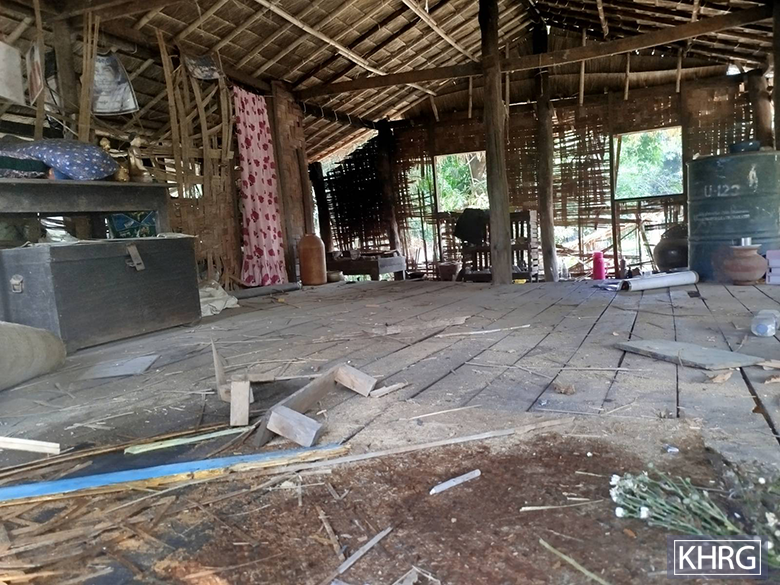
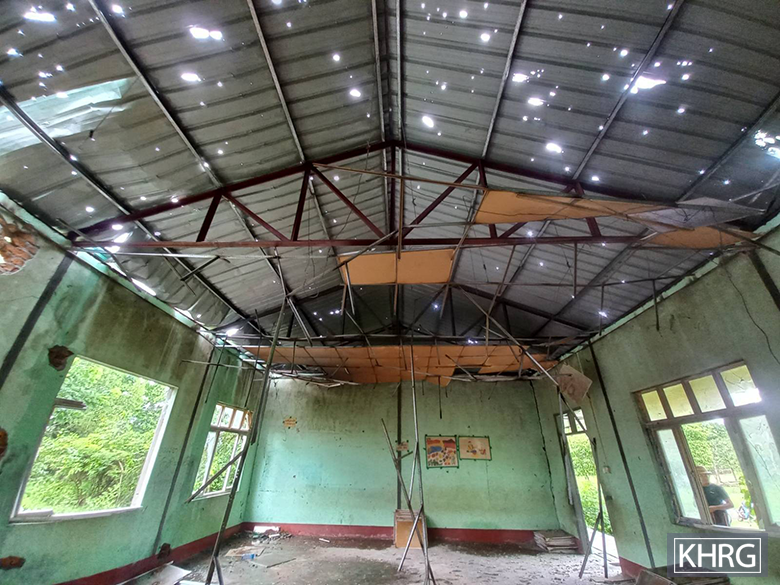
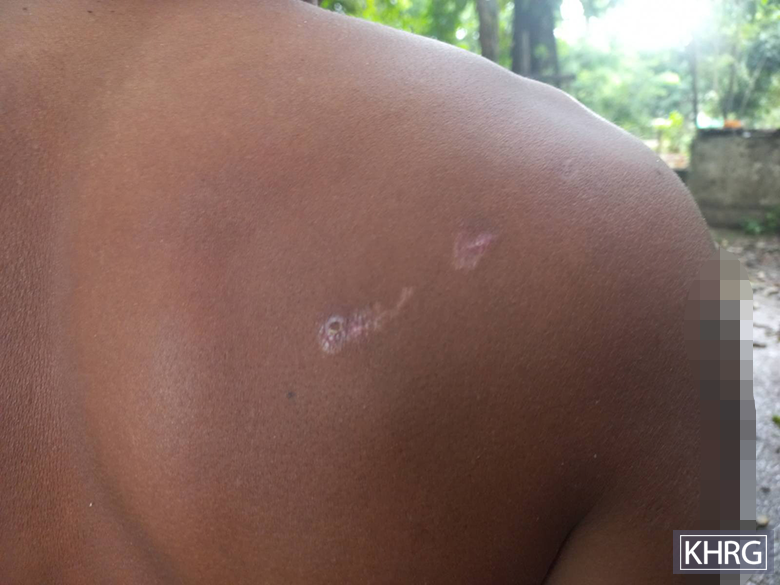


These photos were taken in May 2025, at Aa--- village, Pyin Yay village tract, Hsaw Htee Township, Kler Lwee Htoo District. The photos show the aftermath of an air strike conducted by the SAC on a high school compound on May 11th 2025, injuring a villager and damaging villagers’ property. The two photos at the top row show the high school’s roof, full of holes, and the ceiling collapsing as a result of the air strike. The photo on the middle row, left side, shows the school’s walls and windows damaged, while the photo on the middle right shows a villager named Ko A---, who was injured on his shoulder by the air strike’s shrapnel. The two photos in the bottom row show nearby villagers’ houses that were damaged due to the air strike. [Photos: KHRG]
Footnotes:
[1] The present document is based on information received in June 2025. It was provided by a community member in [Kler Lwee Htoo District] who has been trained by KHRG to monitor human rights conditions on the ground. The names of the victims, their photos and the exact locations are censored for security reasons. The parts in square brackets are explanations added by KHRG. This document combines several received reports with the following KHRG internal log numbers: #25-210-D1, #25-210-I1, and #25-210-A2-I1.
[2] A village tract is an administrative unit of between five and 20 villages in a local area, often centred on a large village.
[3] ‘Ko’ is a Burmese title meaning older brother. It can be used for relatives as well as non-relatives.
[4] The majority ethnic group in Myanmar, also known as ethnic Burmese or Burman.
[5] The State Administration Council (SAC) is the executive governing body created in the aftermath of the February 1st 2021 military coup. It was established by Senior General Min Aung Hlaing on February 2nd 2021, and is composed of eight military officers and eight civilians. The chairperson serves as the de facto head of government of Burma/Myanmar and leads the Military Cabinet of Myanmar, the executive branch of the government. Min Aung Hlaing assumed the role of SAC chairperson following the coup. The military junta changed its name in July 31st 2025 to State Security and Peace Commission (SSPC).
[6] The terms Burma military, Burma Army, Tatmadaw and SAC are used interchangeably throughout this report to describe Burma’s armed forces. Villagers themselves commonly use Burma Army, Burmese soldiers, or alternatively the name adopted by the Burma military regime at the time - since the coup, the State Administration Council (SAC).
[7] The Karen National Union (KNU) is the main Karen political organisation. It was established in 1947 and has been in conflict with the government since 1949. The KNU wields power across large areas of Southeast Myanmar and has been calling for the creation of a democratic federal system since 1976. Although it signed the Nationwide Ceasefire Agreement (NCA) in 2015, following the 2021 coup staged by Burma Army leaders, the KNU officially stated that the NCA has become void.
[8] The Karen Education and Culture Department is the education department of the Karen National Union. Its main goals are to provide mother tongue education services to rural Karen populations in Southeast Myanmar, as well as to preserve the Karen language, culture and history. Despite being an important education provider in the region, it is not officially recognised by the Myanmar government.
[9] ‘Ma’ is a Burmese female honorific title used before a person’s name.
[10] The Karen Department of Health and Welfare (KDHW) is the health department of the Karen National Union. It was established in 1956 to address the lack of public healthcare resources in rural Southeast Myanmar. It currently operates a network of community-based clinics in the region, but its capabilities remain limited due to funding constraints.
[11] The People’s Defence Force (PDF) is an armed resistance established independently as local civilian militias operating across the country. Following the February 1st 2021 military coup and the ongoing brutal violence enacted by the junta, the majority of these groups began working with the National Unity Government (NUG), a body claiming to be the legitimate government of Burma/Myanmar, which then formalized the PDF on May 5th 2021 as a precursor to a federal army.
[12] ‘U’ is a Burmese title used for elder men, used before their name.
[13] ‘Daw’ is a Burmese female honorific title used before a person’s name.


