
 English
 ကညီကျိာ်
 မြန်မာ
 Print:
This Incident Report describes events occurring in Bu Tho Township, Mu Traw (Hpapun) District, in January 2025. On January 28th 2025, the State Administration Council (SAC) carried out an air strike on W--- village, located in Kyaw Pa village tract, Bu Tho Township. The attack caused several casualties: four villagers (including one child and two women) were killed, while six others (including two children and three women) were injured. Additionally, five houses were completely burned down by the air strike. As a consequence, all residents of W--- village were forced to flee. These displaced villagers need food, shelter, and healthcare support in their current hiding locations in Bu Tho Township, although they received some initial support from a civil society organisation. On that same day, January 28th 2025, the SAC also conducted an air strike on nearby R--- village, in Kyaw Pa village tract, destroying a monastery and several other buildings. As a result, villagers from R--- fled to the forest to escape further attacks.[1]
Part 1 – Incident Details
|
Type of Incident |
Air strikes [causing death and injury] |
|
Date of Incident(s) |
January 28th 2025 |
|
Incident Location (Village, Township and District) |
W--- village [and R--- village], Kyaw Pa village tract[2], Bu Tho Township, Mu Traw District. |
|
Victim(s) Information [killed] |
||||
|
Name |
Naw[3] A--- |
Saw[4] G--- |
Naw Y--- |
Saw H--- |
|
Age |
46 years old |
30 years old |
26 years old |
3 years old |
|
Gender |
Woman |
Man |
Woman |
Boy |
|
Ethnicity |
Karen |
Karen |
Karen |
Karen |
|
Marital Status |
Married |
Married |
Married |
- |
|
Occupation |
Farmer |
Farmer |
Farmer |
- |
|
Religion |
Roman Catholic (RC) |
Buddhist |
Buddhist |
Buddhist |
|
Position |
Villager |
Villager |
Villager |
Villager |
|
Village |
W--- village, Kyaw Pa village tract |
W--- village, Kyaw Pa village tract |
W--- village, Kyaw Pa village tract |
W--- village, Kyaw Pa village tract |
|
Victim(s) Information [injured] |
||||||
|
Name |
Naw N--- |
Saw T--- |
Saw E--- |
Naw C--- |
Naw I--- |
Naw M--- |
|
Age |
36 years old |
10 years old |
45 years old |
50 years old |
4 years old |
31 years old |
|
Gender |
Woman |
Boy |
Man |
Woman |
Girl |
Woman |
|
Ethnicity |
Karen |
Karen |
Karen |
Karen |
Karen |
Karen |
|
Marital Status |
Married |
- |
Married |
Married |
- |
Married |
|
Occupation |
Farmer |
Student |
Farmer |
Farmer |
Student |
Farmer |
|
Religion |
Buddhist |
Buddhist |
Buddhist |
Buddhist |
Buddhist |
Buddhist |
|
Position |
Villager |
Villager |
Villager |
Villager |
Villager |
Villager |
|
Village |
W--- village, Kyaw Pa village tract |
W---village, Kyaw Pa village tract |
W---village, Kyaw Pa village tract |
W---village, Kyaw Pa village tract |
W---village, Kyaw Pa village tract |
W---village, Kyaw Pa village tract |
|
Perpetrator Information (Armed Actors) |
||||
|
Name(s) |
Rank |
Unit |
Base |
Commander’s Name |
|
State Administration Council (SAC)[5] [Air force] |
Unknown |
Air force [under the command of the SAC] |
Unknown |
[General Tun Aung serves as the Commander-in-Chief of the Burma Army Air Force] |
Part 2 - Information Quality
|
1. Explain in detail how this information was collected. |
|
On January 29th 2025, I [a KHRG field researcher] conducted an interview with Saw O---, who is the relative [nephew] of the victim Naw A---, who was killed by the air strike. A second interview was conducted with the village head of W--- village, named Saw D---, who witnessed the air strike which took place on January 28th 2025 on W--- village. [He also provided the information about the air strike in nearby R--- village.] |
|
2. Explain how the source verified this information. |
|
The first person [Saw O---] who provided me [KHRG field researcher] with the information knew about the incident because one of the siblings [name unknown] who was watching over the house phoned him after the incident. He is the relative of the victim Naw A---. The second person who provided me [KHRG field researcher] with the information knew about the incident because he is the W--- village head and he witnessed the air strike that happened in the village. [And heard about the incident in R--- village and saw the destruction afterwards.] |
Part 3 – Complete Description of the Incident
|
Describe the Incident(s) in complete detail. |
|
SAC air strike on W--- village, Kyaw Pa village tract: On January 28th 2025, between 5 and 6 pm, an SAC aircraft dropped four 500-pound bombs onto W--- village, Kyaw Pa village tract, Bu Tho Township, Mu Traw District. [Villagers stated the bombs were likely 500-pound bombs given the amount of destruction in the village and the size of bomb craters]. Due to the [SAC] air strike, four W--- villagers (including one child) were killed and six more were injured (including one child). The air strike also caused destruction of houses and displacement.
[Villagers stated that they believed] the air strike was in response to the attack by the Karen National Liberation Army (KNLA)[6] troops combined [with People’s Defence Forces (PDF)[7]] on the SAC army camp based at K’Ter Tee village tract, Dwe Lo Township.
The villagers who were killed by the [SAC] air strike are: 1. Naw A--- (46 years old), 2. Saw G--- (30 years old), 3. Naw Y--- (26 years old), and 4. Saw H--- (3 years old).
Naw A--- left behind her husband, named Saw B---, and their two daughters and two sons. Saw G--- and Naw Y--- were husband and wife. Saw H--- was their child. All four [Naw A---, Saw G---, Naw Y--- and Saw H---] were burned to death and killed immediately inside their houses [by the SAC air strike]. The local villagers including the village head managed to cremate the dead bodies of these villagers and pray for them.
The villagers who were injured are: 1. Naw N--- (36 years old), 2. Saw T--- (10 years old), 3. Saw E--- (45 years old), 4. Naw C--- (50 years old), 5. Naw I--- (4 years old), and 6. Naw M--- (31 years old).
[They were all injured by shrapnel from the explosion of the bombs while inside their houses, although it is unknown how severe the injuries were.] Medics from the KNLA arranged and sent these people to treatment places. Those with less severe injuries were treated within the KNU [Karen National Union (KNU)[8]] administrative area, while those with serious injuries were transported to Thailand [for treatment]. [As of June 18th 2025, the current condition of the injured victims is unknown.]
Five houses were burned down completely by the SAC air strike, owned by Saw B--- (50 years old) [and Naw A---, who was killed]; Saw G--- (30 years old) [and Naw Y---, who were killed]; Saw J--- (55 years old); Saw E--- (45 years old) [who was injured]; and Saw K--- (30 years old). According to the villagers, the estimated prices of two of the houses, which were in good condition, including the materials destroyed inside of the houses, is over 100 million Kyats [USD 47,619][9] each. The three other houses that were burned down were estimated to be worth 60 million Kyats [USD 28,571.40] each. There were also several other houses which were damaged due to the air strike [although the exact number is unknown].
[The Karen Women’s Organisation (KWO)[10] has provided 200,000 Kyats [USD 95.24] as support to each family whose house burned down.]
Saw O---, a villager from W--- village, Kyaw Pa village tract, [and family member of Naw A---, one of the victims], reported to KHRG: “Indigenous Karen elder people predicted that the aircraft would come [by using traditional practices], but they didn’t know which day it was going to come. The KNU organisation also warned us to be vigilant [about potential SAC air strikes].” Saw O--- added: “We didn’t know when the aircraft was going to come. It came in the evening by the time I was eating rice. I did not see [it].”
SAC air strike on R--- village, Kyaw Pa village tract: On the same day [January 28th 2025], the SAC conducted an air strike onto R--- village, Kyaw Pa village tract, Bu Tho Township, and a monastery and other buildings were destroyed. Some houses were also destroyed. However, there were no casualties amongst monks and villagers because R--- villagers heard about the air strike that took place in W--- and fled from their village before the SAC air strike on their village.
Situation during displacement: After the incident [air strike in W--- village], villagers [from all 60 houses in W--- village] fled to the forest, river sources, and caves. As they have to stay uncomfortably [at places where they fled], they have faced difficulties in terms of [securing] food, healthcare, and education. This is the time of the year when villagers must clean [clear weeds, grasses and bushes] on their agricultural land, and it is not easy for them to travel to their plots and prepare them [agricultural land for farming].
In terms of food [for the displaced villagers], they asked for food from their fellow villagers [villagers shared food among themselves]. The Mutraw Community Development and Management Committee (MCDMC)[11] also distributed one box of rice per person to each family. This was enough rice for villagers to survive for one month. Villagers had been displaced for one week [at the time of the interview].
[As of June 9th 2025,] W--- villagers remain displaced in the forest. Saw D--- [the village head] from W--- village, Kyaw Pa village tract, said: “W--- villagers used to secure their livelihoods by working on their hill farmlands. However, they did not have enough food from the farming products, so they had to go to N--- village [located nearby] to buy rice.” [N--- village is located in K’Ter Tee village tract, Dwe Lo Township. After fighting and air strikes occurred in R--- village, located near N--- village, W--- villagers have been unable to travel there to buy food.]
The temporary school at the displacement site for W--- villagers [located in the forest] and the high school, located in Q--- village [Kyaw Pa village tract], are still open. [After fleeing, villagers opened a temporary school at their displacement site to replace the school in W--- village, which closed after the air strike. The school in W--- village only goes until Grade 4, so older students normally would travel to Q---- village, Kyaw Pa village tract, around a one-hour walk, to attend a high school.] However, now, parents do not feel confident enough to let their children study at the high school in Q--- village, far away [from their displacement site] due to this incident. Saw O---, from W--- village, Kyaw Pa village tract, said: “We were unable to open the school [the elementary school in W--- village] as the aircraft conducted reconnaissance once every two or three days.”
There is also a need for healthcare treatment, for children and elderly people who are sleeping in the forest and in cold weather. They are afraid to light fires [because they are worried that it will attract the SAC’s attention] and need medicine [while they are displaced in the forest]. They are also afraid that the smoke from the bombs’ explosions will cause diseases. For accommodation, [villagers] need roofing materials as there are many places that do not have leaves [locally known as ‘K’Haw La’ (wild palm tree), leaves traditionally used for thatching].
The families of those injured or killed need much support. People who were injured need support such as medicine, food, and shelter to keep them safe from the threat of further air strikes. There are also children among the injured, and they also need care. |
Part 4 - Permission for Using the Details
|
Did the victim(s) provide permission to use this information? Explain how that permission was provided. |
|
The nephew of [one of the killed victims] Naw A---, named Saw O---, and the village head of W--- village, Saw D---, allowed KHRG to use the information. Relatives [siblings] of the injured victims also gave KHRG permission to use the information. |
Further background reading on the situation on Air strikes in Mu Traw District in Southeast Burma/Myanmar can be found in the following KHRG reports:
- ကဘီယူၤဟဲလံ Aircraft coming! : Impacts of air strikes on local communities and villagers’ protection strategies in Southeast Burma since the 2021 coup, November 2024.
- “Mu Traw District Short Update: SAC air strikes destroying civilian houses and property and causing displacement and livelihood challenges in Bu Tho and Dwe Lo Townships (April 2024)”, February 2025.
- “Mu Traw District Incident Report: SAC shelling and air strikes killed one villager and injured another in Dwe Lo Township, December 2024”, June 2025.
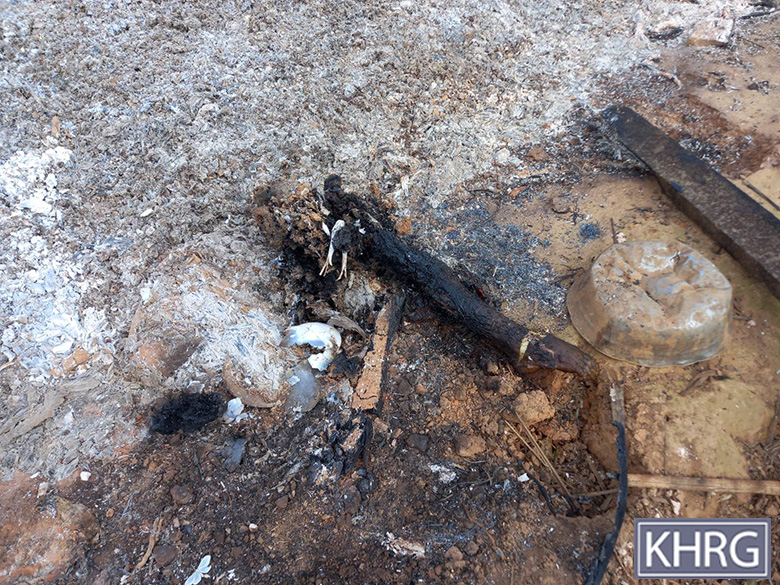
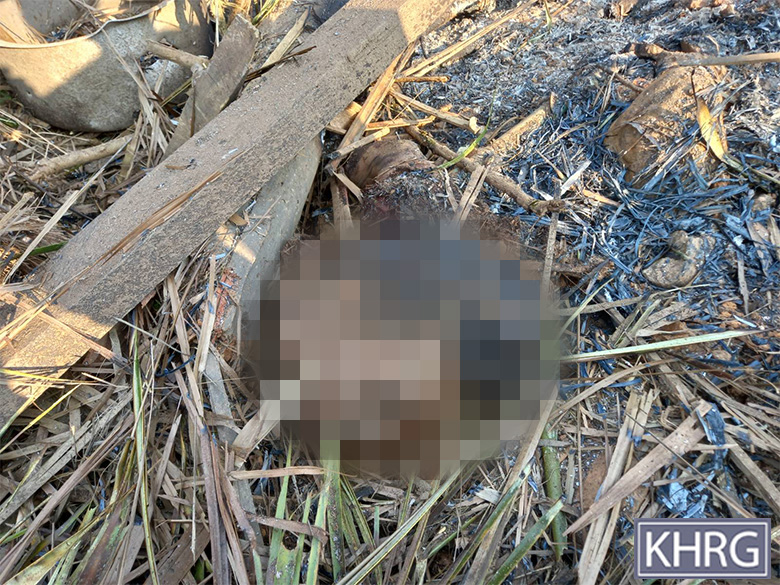

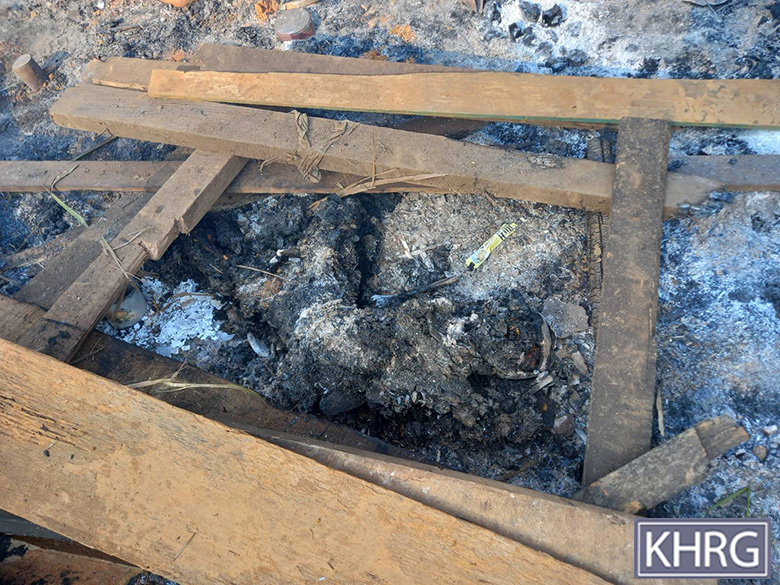


These photos were taken in January 2025 in W--- village, Kyaw Pa village tract, Bu Tho Township, Mu Traw District. These photos show remains of the dead bodies of four villagers who were burned and killed by the air strike conducted by the SAC on January 28th 2025 on W--- village. [Photos: KHRG]

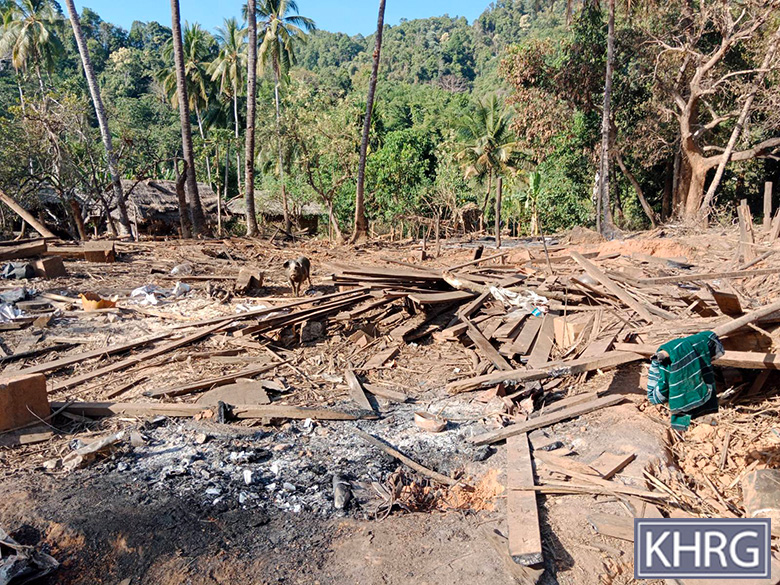
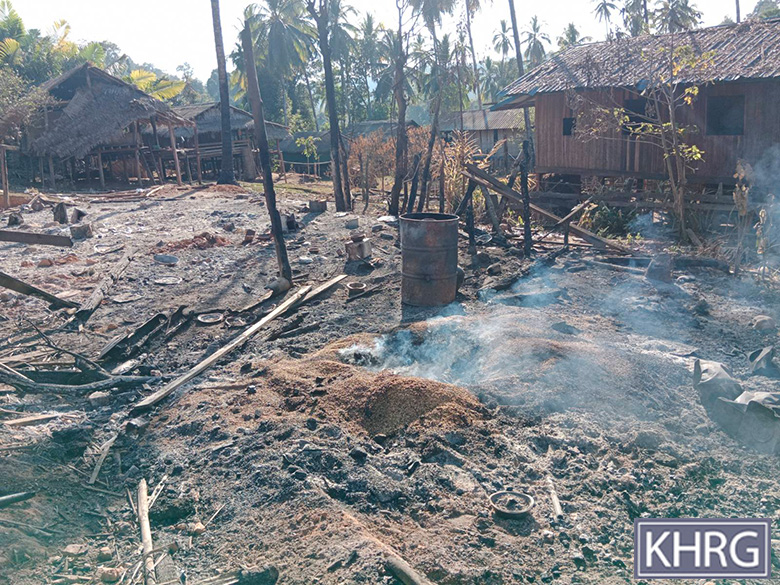
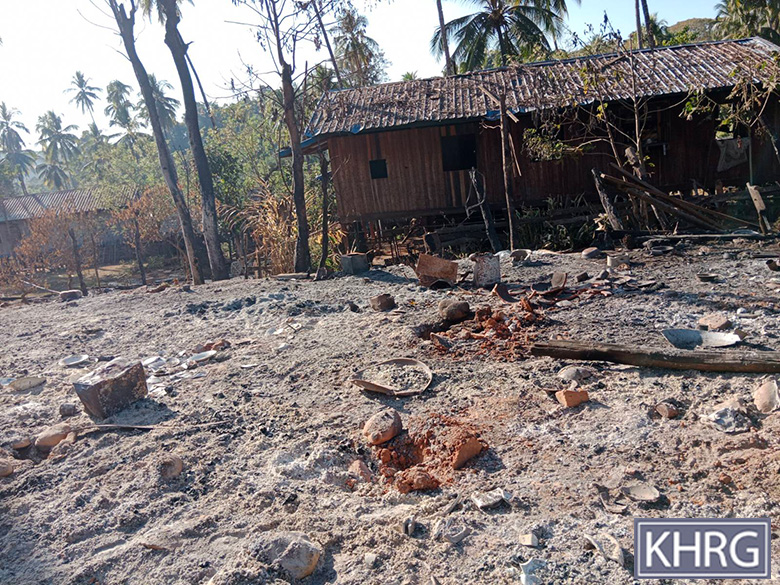



These photos were taken in February 2025 in W--- village, Kyaw Pa village tract, Bu Tho Township, Mu Traw District. These photos show the remains of the five houses that were burned down and destroyed by the SAC air strike conducted on January 28th 2025 in W--- village. [Photos: KHRG]
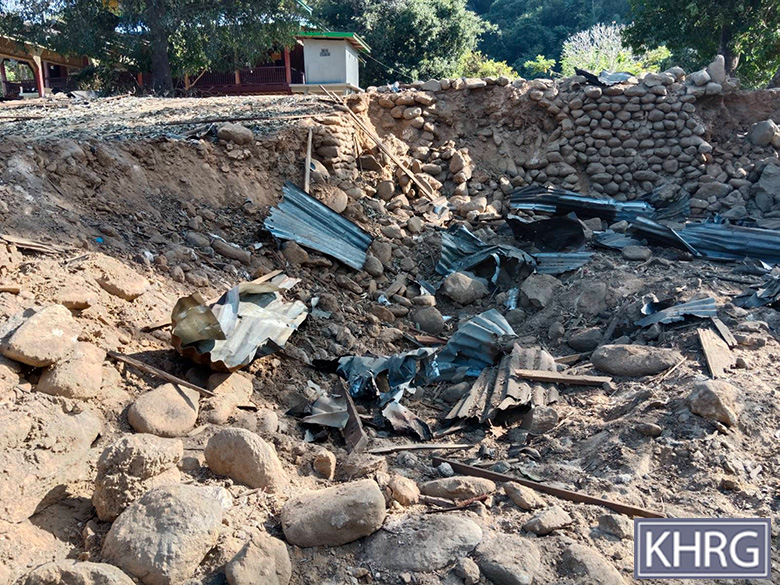
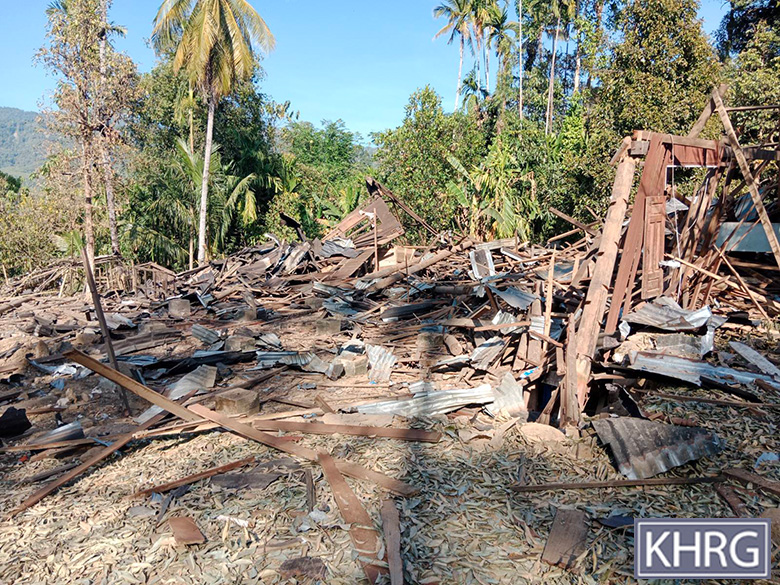
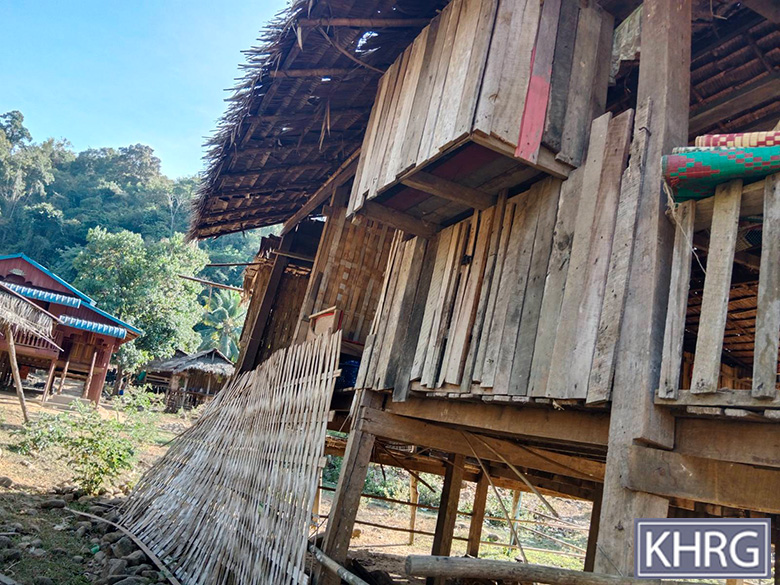


These three photos were taken in February 2025 in R--- village, Kyaw Pa village tract, Bu Tho Township, Mu Traw District. The two photos on the top show the monastery in R--- village that was destroyed by the air strike that happened on January 28th 2025, in R--- village. The photo on the left (bottom row) shows a house in R--- that was damaged due to the air strike. [Photos: KHRG]

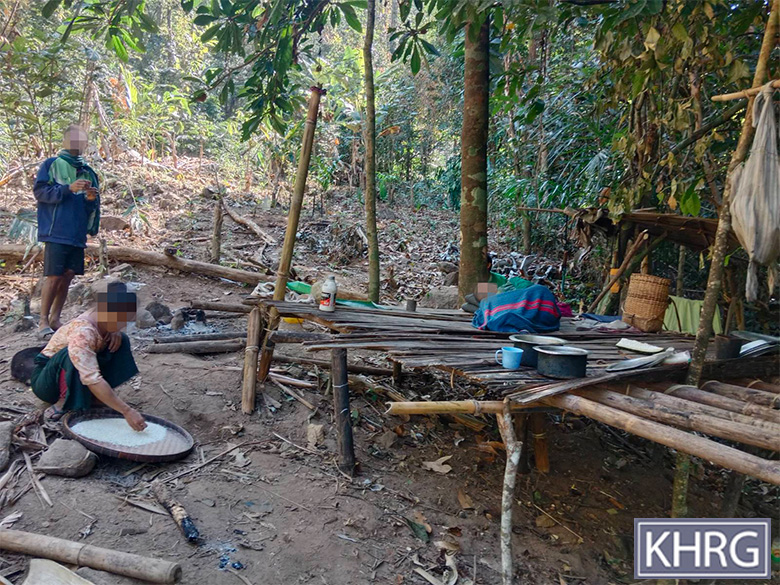


These two photos were taken in February 2025 in the forest near R--- village, Kyaw Pa village tract, Bu Tho Township, Mu Traw District. These photos show displaced R--- villagers. They are staying in the forest due to the SAC air strike that happened on January 28th 2025 in R--- village and on the nearby W--- village. [Photos: KHRG]
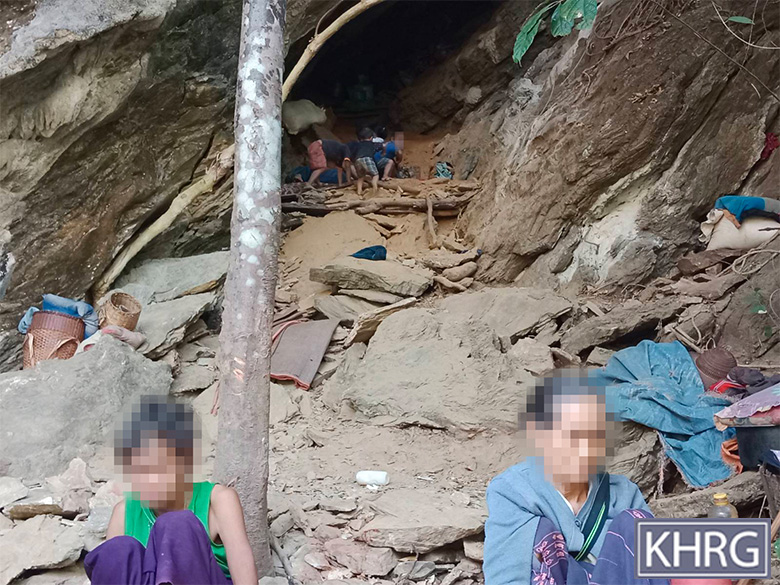


These photos were taken in February 2025 in a forest near W--- village, Kyaw Pa village tract, Bu Tho Township, Mu Traw District. These photos show W--- villagers displaced due to the SAC air strike that happened on January 28th 2025 in W--- village. In the photos, they are staying at the bottom of a valley and in a cave. [Photos: KHRG]
Footnotes:
[1] The present document is based on information received in January 2025. It was provided by a community member in Mu Traw District who has been trained by KHRG to monitor human rights conditions on the ground. The names of the victims, their photos and the exact locations are censored for security reasons. The parts in square brackets are explanations added by KHRG. This document combines several received reports with the following KHRG internal log numbers: #25-58-I2, #25-58-I3, #25-58-A4-I1, and #25-58-A5-I1.
[2] A village tract is an administrative unit of between five and 20 villages in a local area, often centred on a large village.
[3] Naw is a S’gaw Karen female honorific title used before a person’s name.
[4] ‘Saw’ is a S’gaw Karen male honorific title used before a person’s name.
[5] The State Administration Council (SAC) is the executive governing body created in the aftermath of the February 1st 2021 military coup. It was established by Senior General Min Aung Hlaing on February 2nd 2021, and is composed of eight military officers and eight civilians. The chairperson serves as the de facto head of government of Burma/Myanmar and leads the Military Cabinet of Myanmar, the executive branch of the government. Min Aung Hlaing assumed the role of SAC chairperson following the coup.
[6] The Karen National Liberation Army is the armed wing of the Karen National Union.
[7] The People’s Defence Force (PDF) is an armed resistance established independently as local civilian militias operating across the country. Following the February 1st 2021 military coup and the ongoing brutal violence enacted by the junta, the majority of these groups began working with the National Unity Government (NUG), a body claiming to be the legitimate government of Burma/Myanmar, which then formalized the PDF on May 5th 2021 as a precursor to a federal army.
[8] The Karen National Union (KNU) is the main Karen political organisation. It was established in 1947 and has been in conflict with the Burma/Myanmar government since 1949. The KNU wields power across large areas of Southeast Myanmar and has been calling for the creation of a democratic federal system since 1976. Although it signed the Nationwide Ceasefire Agreement in 2015, relations with the government remain tense.
[9] All conversion estimates for the kyat are based on the June 24th 2025 mid-market exchange rate of 1,000 kyats to USD 0.48 (taken from https://wise.com/gb/currency-converter/mmk-to-usd-rate).
[10] The Karen Women’s Organisation (KWO) is a Karen community-based organisation formed in 1949 to support women in its operational areas across locally-defined Karen State and in refugee camps along the Thai-Burma border. KWO works to empower women, fights against all forms of oppression of women and children, and provides support for communities in their operational areas. The organisation promotes women’s leadership, gender sensitivity, and runs health and education programs.
[11] Mutraw Community Development and Management Committee (MCDMC) is a KNU-affiliated body that focuses on supporting internally displaced persons (IDPs) in Mu Traw District. Specifically, they have been involved in purchasing and distributing essential supplies like rice to vulnerable IDPs seeking refuge in the jungle. They also work to monitor the situation of IDPs who are under threat from attacks. They also help coordinate with civil society organisations, NGOs, INGOs, and community-based organizations working on development and humanitarian issues in Mu Traw District.


