
 English
 ကညီကျိာ်
 မြန်မာ
This Situation Update covers events that occurred in Waw Ray (Win Yay) Township, Dooplaya District, during the period between January and March 2026. This update includes information about challenges related to livelihoods, education, healthcare, militarisation, displacement, travel restrictions, and drug issues. The situation has worsened compared to 2025, making it more difficult for villagers to maintain their livelihoods due to rising prices of commodities and gasoline. Due to high petrol prices and frequent fuel shortages, villagers have faced significant challenges in travelling to access healthcare services. In some areas, the students were unable to study in the schools because they were afraid of Burma Army air strikes. The Burma Army deployed more soldiers in Waw Ray Township, and the soldiers stationed themselves in the villages. As a result, the villagers fled because they were afraid of the Burma Army soldiers and worried that fighting might occur. The villagers also faced travel restrictions because they had to avoid Burma Army checkpoints. In some areas of Waw Ray Township, drug use among young people increased, even though drugs are banned.[1]
Livelihood challenges
In Waw Ray (Win Yay) Township, Dooplaya District, villagers mainly work in plantation farming, such as on farms, hill farms, rubber plantations, lime and giant lime plantations, and mango plantations. Aircraft often flew over the villages, so villagers worried that aircraft would carry out air strikes. Villagers were afraid of the aircraft because of previously conducted air strikes.[2]
From January to March 2026, villagers in Waw Ray Township faced rising prices, including increased motorcycle petrol costs. Petrol was also often unavailable, which created challenges for villagers transporting goods. In March 2026, in Waw Ray Township, motorcycle fuel prices increased significantly. In the past, the price was not this high; usually around 7,000 to 8,000 kyats (3.33 to 3.81 USD[3]) per litre. However, the price has now risen to 15,000 kyats (7.14 USD) per litre, and in some areas, it has reached 20,000 kyats (9.52 USD) per litre. Furthermore, the prices of rice, salt, MSG, and cooking oil have also increased. [For example,] usually, the villagers drink coffee mix while working because it helps them stay energised. However, the price of one large pack of coffee mix has now risen from 2,000 to 2,500 kyats (0.95 to 1.19 USD). In contrast, the price of local products has gradually decreased [villagers earned fewer profits from selling their goods]. In the past, one viss (1.6 kg)[4] of betelnut was 25,000 kyats (11.90 USD). Recently, it has been only 7,000 to 8,000 kyats (3.33 to 3.81 USD) per viss [of betelnut].
Education situation
In Waw Ray Township, some schools were being operated by the Burma government [Burma military regime],[5] while others did not accept the regime’s authority. In some areas, students were able to study normally in school. However, in other areas [near Burma Army camps], the schools were closed, and the students had to study in villagers’ houses due to security concerns. Even though the students had to study in fear, they were able to complete the 2025-2026 school year.
Health care challenges
Regarding the health care situation, no unusual diseases have emerged in Waw Ray Township. As usual, villagers experienced common illnesses such as colds and fevers. Recently, villagers have faced challenges accessing surgical care because petrol prices were high and fuel was often unavailable. Some people could not afford to rent a motorcycle due to the sharp increase in transportation costs.
There is one Karen Department of Health and Welfare (KDHW)[6] clinic in Az--- village tract,[7] located in Az--- village. In this clinic, there was an insufficient supply of medicine. Some people found a way and sought treatment in Noh Hpoe refugee camp [in Thailand]. In other areas, there were only individuals with basic medical knowledge who ran small shops and sold medicine. Some of the individuals selling the medicine were former health workers who previously received medical training. They used to live in a refugee camp and may have learned about medicine or worked in a clinic there, so they had some medical knowledge. After returning, they began looking after the village. Villagers suffering from fever or headaches bought medicine from these shops. People who were in critical condition had to seek treatment in hospitals located in towns, such as Mawlamyine Town or Yangon City. People who did not have money faced challenges accessing treatment.
Militarisation and displacement
While in the past [2025], air strikes occurred in Waw Ray Township, from January to March 2026 there were no air strikes. However, the Burma Army deployed more troops and retook control of Aa--- [area], Loh Hsah village tract, which was previously captured by the Karen National Liberation Army (KNLA).[8] Burma Army soldiers stationed in Aa--- village, Ab--- village, Ac--- village, and Ad--- village, Loh Hsah village tract; Ae--- village, Noh Hsoh Neh village tract; and Af--- village, P’Naw Kleh Hkee village tract, stayed in some villagers’ houses. Burma Army soldiers who were stationed in the villages extracted villagers’ rubber [without permission from the villagers]. As the Burma Army stayed in villagers’ houses, the villagers became afraid and fled from their villages to different locations.
Noh Hsoh Neh Burma Army military camp is located [distance censored] from Ae--- village, Noh Hsoh Neh village tract, and it is [distance censored] from Af--- village, P’Naw Kleh Hkee village tract. On 13 March 2024, when the KNLA attacked the Burma Army camp, some villagers from Ae--- village and Af--- village fled to their farm huts and the forest, while some fled to Ag--- village, Kyaw B’Loo village tract, Waw Ray Township. Some people fled to the Thai border and refugee camps. The displaced villagers were not able to stay in the village. Some villagers returned temporarily to the village to check and clean their houses. However, some villagers dared not to return to the village because the Burma Army often conducted shelling. As of March 2026, they still had not been able to return home because the Burma Army had not allowed them to return, and the fighting continued. As a result of the fighting, some of the villagers’ houses were burned down.
Villagers from Ah--- village, Way Hk’Nah village tract; Ai--- village, Kyaw B’Loo village tract; Aj--- village, Ya Thaw Hta village tract; Ak--- village, Al--- village tract; Am--- village and An--- village, Hpah Pra village tract, and nearby villages, all in Waw Ray Township, could live in their village and were able to work and travel, but they had to stay alert because the Burma Army could indiscriminately conduct shelling. Villages that were located close to the Burma Army military camp [Af--- and Ae--- village] had more risk because the shelling can reach them.
Travel restrictions
A Burma Army military camp is still present in T’Koo Teh area, T’Koo Teh village tract, Waw Ray Township, so the villagers needed to avoid the road when travelling. If villagers passed through in front of the camp, they were stopped and checked, so villagers did not want to use that road and used another road instead. According to a local villager, the villagers had to avoid this camp, because in the past, Burma Army soldiers shot at villagers when travelling. Until now [as of March 2026], no one has travelled on that road.
On the other side of the mountain, the road to Ao--- village, T’Ree T’Kaw village tract, Noh T’Kaw Township, Dooplaya District, was used by the villagers for travelling, but they often got checked. The villages that were located beside the road, such as Ap--- village and Aq--- village, Ber L’Mer Hkee village tract; Ar--- village, K’Neh K’Maw village tract; and As--- village and At--- village, Der Hpee village tract, all in Waw Ray Township, faced high security risks because there was Burma Army, KNLA, and Mon National Liberation Army (MNLA) presence, and fighting often occurred. Moreover, the Burma Army often conducted shelling. Therefore, the villagers lived and travelled in fear.
Drug issues
[In Waw Ray Township] some young people were using drugs. The drugs exist everywhere and people were using drugs in most areas. Regarding drugs, even though all organisations [local authorities] have banned them, their use has not decreased; instead, it has increased in some areas.
Further background reading on the situation in Dooplaya District in Southeast Burma/Myanmar can be found in the following KHRG reports:
- Stolen Childhoods: Violations of children’s rights, urgent needs, and local agency in rural Southeast Burma during the conflict, October 2025.
- “Dooplaya District Short Update: Burma Army shelling, fighting, and villagers’ protest against the Burma military regime’s election in Noh T’Kaw Township (December 2025 to January 2026)”, May 2025.
- “Dooplaya District Incident Report: Burma Army shelling injured a villager in Noh T’Kaw Township (December 2025)”, March 2026.
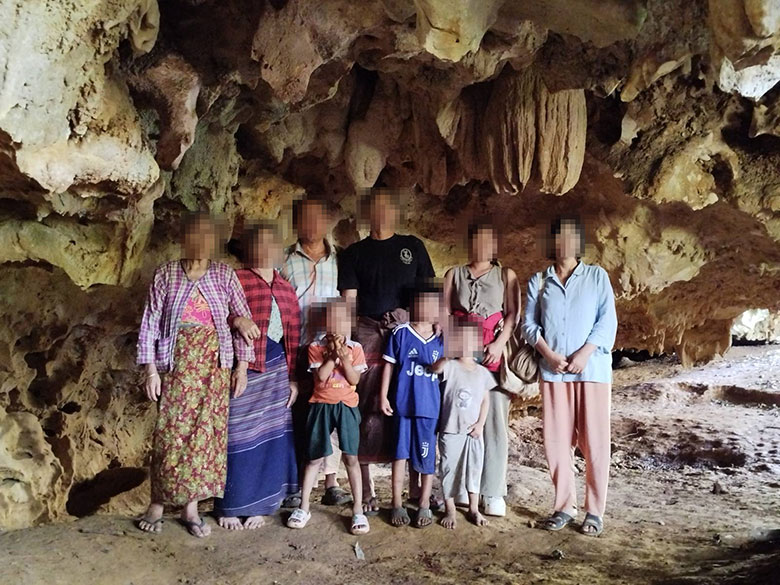
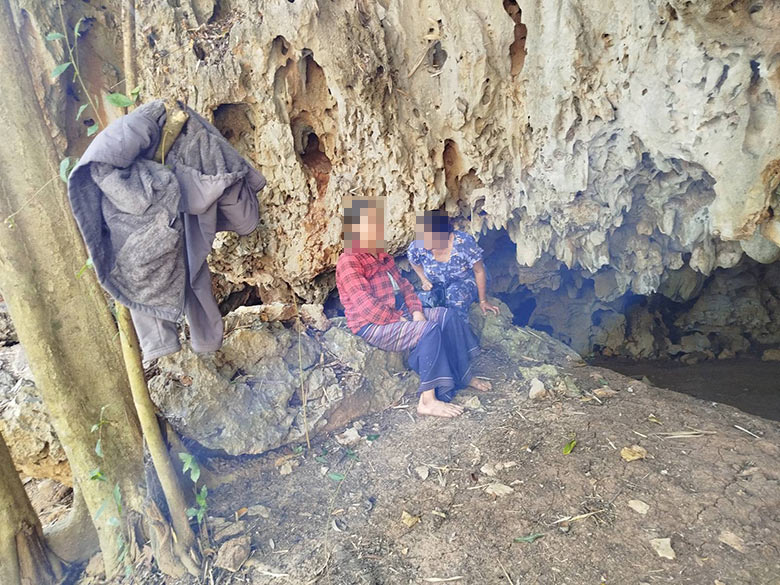
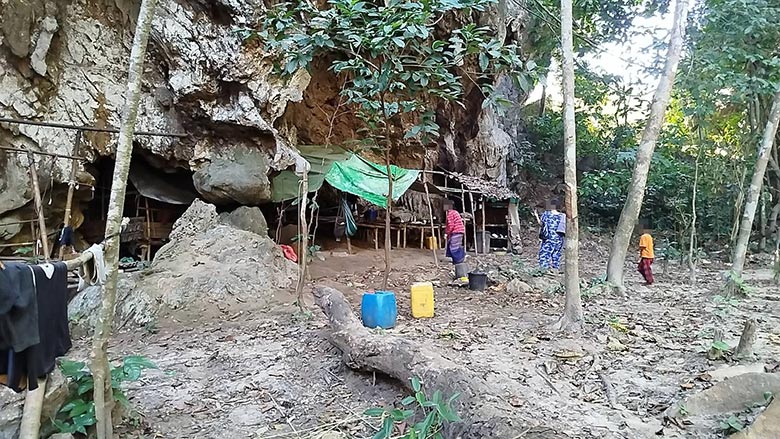
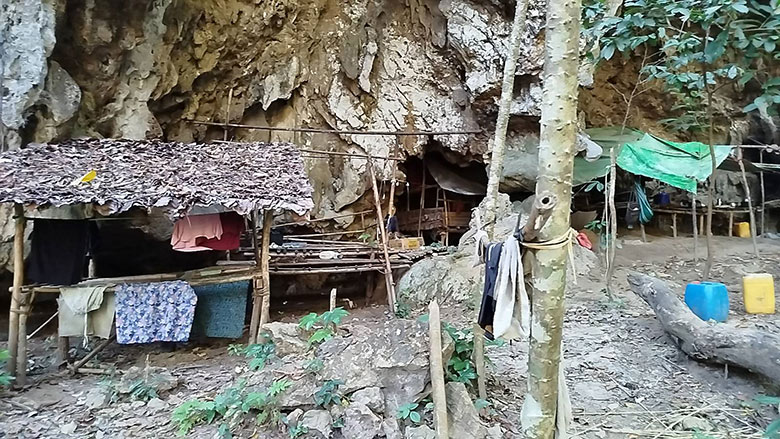


KHRG received these photos from a villager on 11 April 2026. On 13 March 2024, when the KNLA attacked the Noh Hsoh Neh Burma Army military camp in Waw Ray (Win Yay) Township, Dooplaya District, some villagers from Ae--- village, Noh Hsoh Neh village tract, Waw Ray Township, and Af--- village, P’Naw Kleh Hkee village tract, Waw Ray Township, fled to their farm huts and the forest. These photos show living conditions of the displaced villagers from Ae--- village. [Photos: Local villager]
Footnotes:
[1] The present document is based on information received in April 2026. It was provided by a community member in Dooplaya District who has been trained by KHRG as a researcher to monitor human rights conditions on the ground. The names of the victims, their photos and the exact locations are censored for security reasons. The parts in square brackets are explanations added by KHRG. This document combines several received reports with the following KHRG internal log numbers: #26-113-S1 and #26-104-S3.
[2] See, for instance: KHRG, “Dooplaya District Situation Update: SAC shelling and air strikes causing 24 civilian casualties and damaging civilian property; extensive house burning and use of human shields; and a landmine explosion, in Dooplaya District (October to December 2023)”, February 2025.
[3] All conversion estimates for the kyat are based on the 27 May 2026 mid-market exchange rate of 1 USD to 2,100 MK (taken from wise.com/gb/currency-converter/mmk-to-usd-rate)
[4] A viss is a unit of weight equivalent to 1.6 kg or 3.52 lb.
[5] The terms Burma military, Burma Army, SAC, Tatmadaw, and junta are used interchangeably throughout this report to describe the Burma military regime’s armed forces. Villagers themselves commonly use Burma Army, Burmese soldiers, or alternatively the name adopted by the Burma military regime at the time —from the 2021 coup to July 2025, the State Administration Council (SAC). On 31 July 2025, the military junta changed its name to the State Security and Peace Commission (SSPC).
[6] The Karen Department of Health and Welfare (KDHW) is the health department of the Karen National Union. It was established in 1956 to address the lack of public healthcare resources in rural Southeast Myanmar. It currently operates a network of community-based clinics in the region, but its capabilities remain limited due to funding constraints.
[7] A village tract is an administrative unit of between five and 20 villages in a local area, often centred on a large village.
[8] The Karen National Liberation Army is the armed wing of the Karen National Union.
 Print: