English
 ကညီကျိာ်
 မြန်မာ
 Print:
This Incident Report describes events occurring in Moo special area, Moo (Mone) Township, Kler Lwee Htoo (Nyaunglebin) District, in January 2026. On January 24th 2026, at 11:15 am, a Burma Army fighter jet dropped four bombs onto Aa--- village, Mya P’Go village tract. As a result, one villager was killed, and two villagers, including a woman and an elderly man, were injured while they were staying in their houses. Furthermore, three villagers’ houses and a monastery were damaged. After the incident, some of the villagers fled to safer places. The villagers who did not flee continue to live in fear and must remain alert constantly, with many choosing to sleep in makeshift bunkers.[1]
Part 1 – Incident Details
|
Type of Incident |
Air strike. [Burma Army[2] air strike killed one villager, injured two villagers, and damaged three villagers’ houses and a monastery.] |
|
Date of Incident(s) |
January 24th 2026 |
|
Incident Location (Village, Township and District) |
Aa--- village, Mya P’Go village tract[3], Moo special area, Moo Township, Kler Lwee Htoo District. |
|
Victim(s) Information |
|||
|
Name |
U[4] A--- |
U B--- |
Ma[5] C--- |
|
Age |
75 years old |
55 years old |
27 years old |
|
Gender |
Man |
Man |
Woman |
|
Ethnicity |
[Bamar[6]] |
[Bamar] |
[Bamar] |
|
Marital Status |
[Married] |
Unknown |
Unknown |
|
Occupation |
Undertaker |
Unknown |
Unknown |
|
Religion |
Unknown |
Unknown |
Unknown |
|
Position |
Unknown |
Unknown |
Unknown |
|
Village |
Aa--- village, Mya P’Go village tract, Moo special area, Moo Township, Kler Lwee Htoo District. |
Aa--- village, Mya P’Go village tract, Moo special area, Moo Township, Kler Lwee Htoo District. |
Aa--- village, Mya P’Go village tract, Moo special area, Moo Township, Kler Lwee Htoo District. |
|
Perpetrator Information (Armed Actors) |
|||
|
Type of Aircraft |
Unit |
Base |
Commander’s Name |
|
Fighter jet |
Burma military regime Air Force |
Unknown |
Min Aung Hlaing[7] [General Htun Aung serves as the Commander-in-Chief of the Burma Army Air Force] |
Part 2 - Information Quality
|
1. Explain in detail how this information was collected. |
|
Regarding this incident, I [a KHRG researcher] contacted an Aa--- villager, Ko[8] I---, and he told me about the incident. I [a KHRG researcher] went to Aa--- village and conducted an interview with a victim’s family member, Ma T---. I [a KHRG researcher] also took the incident photos. |
|
2. Explain how the source verified this information. |
|
The people who provided the information to me are KNU [Karen National Union][9] local authorities in that area, and some [of the villagers who provided information] are the victims who witnessed the incident that had happened. |
Part 3 – Complete Description of the Incident
|
Describe the Incident(s) in complete detail. |
|
On January 24th 2026, at 11:15 am, a Burma military regime fighter jet dropped four bombs on Aa--- village, Mya P’Go village tract, Moo special area, Moo Township, Kler Lwee Htoo District. All of the bombs landed and exploded in the village. Due to the air strike, U B--- was hit by shrapnel while he was staying in his house; U A--- was hit by shrapnel while he was sitting with his family under his house; and Ma C--- was hit by shrapnel while she was staying in her house. Furthermore, three villagers’ houses and a monastery in the village were damaged. There were casualties and damages in the village because the villagers had not known the fighter jet would come and conduct an air strike [no fighting was occurring in the village at the time of the incident][10].
The villager who was killed by the air strike was 55-year-old U B---, and the villagers who were injured by the air strike were 75-year-old U A--- and 27-year-old Ma C---. U B--- was hit by the shrapnel and sustained severe injury on his back. U A--- was injured on his right arm and Ma C--- sustained minor injury on her right cheek. Furthermore, the iron sheet roofs and the walls of U B---’s house, Daw[11] O---’s house, and U A---’s house were damaged, and the monastery wall was also minorly damaged.
After the air strike, the villagers transported U A--- and U B--- to Ab--- clinic, located in Ab--- village, Kyaung Pya village tract, Moo special area, by car to access treatment. The clinic is run by the KDHW [Karen Department of Health and Welfare][12]. Regarding Ma C---, she received treatment from another villager in the village because she just sustained minor injuries. U B--- died after he was transported to the clinic, the same afternoon of the air strike. After four days, on January 28th, U A--- recovered and was discharged from the clinic. U A--- did not have to pay for the treatment. After the incident, all the villagers were afraid the aircraft would return and conduct an air strike again, so some of the villagers fled to their workplaces [plantations and farms], and some fled to the nearby Ba--- and Bb--- villages. Regarding the villagers who did not flee, they have to live in fear and some of them sleep in makeshift bunkers at night.
U A---’s daughter, Ma T---, explained: “I heard the children shout: ‘Aircraft is coming’, and before I was able to enter into the makeshift bunker, the bombs already landed. After the bomb explosion, we were afraid and ran. Then, our aunty called us and told us that our father [U A---] was hit, and she let us take the children and flee to the back part [of the house], so we fled to the back part. I do not know why they [the Burma Army] came and conducted an air strike. […] After the air strike, we have had to stay alert for the sound of an aircraft and the sound of shelling. If we hear the sound, we get into bunkers. We have to stay like that. Because the aircraft came and conducted that air strike, I feel unsafe and I feel so scared that I cannot eat. I sleep in a makeshift bunker at another villager’s house. They let me sleep in the house, but I dare not to sleep [in the house], so I sleep in the makeshift bunker.”
Because the Burma military regime conducts shelling, drone strikes, and air strikes like this, most of the civilians in Moo special area have to flee; face shelter difficulties, food shortages, and illnesses; and always have to live with fear and anxiety. |
Part 4 - Permission for Using the Details
|
Did the victim(s) provide permission to use this information? Explain how that permission was provided. |
|
Ma T---, who provided us with the information, and the other two victims’ family members, gave full permission to us [KHRG] to use this information. |
Further background reading on the situation on air strikes in Southeast Burma/Myanmar can be found in the following KHRG reports:
- ကဘီယူၤဟဲလံ Aircraft coming! : Impacts of air strikes on local communities and villagers’ protection strategies in Southeast Burma since the 2021 coup, November 2024.
- “Photo Set: Burma Army air strikes on local communities, resulting in casualties, destruction, and displacement (January to December 2025)”, March 2026.
- “Dooplaya District Incident Report: Burma Army drone strike injured two villagers in Noh T’Kaw Township (January 2026)”, March 2026.
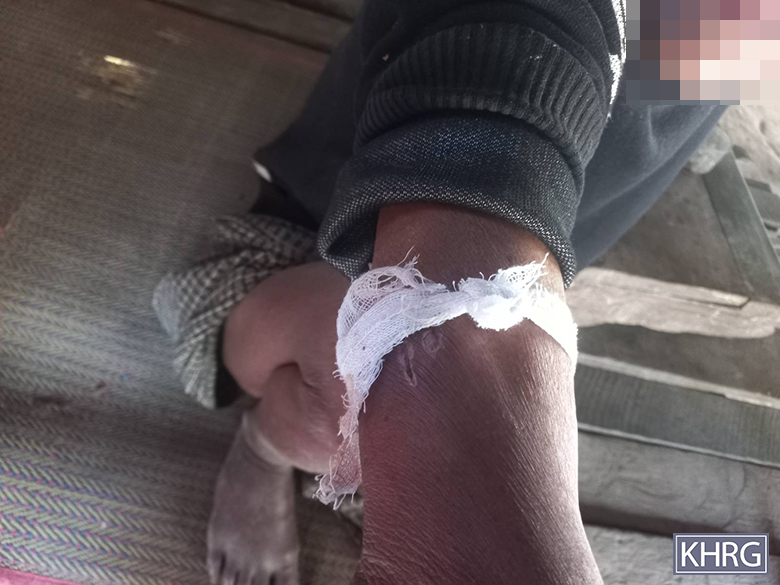
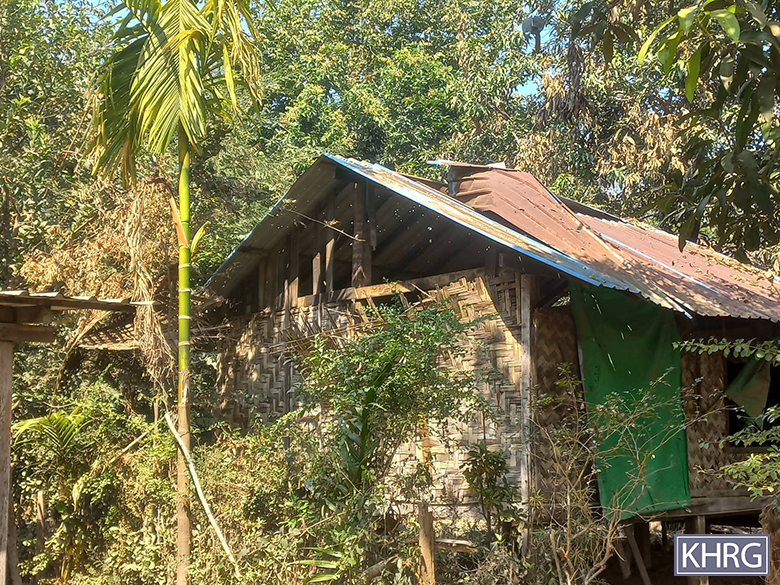
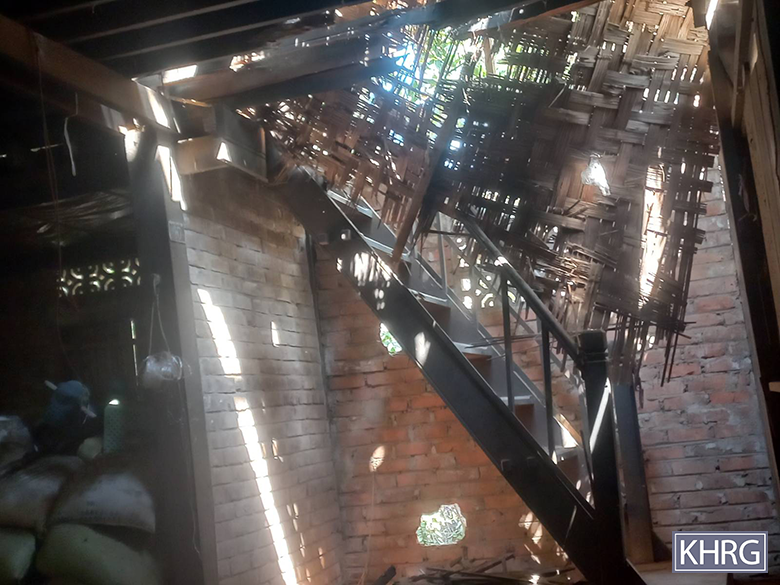
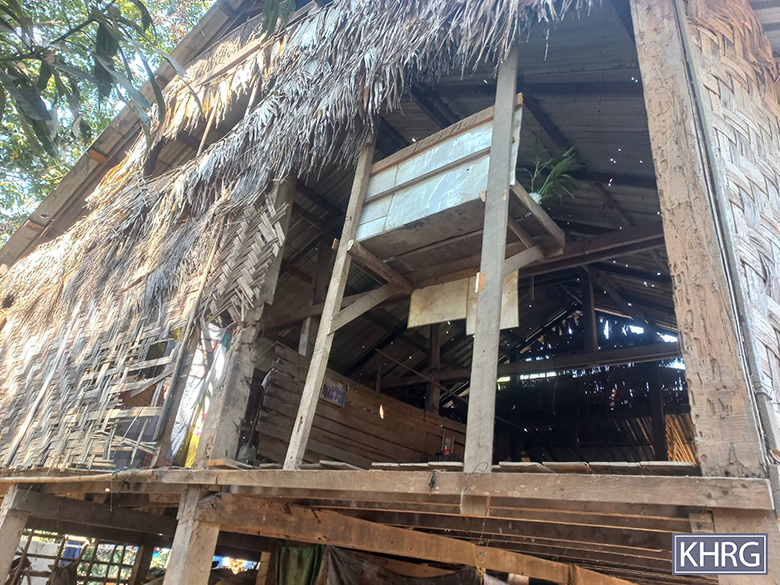


On January 24th 2026, the Burma Army carried out an air strike on Aa--- village, Mya P’Go village tract, Moo special area, Moo Township, Kler Lwee Htoo District. Due to the air strike, one villager was killed and two villagers were injured. Additionally, three villagers’ houses and the village monastery were damaged. The four photos above were taken by a KHRG researcher in February 2026. The photo on the bottom right shows U A---’s injury to his right arm after getting discharged from the clinic. The photo on the top left is Daw O---’s house, the top right is U B---’s house, and the bottom left is U A---’s house. These three photos show the damages caused to the villagers’ houses as a result of the Burma Army’s air strike. [Photos: KHRG]
Footnotes:
[1] The present document is based on information received in February 2026. It was provided by a community member in Kler Lwee Htoo District who has been trained by KHRG to monitor human rights conditions on the ground. The names of the victims, their photos and the exact locations are censored for security reasons. The parts in square brackets are explanations added by KHRG. This document combines several received reports with the following KHRG internal log numbers: #26-56-I1, #26-56-A1-I1, and #26-56-M1.
[2] The terms Burma military, Burma Army, SAC, Tatmadaw, and junta are used interchangeably throughout this report to describe the Burma military regime’s armed forces. Villagers themselves commonly use Burma Army, Burmese soldiers, or alternatively the name adopted by the Burma military regime at the time —from the 2021 coup to July 2025, the State Administration Council (SAC). On July 31st 2025, the military junta changed its name to the State Security and Peace Commission (SSPC).
[3] A village tract is an administrative unit of between five and 20 villages in a local area, often centred on a large village.
[4] ‘U’ is a Burmese title used for elder men, used before their name.
[5] ‘Ma’ is a Burmese female honorific title used before a person’s name.
[6] The majority ethnic group in Myanmar, also known as ethnic Burmese or Burman.
[7] A Senior General in the Burma Army who has served as the chairman of the executive body governing Burma/Myanmar since February 2021, first called the State Administration Council and later renamed as the State Security and Peace Commission (SSPC) in July 2025. He has also served as the Commander-in-Chief of Burma's Armed Forces since March 2011. Min Aung Hlaing seized power after overthrowing the civilian government led by Daw Aung San Suu Kyi on February 1st 2021, ending a nearly ten-year period of civilian rule. He appointed himself as Prime Minister of Burma on August 1st 2021, and became Acting President of Burma on July 22nd 2024.
[8] The Karen National Union (KNU) is the main Karen political organisation. It was established in 1947 and has been in conflict with the government since 1949. The KNU wields power across large areas of Southeast Myanmar and has been calling for the creation of a democratic federal system since 1976. Although it signed the Nationwide Ceasefire Agreement (NCA) in 2015, following the 2021 coup staged by Burma Army leaders, the KNU officially stated that the NCA has become void.
[9] The Karen National Union (KNU) is the main Karen political organisation. It was established in 1947 and has been in conflict with the government since 1949. The KNU wields power across large areas of Southeast Myanmar and has been calling for the creation of a democratic federal system since 1976. Although it signed the Nationwide Ceasefire Agreement (NCA) in 2015, following the 2021 coup staged by Burma Army leaders, the KNU officially stated that the NCA has become void.
[10] Some villagers express human rights violations or abuses that they have suffered as part of their fate or luck, or express that they should have taken more precautions, rather than directly attributing the abuse or impact to the Burma military regime or other powerful actors who commit these violations. KHRG has not modified the researcher’s words to preserve the local voice, while as an organisation also emphasising the overall pattern and source of indiscriminate human rights violations in Southeast Burma.
[11] ‘Daw’ is a Burmese female honorific title used before a person’s name.
[12] The Karen Department of Health and Welfare (KDHW) is the health department of the Karen National Union. It was established in 1956 to address the lack of public healthcare resources in rural Southeast Myanmar. It currently operates a network of community-based clinics in the region, but its capabilities remain limited due to funding constraints.