
 English
 ကညီကျိာ်
 မြန်မာ
 Print:
This Incident Report describes events that occurred in Htaw Ta Htoo (Htantabin) and Daw Hpah Hkoh (Thandaunggyi) townships, Taw Oo (Toungoo) District, in November 2024. On November 21st 2024, the State Administration Council (SAC) troops from three army camps under the Military Operations Command (MOC) #20 fired approximately ten mortar rounds into Kaw Thay Der village tract (Htaw Ta Htoo Township) and K’Lay Loh Mu Nu village tract (Daw Hpah Hkoh Township). One of the mortar shells landed and exploded in a betel nut plantation near A--- village, Kaw Thay Der village tract, where local villagers were working. As a result, one villager was killed and another villager was injured. Many betel nut trees were also damaged. Family members of the deceased villager are now facing livelihood challenges, having lost their breadwinner.[1]
Part 1 – Incident Details
|
Type of Incident |
Indiscriminate shelling [killing and injuries] |
|
Date of Incident(s) |
November 21st 2024 |
|
Incident Location (Village, Township and District) |
A plantation near A--- village (also known as B--- village), Kaw Thay Der (Yay Tho Gyi) village tract[2], Htaw Ta Htoo Township, Taw Oo District |
|
Victim Information |
||
|
Name |
Saw[3] C--- |
Naw[4] D--- |
|
Age |
Over 30 years old |
55 years old |
|
Gender |
Man |
Woman |
|
Ethnicity |
Karen |
Karen |
|
Marital Status |
Married |
Married |
|
Occupation |
Plantation worker |
Plantation owner |
|
Religion |
Christian |
Christian |
|
Position |
Villager |
Villager |
|
Village |
E--- village, Day Loh village tract, Htaw Ta Htoo Township, Taw Oo District |
A--- village, Kaw Thay Der village tract, Daw Hpah Hkoh Township, Taw Oo District |
|
Perpetrator Information (Armed Actors) |
||||
|
Name(s) |
Rank |
Unit |
Base |
Commander’s Name |
|
Unknown |
Unknown
|
SAC [State Administration Council[5]] troops under the command of the MOC [Military Operations Command[6]] #20 |
|
LID [Light Infantry Division[7]] Commander Zay Yar Lin [unknown LID number; based in Baw G’Lee army camp] |
Part 2 - Information Quality
|
1. Explain in detail how this information was collected. |
|
On the day after the incident, local [Karen National Union (KNU)[8]] authorities informed me [the KHRG researcher] about the incident. Then, I contacted Saw F---, the village head from A--- village, and I interviewed him about the case. In addition, I conducted an interview with a villager named Saw G---, who witnessed the incident. |
|
2. Explain how the source verified this information. |
|
The information was verified by Saw F---, the village head from A--- village, and a local villager, Saw G---, who witnessed the incident. [Saw F--- is the person who organised and managed transportation of the victims to the hospital in Toungoo Town. Saw G--- witnessed the incident as he was working in the betel nut plantation when the incident happened]. |
Part 3 – Complete Description of the Incident
|
Describe the Incident(s) in complete detail. |
|
On November 21st 2024, at around 11 am, SAC [State Administration Council] soldiers from Thay Say Taung army camp, Pyoung Tho army camp, and Baw G’Lee army camp, under the command of the MOC [Military Operations Command] #20, fired about 10 rounds of 120 mm and 60 mm mortars into Kaw Thay Der village tract, Htaw Ta Htoo Township, and K’Lay Loh Mu Nu village tract, Daw Hpah Hkoh Township, Taw Oo District. [KHRG was only able to document the situation on one of the mortar shells, which landed and exploded in a betel nut plantation near A--- village, but the impact and location of the other nine shells could not be verified.]
Baw G’Lee army camp is located in Baw G’Lee Town, Htaw Ta Htoo Township. Thay Say Tuang army camp is located in Thay Say Taung village, Kaw Thay Der village tract. Pyoung Tho army camp is located in Pyoung Tho village, K’Lay Loh Mu Nu village tract. Local villagers do not know why the SAC conducted shelling in the area. [Local Karen National Liberation Army (KNLA)[9] soldiers were operating in Yay Tho Gyi village tract. They were staying in the area when the SAC conducted shelling.]
One of the mortar shells landed and exploded in a betel nut[10] plantation, owned by a villager named Naw D--- (55 years), located between A--- village [Kaw Thay Der village tract] and H--- village [K’Lay Loh Mu Nu village tract]. There were six villagers, including Naw D---, working in the betel nut plantation when the shelling happened. The other villagers were Saw I--- (58 years old), Naw J--- (23 years old), Saw C--- (over 30 years old), Saw G--- (44 years old), and Saw K--- (50 years old). Naw D--- and Saw I--- are wife and husband. Naw J--- is their daughter. Saw C---, Saw G---, and Saw K--- are plantation workers hired by Saw I--- and Naw D---. The shrapnel of the mortar shell hit Saw C---’s legs, hands, and neck. As a result, he died on the spot. Naw D--- sustained injuries on her cheek and abdomen. The other four villagers were not hit or injured. Many betel nut trees were damaged by the mortar shell shrapnel.
Saw G---, [one of the plantation workers] who witnessed the incident, shared his feelings and experience: “At first, we heard the sound of the shelling, but it [the mortar shell they first heard] landed and exploded beside a road, which is a bit far from the betel nut plantation. We were afraid. We laid down on the ground, but she [Naw D---] was sitting beside a pile of betel nut. […] Then [a moment later], one of the other mortar shells landed and exploded in the betel nut plantation where we were working. […] The shrapnel hit her [Naw D---] cheek and abdomen, and she was injured. The shrapnel hit his [Saw C---] neck, hand, and leg and he died on the spot. […] There was no [safe] place to hide [from the shelling] in the betel nut plantation when the shelling happened. […] I was very afraid because I had never experienced such an incident in my life.”
After the incident, Saw I--- called other villagers from A--- village for help. Then, local villagers called a car, run by a local group of volunteers from Toungoo Town [Daw Hpah Hkoh Township] who provide transportation services, in order to transport the victims to a hospital. Naw D--- was sent to Toungoo hospital in Toungoo Town [administered by the SAC], where she received medical treatment. [She paid her own medical costs].
The body of Saw C--- was brought to his family members in Toungoo Town. [Before the incident,] they [Saw C--- and his family] had fled to Y--- [religious place], which is located in Section X--- of Toungoo Town, in order to seek refuge, as they were afraid to stay in their village [E--- village] due to the armed conflict. The family members of Saw C--- buried him in a cemetery in Toungoo Town. Saw I---, employer of Saw C---, arranged, organised [and paid for] the funeral. Saw C--- is survived by his wife, Naw L--- (35 years old), and three children.
Since Saw C--- passed away due to the SAC shelling, his family members have faced more livelihood challenges. The three children of Saw C--- are an 11-year-old daughter, a 10-year-old daughter, and a 6-year-old son. The 11-year-old daughter had recently received medical treatment because she accidentally broke her hand when she was playing. The 6-year-old son has to receive medical treatment every month due to his [unknown] health condition. He has to get a blood transfusion once per month. The family members of Saw C--- did not receive any financial support [after the death of Saw C---]. Local authorities and villagers requested KHRG to look for a humanitarian organisation or donor to provide support to the family members. |
Part 4 - Permission for Using the Details
|
Did the victim(s) provide permission to use this information? Explain how that permission was provided. |
|
Saw F---, the village head, and Saw G---, the villager who witnessed the incident, gave KHRG permission to use this information. They wanted KHRG to publish the information and the challenges that the victim’s family members faced. |
Further background reading on the situation on Taw Oo District in Southeast Burma/Myanmar can be found in the following KHRG reports:
- “Taw Oo District Incident Report: SAC indiscriminate shelling damaged villagers’ houses and property and caused displacement in Daw Hpah Hkoh Township (November 2024)”, March 2025.
- “Taw Oo District Short Update: SAC soldiers killed five villagers and burned houses after a skirmish with PDF troops in Daw Hpah Hkoh Township (January 2025)”, February 2025.
- “Taw Oo District Short Update: SAC indiscriminate shelling killed one villager and injured six, including children, and destroyed villagers’ property in Daw Hpah Hkoh and Htaw Ta Htoo Townships (October and December 2024)”, February 2025.
- “Taw Oo District Short Update: SAC drone attacks killed a villager, injured livestock, and damaged houses in Daw Hpah Hkoh Township (December 2024)”, January 2025.
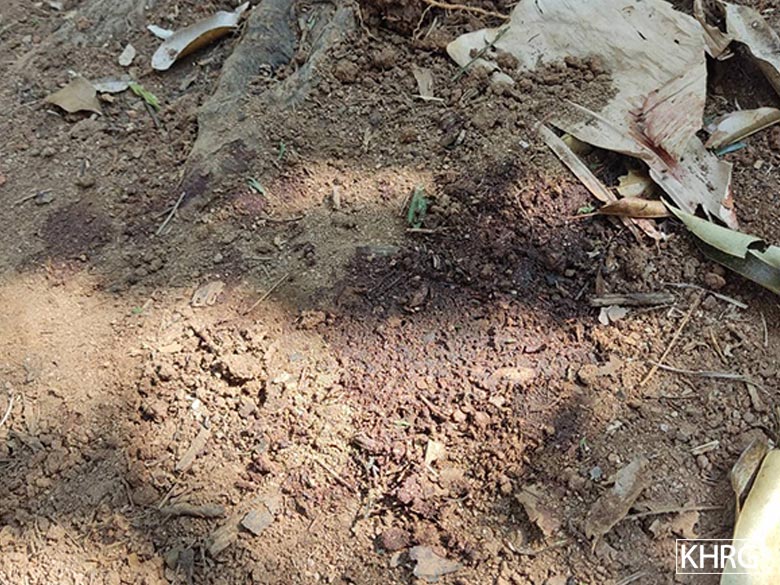


These photos were taken in November 2024 in a betel nut plantation near A--- village, Kaw Thay Der village tract, Htaw Ta Htoo Township, Taw Oo District. The left photo shows the rubber shoe that Saw C--- was wearing while working in the betel plantation. He was hit by the shrapnel of the mortar shell fired by the SAC on November 21st 2024. The explosion severed his leg and also caused a neck wound, leading to significant blood loss and ultimately causing his death. The right photo shows some blood of Saw C--- on the ground of the betel nut plantation. [Photos: KHRG]
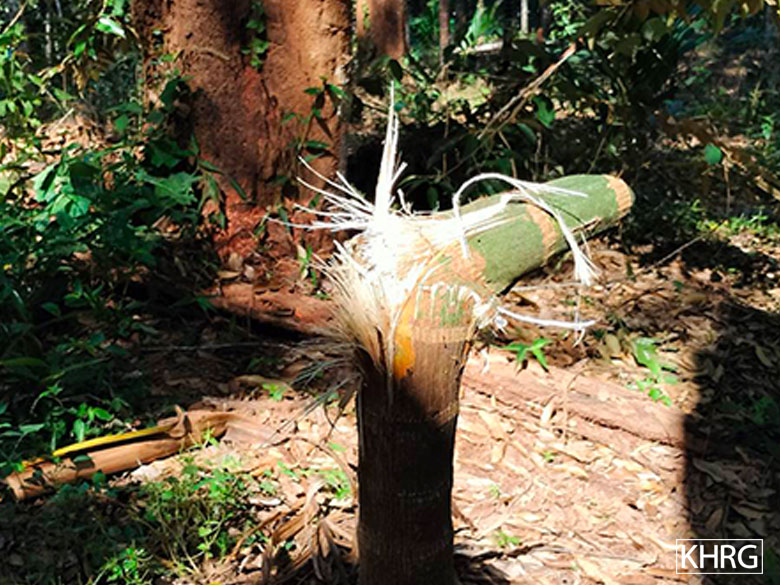
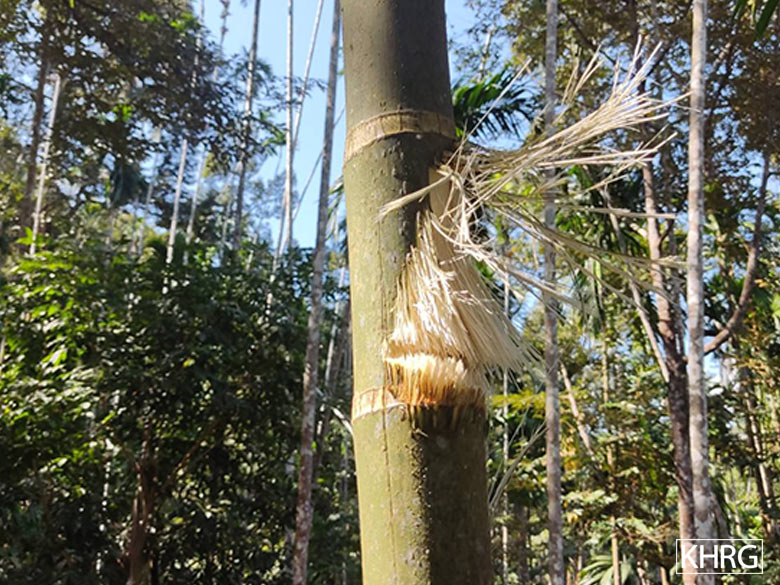


These photos were taken in November 2024 in a betel nut plantation near A--- village, Kaw Thay Der village tract, Htaw Ta Htoo Township, Taw Oo District. It shows some of the betel nut trees, owned by a villager named Saw I---, that were damaged by SAC shelling on November 21st 2024. [Photos: KHRG]
Footnotes:
[1] The present document is based on information received in December 2024. It was provided by a community member in Taw Oo District who has been trained by KHRG to monitor human rights conditions on the ground. The names of the victims, their photos and the exact locations are censored for security reasons. The parts in square brackets are explanations added by KHRG.
[2] A village tract is an administrative unit of between five and 20 villages in a local area, often centred on a large village.
[3] ‘Saw’ is a S’gaw Karen male honorific title used before a person’s name.
[4] ‘Naw’ is a S’gaw Karen female honorific title used before a person’s name.
[5] The State Administration Council (SAC) is the executive governing body created in the aftermath of the February 1st 2021 military coup. It was established by Senior General Min Aung Hlaing on February 2nd 2021, and is composed of eight military officers and eight civilians. The chairperson serves as the de facto head of government of Burma/Myanmar and leads the Military Cabinet of Myanmar, the executive branch of the government. Min Aung Hlaing assumed the role of SAC chairperson following the coup.
[6] Military Operations Command (MOC) is comprised of ten battalions for offensive operations. Most MOCs have three Tactical Operations Commands (TOCs) made up of three battalions each.
[7] A Light Infantry Division (LID) of the Burma Army is commanded by a brigadier general and consists of ten light infantry battalions specially trained in counter-insurgency, jungle warfare, search and destroy operations against ethnic insurgents. They were first incorporated into the Tatmadaw in 1966. LIDs are organised under three Tactical Operations Commands, commanded by a colonel, three battalions each and one reserve, one field artillery battalion, one armoured squadron and other support units. Each division is directly under the command of the Chief of Staff (Army).
[8] The Karen National Union (KNU) is the main Karen political organisation. It was established in 1947 and has been in conflict with the government since 1949. The KNU wields power across large areas of Southeast Myanmar and has been calling for the creation of a democratic federal system since 1976. Although it signed the Nationwide Ceasefire Agreement in 2015, relations with the government remain tense.
[9] The Karen National Liberation Army is the armed wing of the Karen National Union.
[10] In Burmese, ‘betel nut’ and ‘betel leaf’ are referred to as konywet and konthih, respectively, as if they are from the same plant. The Burmese names are also commonly used by Karen language speakers. Betel nut is the seed from an areca palm tree, Areca catechu; "betel leaf" is the leaf of the piper betel vine, belonging to the Piperaceae family.


