English
 ကညီကျိာ်
 မြန်မာ
 Print:
This Short Update describes events occurring in Daw Hpah Hkoh (Thandaunggyi) Township, Taw Oo (Toungoo) District in July 2025. On July 4th 2025, a skirmish happened between State Administration Council (SAC) soldiers and People’s Defence Force (PDF) soldiers near A--- village, Way Htoo village tract, Daw Hpah Hkoh Township. Local villagers fled to their plantations and forests near the village during the skirmish, worried about their safety. After the skirmish, the SAC soldiers entered the village and set 39 houses and two motorbikes on fire, all of which were owned by local villagers. The displaced villagers faced livelihood challenges to cover essential needs and health problems, as they could not bring anything with them when they fled.[1]
Fighting, house burning, and displacement
On the morning of July 4th 2025, more than 150 State Administration Council [SAC][2] soldiers from an unknown battalion travelled to Way Htoo village tract[3], Daw Hpah Hkoh Township, Taw Oo District, to conduct a military operation [to remove armed resistance groups’ activities and control from the area]. These SAC soldiers encountered the People’s Defence Force [PDF][4] Battalion #3504 near A--- village, Way Htoo village tract, while they were travelling. Then, a skirmish happened between the SAC and PDF. Local villagers from A--- village fled to their plantations and forest nearby, for their safety during the skirmish. After the skirmish, the PDF retreated from where the skirmish took place. Then, the SAC soldiers entered into A--- village [and stayed overnight]. [A--- village is the closest village to the area where the skirmish between the SAC and PDF took place.]
At around 10 am on July 5th 2025, [before leaving the village,] the SAC soldiers set fire to 39 houses in A--- village, all of which were owned by local villagers. Most of the houses were completely burned down. A few of the houses were not completely burned down, but many of the things inside these houses were destroyed by the fire. Two villagers’ motorbikes were also burned down. Only four houses in A--- village were not set on fire. [Villagers believed the SAC carried out the arson attack because they thought the villagers had connections with the PDF. Villagers believed that the SAC troops returned to their army base after the attack.]
According to a displaced villager from A--- village whose house was burned down: “On the day [of the incident], we [the villagers] were organising a funeral [in the village]. We were also preparing food at the funeral. When fighting happened, villagers fled to the nearby forest and plantations as they were afraid to stay in the village. Villagers could not bring anything with them when they fled. They could not even bring their extra clothes and cooking materials, such as pots and plates. Now, we do not have homes to return to. We are also afraid to stay in the village because we are afraid of SAC soldiers.”
After this attack, the villagers in A--- village faced [livelihood] difficulties and challenges because they had lost their houses. As villagers lost their houses and were afraid to return to their village, they built small huts and makeshift shelters in their plantations and in the forest near A--- village. The displaced villagers received rice and old clothes from other villagers [in Way Htoo village tract]. However, these support items were not enough for the displaced villagers. [At the displacement site, villagers were facing issues getting enough food, essential items, and proper shelter, including mosquito nets, hygiene, and medicine.] Elderly people and young children got seasonal flu at the displacement sites. The displaced villager said: “The most important thing is food. We need food to eat.”
The villager also reported that the displaced did not receive any support from any humanitarian or healthcare organisations. The children from A--- village had been unable to go to school since the school in the village was closed after the 2021 coup. [This primary school was formerly run by the Burma government and closed after the coup because the Burma government teachers stopped travelling to the village.] [As of October 2025, some villagers were living at the displacement site, and some often travelled back to the village to check on their property and houses.]
[Before this incident,] on December 11th 2024, the SAC had conducted a drone attack in A--- village, killing a villager and damaging some villagers’ houses.[5] Then, on January 2nd 2025, SAC soldiers [from an unknown battalion] arrested a villager in his house in A--- village [after a skirmish] and killed him later [that day]. After killing the villager, the SAC put his dead body back inside his house.[6]
This information was provided by a local villager from A--- village whose house was burned down, and another villager who attended a VAW [Village Agency Workshop] training, provided by KHRG [who knew about the incident and contacted the KHRG researcher about it]. [These villagers witnessed the incident and know about it.]
Further background reading on the situation of arson attacks in Southeast Burma/Myanmar can be found in the following KHRG reports:
- “Mergui-Tavoy District Short Update: SAC military activities causing casualties, including shelling, shootings, arbitrary arrests, use of porters, and burning of houses in K’Ser Doh, Ler Doh Soe, and Ler Muh Lah townships (August to September 2024)” September 2025
- “Taw Oo District Short Update: SAC soldiers killed five villagers and burned houses after a skirmish with PDF troops in Daw Hpah Hkoh Township (January 2025)” February 2025
- Burning Karen State: Retaliatory burning of houses and property against rural civilian communities of Southeast Burma (2021 and 2022), March 2023
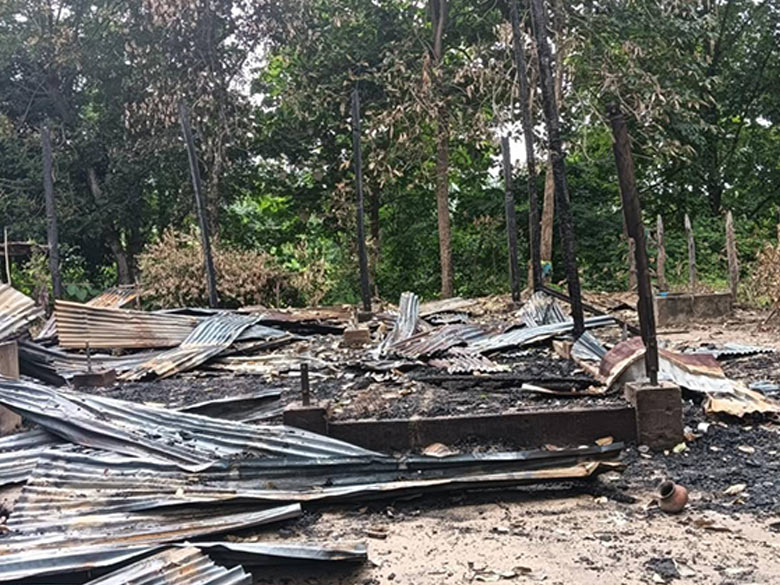
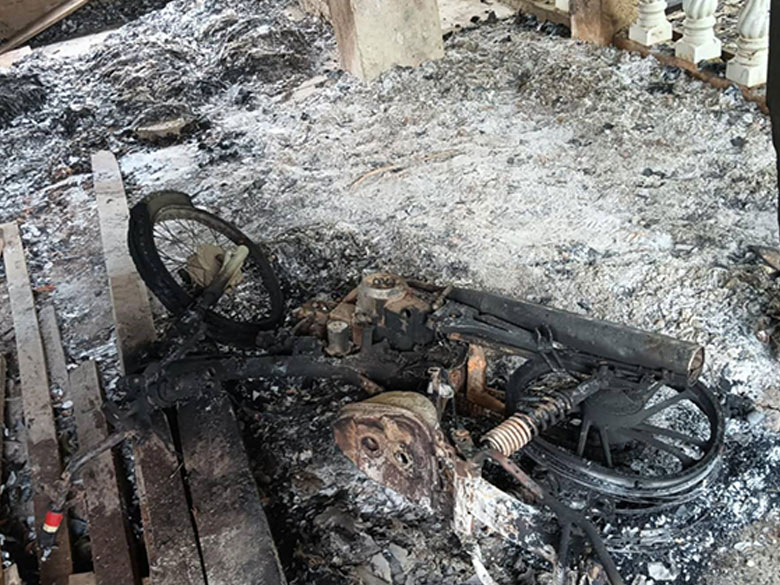

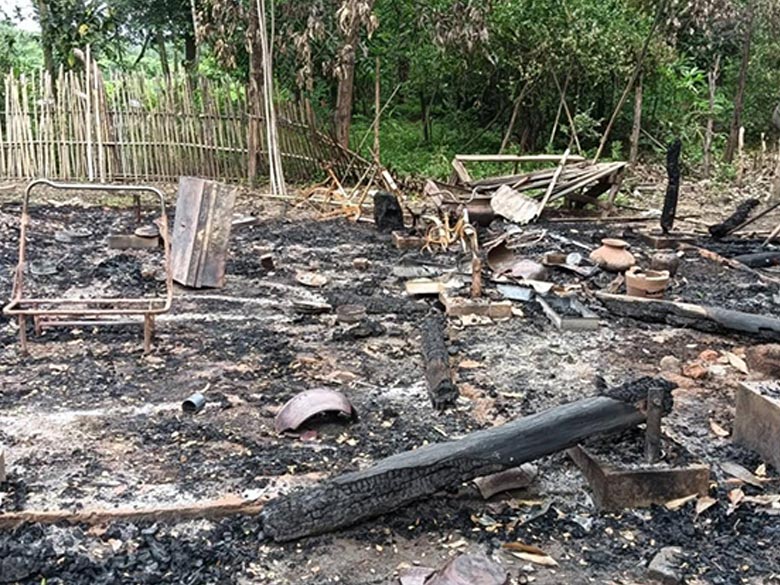


KHRG received these photos from a local villager on July 27th 2025. They were taken in A--- village, Way Htoo village tract, Daw Hpah Hkoh Township, Taw Oo District. On July 5th 2025, SAC soldiers burned down 39 houses and two motorbikes in A--- village, owned by local villagers, after clashes with PDF troops. The four photos on the first and second rows show villagers’ houses, completely burned down by the SAC soldiers. The two photos on the third row show two villagers’ motorbikes, destroyed by the SAC troops’ arson attack. [Photos: a local villager]
Footnotes:
[1] The present document is based on information received in July 2025. It was provided by a community member in Taw Oo District who has been trained by KHRG to monitor human rights conditions on the ground. The names of the victims, their photos and the exact locations are censored for security reasons. The parts in square brackets are explanations added by KHRG.
[2] The State Administration Council (SAC) is the executive governing body created in the aftermath of the February 1st 2021 military coup. It was established by Senior General Min Aung Hlaing on February 2nd 2021, and is composed of eight military officers and eight civilians. The chairperson serves as the de facto head of government of Burma/Myanmar and leads the Military Cabinet of Myanmar, the executive branch of the government. Min Aung Hlaing assumed the role of SAC chairperson following the coup. The military junta changed its name in July 31st 2025 to State Security and Peace Commission (SSPC).
[3] A village tract is an administrative unit of between five and 20 villages in a local area, often centred on a large village.
[4] The People’s Defence Force (PDF) is an armed resistance established independently as local civilian militias operating across the country. Following the February 1st 2021 military coup and the ongoing brutal violence enacted by the junta, the majority of these groups began working with the National Unity Government (NUG), a body claiming to be the legitimate government of Burma/Myanmar, which then formalized the PDF on May 5th 2021 as a precursor to a federal army.